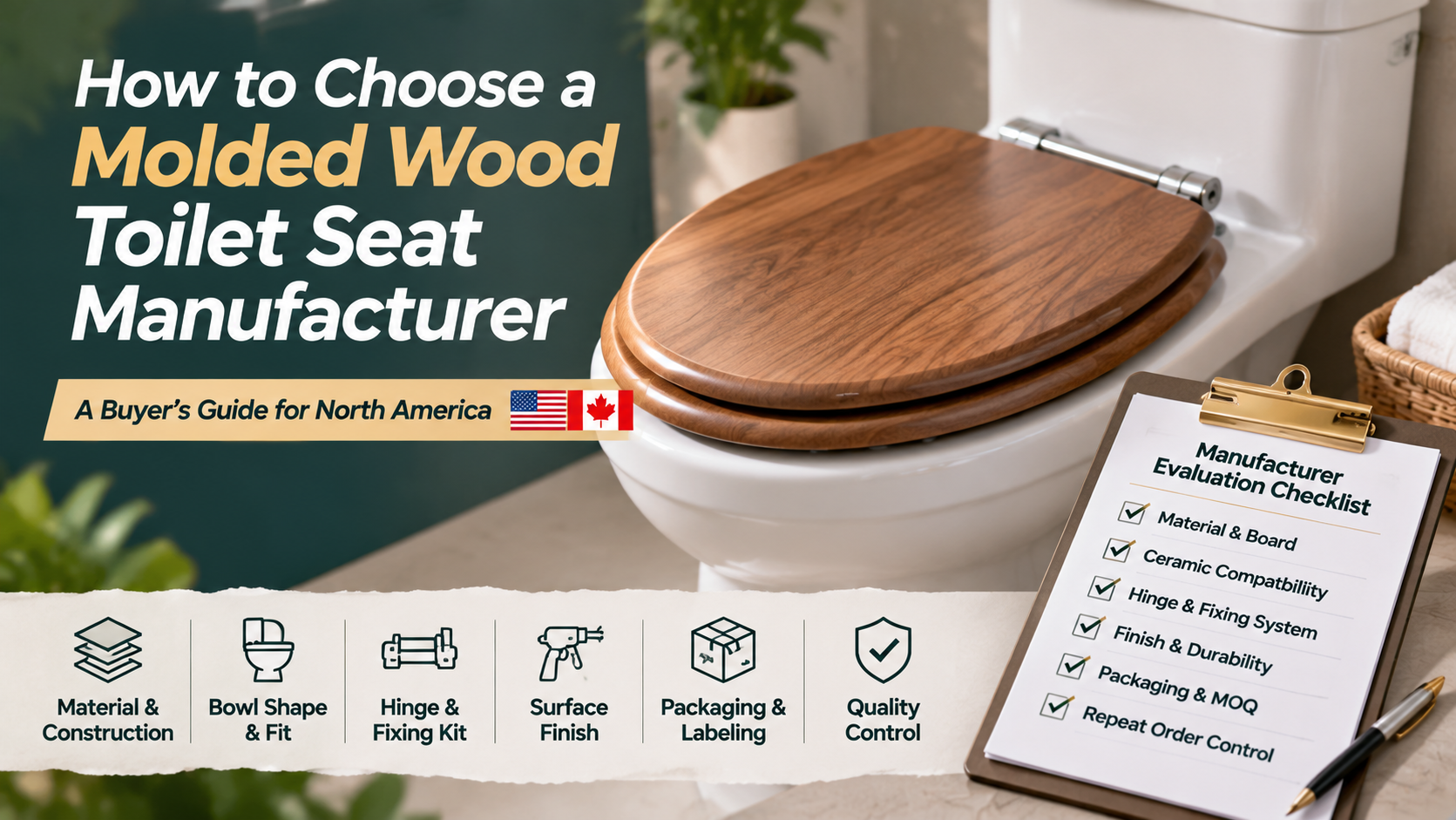
How to Choose a Molded Wood Toilet Seat Manufacturer for North American Buyers
Molded wood toilet seats remain a practical choice for bathroom brands, distributors and retailers that want a substantial feel, decorative options and a more traditional product appearance.
However, a molded wood toilet seat program involves more than choosing a shape and color. The finished product depends on board construction, moisture control, coating quality, hinge selection, fixing hardware, packaging protection and consistency across repeat orders.
For North American buyers, the right molded wood toilet seat manufacturer should be able to explain the product structure clearly and support a controlled approval process before bulk production.
Start With the Intended Product Position
Before contacting suppliers, define where the wood toilet seat will sit in your assortment.
Common program types include:
Entry-level retail replacement seats
Mid-range private-label bathroom collections
Decorative wood-effect toilet seats
Home-improvement retail programs
Plumbing distributor ranges
Hospitality or apartment replacement programs
E-commerce products requiring parcel-ready packaging
The intended sales channel affects the specification. An e-commerce seat may need stronger internal carton protection and clearer installation instructions. A showroom collection may place more emphasis on finish, hinge appearance and coordinated color options.
Share the target price position, expected quantity, destination and sales channel with the supplier early.
Understand Molded Wood Toilet Seat Construction
“Molded wood” can describe different product structures and finishes.
Buyers should ask the manufacturer to confirm:
Base board type
Board density
Product thickness
Seat and lid weight
Surface treatment
Edge sealing method
Top coat or paint system
Required gloss or matte finish
Printed or decorative finish option
Moisture-protection process
The board and coating system should be evaluated together. A good-looking sample is not enough if edge treatment, underside coating or drilling areas are not controlled for normal bathroom use.
For each approved SKU, record the material description in the product specification.
Confirm the Shape and Ceramic Compatibility
A wood toilet seat must fit the intended bowl correctly.
Provide the supplier with:
Bowl length and width
Mounting-hole spacing
Mounting-hole diameter
Rear ceramic platform details
Product photos with measurements
Technical drawing where available
Physical ceramic sample or reference fixture if possible
The supplier should check whether the seat has enough hinge adjustment range and whether the fixing kit is suitable for the ceramic.
Before bulk approval, install the sample and review:
Seat alignment
Front overhang
Side coverage
Buffer contact
Stability after tightening
Access to the fixing hardware
Clearance from the tank or wall
Lid opening position
A seat that looks suitable in a catalogue may not perform well on a specific ceramic model.
Select the Hinge and Fixing Kit as a Controlled System
The hinge and fixing kit affect installation, stability, appearance and cost.
Confirm:
| Component | What to specify |
|---|---|
| Hinge type | Standard close or soft close |
| Hinge function | Lid only, seat only or both-part soft close |
| Hinge material | Zinc alloy, stainless steel, plastic or approved option |
| Hinge finish | Chrome, black, white, brushed or other approved finish |
| Quick release | Required or not required |
| Fixing method | Top fix or bottom fix |
| Fixing-kit code | Exact bolt, nut, washer and plug configuration |
| Adjustment range | Suitability for the intended ceramic |
| Buffers | Quantity, material and placement |
Avoid approving a product with only “metal hinge” written on the quotation. The exact hinge and fixing-kit code should be connected to the buyer SKU.
This is especially important for repeat orders and spare-parts support.
Approve the Finish on a Complete Physical Sample
Molded wood seats can be supplied in solid colors, printed patterns, wood effects and decorative finishes.
A digital artwork file or color chip can support development, but final approval should be based on a physical product sample.
Check:
Top surface appearance
Lid and seat-ring color consistency
Edge finish
Underside finish
Coating coverage around hinge holes
Surface smoothness
Gloss level
Print registration, where applicable
Visible marks, dust or coating defects
Hinge-cover appearance
Buffer color and placement
For custom colors, identify the approved physical sample as the reference for bulk production.
Review Packaging Before Releasing the First Order
Molded wood seats can be heavier than standard PP products, and their painted surfaces may require additional protection.
Confirm:
Individual packaging format
Surface protection material
Hinge-area protection
Hardware-bag placement
Installation instructions
Retail box artwork
Barcode placement
Carton quantity
Maximum carton weight
Carton dimensions and CBM
Outer-carton shipping marks
Pallet requirements
A packed sample is useful because it allows the buyer to inspect the complete sellable unit, not only the product itself.
For e-commerce orders, confirm whether the carton needs to withstand parcel handling or whether an additional outer shipping carton is required.
Establish Quality Controls Before Bulk Production
A controlled quality process should cover both appearance and function.
Typical inspection points include:
Product dimensions
Board construction and thickness
Surface finish
Color or print accuracy
Edge sealing
Hinge alignment
Soft-close operation, if applicable
Fixing-kit completeness
Buffer position
Product stability after installation
Packaging protection
Barcode and carton markings
The buyer and manufacturer should agree on the inspection method and acceptance expectations before production starts.
If a sample is approved with a particular hinge, coating or packaging arrangement, any proposed substitution should require buyer approval.
Ask the Manufacturer the Right Questions
Before selecting a molded wood toilet seat manufacturer, ask:
Which molded wood models are available for round, elongated or D-shape bowls?
What base board and coating system is used for the proposed model?
Can the seat be tested on our intended ceramic?
Which hinges and fixing kits are compatible with the product?
Can you provide standard-close, soft-close or quick-release options?
What MOQ applies to the product, color and packaging?
Can you support private-label packaging and barcode requirements?
How is the approved finish controlled during production?
What information is included in the product specification?
How are repeat-order changes managed?
The answers should be documented in the quotation and approval file rather than left as general sales promises.
Plan Repeat Orders From the Beginning
A successful first order does not automatically guarantee that later orders will be the same.
Keep the following records:
Buyer SKU
Factory model
Approved material description
Color and finish reference
Hinge and fixing-kit codes
Buffer configuration
Approved physical sample
Packaging artwork version
Barcode version
Inspection record
Batch reference
Approved changes
A repeat purchase order should refer to this controlled specification, not only to a description such as “white wood soft-close toilet seat.”
How BOFAN Supports Molded Wood Toilet Seat Programs
BOFAN supports molded wood toilet seat programs for North American buyers, distributors and private-label retail projects.
Depending on the selected model, support may include ceramic-fit discussion, material and finish review, hinge and fixing options, sample preparation, private-label packaging coordination and repeat-order change control.
Final product suitability, MOQ, lead time and project documentation should be confirmed for the selected model, quantity and destination.
CTA: Request a Molded Wood Toilet Seat Review
Planning a molded wood toilet seat program? Send BOFAN your ceramic details, target material and finish, hinge requirements, expected quantity, packaging format and destination. Our team can help identify a suitable model and sample path.
FAQ
What is a molded wood toilet seat?
A molded wood toilet seat is made from engineered wood-based board formed into a seat and lid, then finished with a protective coating, paint or decorative surface.
Are molded wood toilet seats suitable for private-label programs?
They can be suitable for private-label retail, distributor and decorative bathroom programs when the product specification, finish, hinge and packaging are controlled.
Why is ceramic fit important for wood toilet seats?
The seat must align with the bowl, contact the ceramic correctly through its buffers and remain stable after installation.
Can molded wood toilet seats use soft-close hinges?
Suitable models may be configured with soft-close hinges. Buyers should confirm the exact hinge, fixing kit and intended performance before approval.
What should buyers keep for repeat wood toilet seat orders?
Keep the approved sample, factory model, material description, finish reference, hinge and fixing codes, packaging version and inspection record.
Table of Contents
- How to Choose a Molded Wood Toilet Seat Manufacturer for North American Buyers
- Start With the Intended Product Position
- Understand Molded Wood Toilet Seat Construction
- Confirm the Shape and Ceramic Compatibility
- Select the Hinge and Fixing Kit as a Controlled System
- Approve the Finish on a Complete Physical Sample
- Review Packaging Before Releasing the First Order
- Establish Quality Controls Before Bulk Production
- Ask the Manufacturer the Right Questions
- Plan Repeat Orders From the Beginning
- How BOFAN Supports Molded Wood Toilet Seat Programs
- FAQ