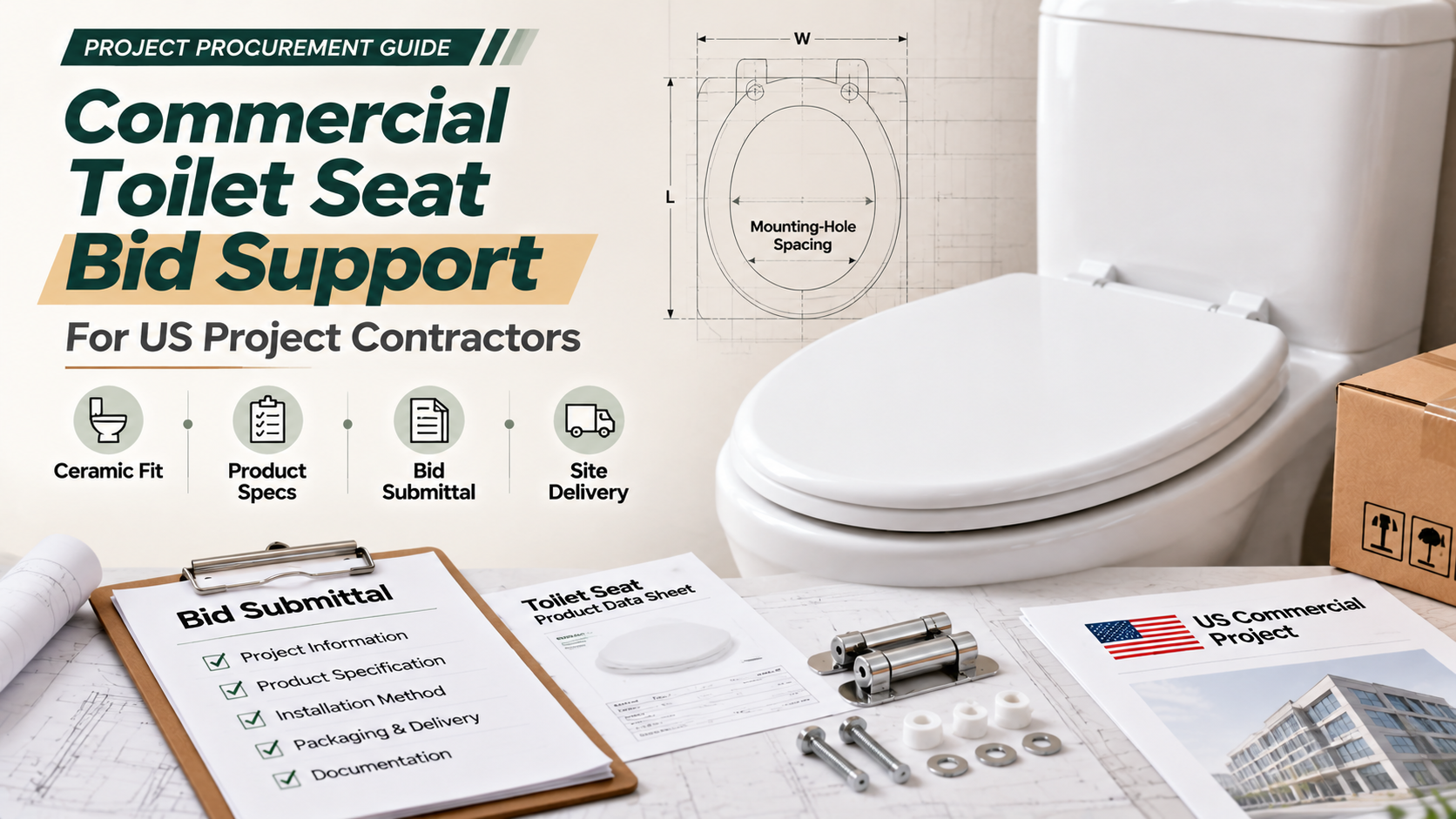
Commercial Toilet Seat Bid Support for US Project Contractors
Commercial toilet seat purchasing is often decided before the purchase order is issued.
For project contractors, plumbing contractors, bathroom-specification teams and distributors, a successful bid depends on more than a unit price. The proposed toilet seat must match the ceramic, installation method, project schedule, product specification, packing plan and site-delivery requirements.
A clear commercial toilet seat bid package helps reduce later questions, substitutions and installation problems.
This guide explains what US project contractors should prepare and request when sourcing toilet seats for a commercial bathroom project.
Start With the Project Brief
The supplier needs enough project information to identify a suitable product and quote the correct scope.
A useful brief includes:
Project type: hotel, apartment, student housing, office, hospitality, public facility or renovation
Project location
Number of toilet rooms or fixtures
Expected toilet seat quantity
Product delivery schedule
Required delivery sequence
Destination warehouse or job site
Required trade term
Whether the project requires a standard model or a specified product
Whether samples or submittals are required before award
Expected spare-part or replacement requirement
A project may require phased delivery rather than one bulk shipment. This should be discussed before the supplier confirms lead time.
Confirm the Intended Ceramic and Installation Method
The toilet bowl is part of the specification.
A seat that appears similar in a catalogue may not align correctly with the selected ceramic. Before final quotation, share:
Ceramic brand and model, where available
Bowl shape and dimensions
Mounting-hole spacing
Mounting-hole diameter
Rear platform details
Top-fix or bottom-fix access
Technical drawings
Product photographs
Physical ceramic sample or representative fixture where possible
The supplier should review whether the proposed seat has sufficient adjustment range and whether the selected fixing kit suits the installation conditions.
A physical installation sample is especially useful for projects with a proprietary bowl shape or limited access beneath the ceramic.
Define the Product Specification Clearly
Commercial projects need a controlled product description.
Confirm the following details:
| Specification area | Details to include |
|---|---|
| Product shape | Round, elongated, D-shape or ceramic-specific profile |
| Material | PP, UF, MDF, molded wood or approved alternative |
| Color and finish | White, custom color, gloss level or decorative requirement |
| Hinge system | Standard-close or soft-close; exact material and finish |
| Fixing method | Top-fix or bottom-fix hardware |
| Function | Quick release, soft close or standard configuration |
| Buffers | Number, material and contact position |
| Installation | Adjustment range and hardware-bag contents |
| Packaging | Individual project pack, retail box or bulk packing |
| Spare parts | Fixing kits, hinges or replacement-seat requirements |
Avoid using vague descriptions such as “commercial grade” without defining how the seat will be evaluated.
The contract or purchase order should identify the approved product model, material, hinge and fixing configuration.
Prepare a Practical Bid Submittal Package
A bid package should allow the contractor, architect, owner or procurement team to assess the product efficiently.
Useful submittal items may include:
Product model reference
Product photographs
Dimensions
Material description
Hinge and fixing description
Installation method
Packing information
Carton dimensions and weight
Estimated production lead time
Sample availability
Product data sheet
Instructions
Available supporting documents where required by the project
The buyer should clarify which documents are mandatory for the bid and which are needed only after award.
Any project-specific compliance, testing or documentation requirement should be confirmed for the selected product rather than assumed from a general catalogue statement.
Request an Installed Sample Before Final Approval
For a commercial project, the installed sample should represent the intended bulk configuration.
Review:
Fit with the selected ceramic
Alignment and adjustment range
Stability after installation
Fixing-kit access
Hinge appearance
Seat and lid movement
Soft-close operation, if selected
Buffer contact
Surface finish
Ease of cleaning around the hinge area
Completeness of the installation kit
If the project involves multiple ceramic models, test the proposed seat on each applicable bowl or confirm which SKU applies to each fixture.
A sample that fits one bowl should not automatically be assumed to fit every toilet model on the project.
Define What Is Included in the Quotation
Commercial bids can become difficult to compare when each supplier quotes a different scope.
Ask each supplier to confirm:
| Quote item | What should be confirmed |
|---|---|
| Product | Model, shape, material and color |
| Hinge | Exact type, finish and function |
| Fixing kit | Included components and installation method |
| Packaging | Individual, bulk or project-specific format |
| Unit price | Currency, price basis and included components |
| MOQ | Product, color, packaging and order requirements |
| Sample | Cost, timing and approval process |
| Tooling | Existing model or new tooling requirement |
| Production lead time | Timing basis from deposit, sample or artwork approval |
| Delivery | Shipment method, destination and trade term |
| Spare parts | Available fixing kits, hinges or replacement components |
A comparable quotation format helps the contractor evaluate the full project cost instead of comparing only headline unit prices.
Plan Site Delivery and Storage Requirements
Project delivery conditions can affect product choice and packaging.
Confirm:
Delivery location
Delivery appointment requirements
Pallet requirement
Carton quantity and maximum carton weight
Carton labeling
Room-by-room or floor-by-floor delivery need
Storage conditions before installation
Phased delivery schedule
Required replacement quantity
Who receives and checks the goods on site
If the project is delivered in stages, the buyer should confirm whether all batches must use the same approved material, hinge and packaging version.
Control Product Changes During the Project
A change to a hinge, fixing kit, buffer, material or packaging component can affect installation, appearance and replacement-part continuity.
Before approving any substitution, review:
Effect on ceramic fit
Effect on installation method
Effect on soft-close or quick-release function
Effect on appearance
Effect on sample approval
Effect on project documents
Effect on spare parts
Effect on delivery timing
The supplier should identify the affected product model and obtain approval before the revised component is used.
Keep Records for Handover and Replacement
After installation, the project team may need replacement seats, fixing kits or hinge components.
Keep these records:
Approved product model
Buyer or project SKU
Ceramic reference
Material and color
Hinge code
Fixing-kit code
Installation instructions
Packaging specification
Sample-approval record
Delivery batch information
Approved changes
Spare-part contacts
This information makes maintenance and future replacement orders easier to manage.
How BOFAN Supports Commercial Toilet Seat Bids
BOFAN supports commercial toilet seat sourcing discussions for project contractors, distributors and bathroom buyers.
Depending on the project, support may include product-model selection, ceramic-fit review, material and hinge options, fixing-kit confirmation, sample preparation, project packing discussion and product-data support.
Final product suitability, lead time, documentation and delivery requirements should be confirmed for the selected project configuration.
CTA: Request Commercial Bid Support
Preparing a toilet seat bid for a US project? Send BOFAN your ceramic information, product specification, quantity, delivery schedule, packaging requirements and destination. Our team can help identify an appropriate product and quotation scope.
FAQ
What should be included in a commercial toilet seat bid?
Include the product model, material, shape, hinge, fixing kit, dimensions, packaging, quantity, sample plan, lead-time basis and delivery requirements.
Why should contractors provide ceramic information?
The toilet seat must fit the intended bowl. Ceramic dimensions, mounting-hole spacing and fixing access affect compatibility.
Should a commercial toilet seat be installed before approval?
Yes. An installed sample helps verify alignment, stability, fixing access, buffer contact and function before bulk supply.
Can commercial projects use soft-close toilet seats?
Soft-close may be available for suitable product configurations. The buyer should confirm the exact hinge, performance expectation and project requirements before approval.
What records should be kept after project delivery?
Keep the approved model, ceramic reference, hinge and fixing codes, installation instructions, batch information and any approved product changes for future replacements.
Table of Contents
- Commercial Toilet Seat Bid Support for US Project Contractors
- Start With the Project Brief
- Confirm the Intended Ceramic and Installation Method
- Define the Product Specification Clearly
- Prepare a Practical Bid Submittal Package
- Request an Installed Sample Before Final Approval
- Define What Is Included in the Quotation
- Plan Site Delivery and Storage Requirements
- Control Product Changes During the Project
- Keep Records for Handover and Replacement
- How BOFAN Supports Commercial Toilet Seat Bids
- FAQ