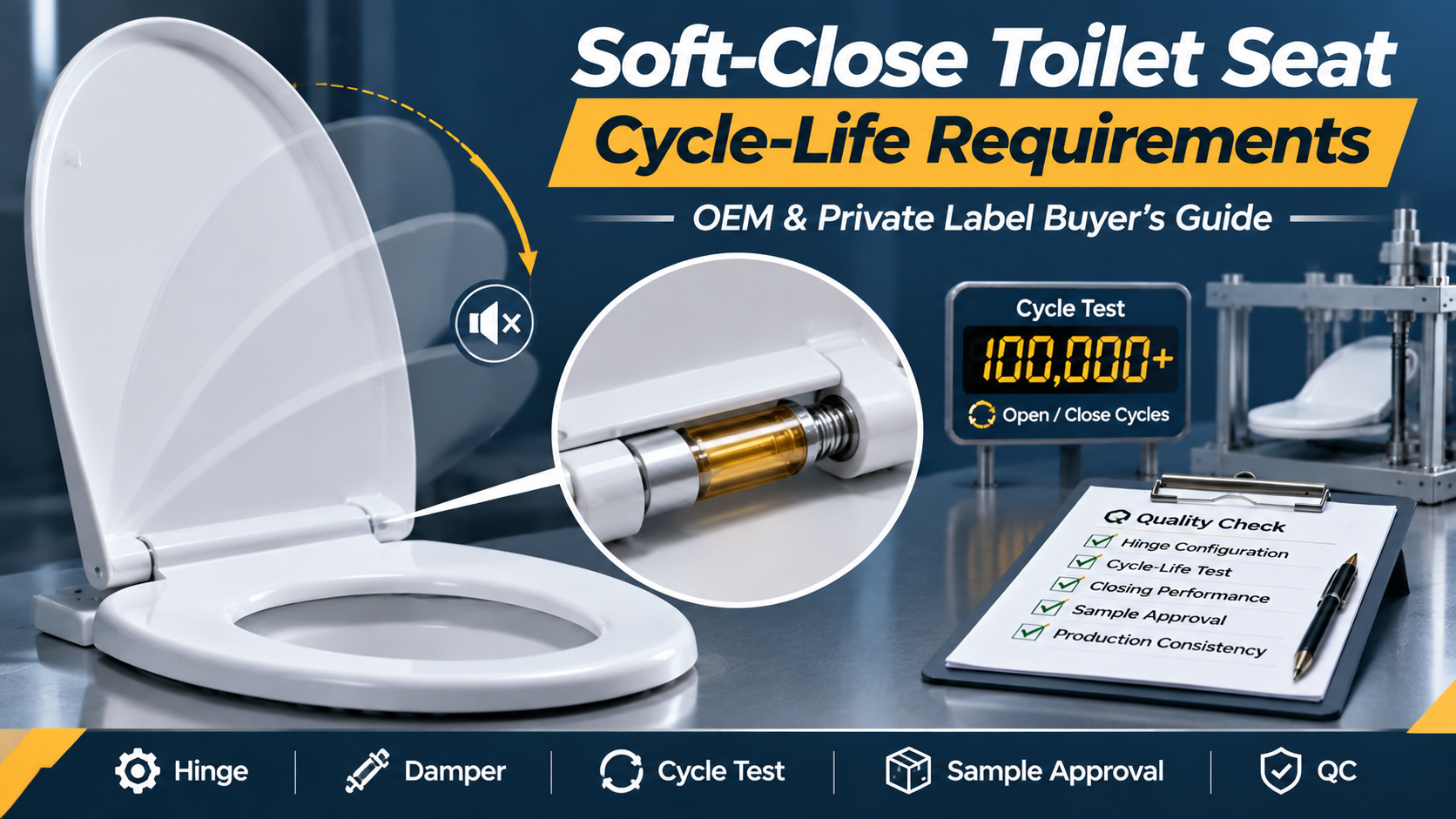
Soft-Close Mechanism Cycle-Life Requirements for Private Label Toilet Seat Programs
Soft-close is one of the most visible functional features in a toilet seat program.
When it works correctly, the seat and lid lower smoothly and quietly. When it performs poorly, customers may experience uneven closing, sudden dropping, slow movement, hinge misalignment or inconsistent operation between the seat and lid.
For private-label buyers, “soft close” should not be treated as a general product description. The expected function, hinge configuration, test method and approval standard should be agreed before bulk production.
This guide explains how buyers can define practical soft-close mechanism cycle-life requirements for an OEM or private-label toilet seat program.
Define What “Soft Close” Means for the Product
Soft-close systems are not all configured in the same way.
Before requesting samples or quotations, clarify:
Whether soft close applies to the lid, seat ring or both
Required closing behavior
Target product material
Product weight
Hinge design
Hinge finish
Whether quick release is required
Intended sales channel
Expected product position
Required warranty or customer-service approach, if applicable
A lightweight PP seat and a heavier molded wood or UF seat may require different hinge and damper arrangements.
The approved mechanism should be evaluated on the exact product configuration, not on a separate hinge sample.
Identify the Complete Hinge Configuration
The soft-close feature depends on more than the damper alone.
The supplier should identify:
| Component | Why it matters |
|---|---|
| Hinge code | Identifies the approved hinge system |
| Damper type | Affects closing motion and cycle performance |
| Hinge material | Influences strength, appearance and assembly |
| Fixing-kit code | Affects stability after installation |
| Seat and lid weight | Affects closing speed and damper load |
| Buffer configuration | Affects final contact with the ceramic |
| Quick-release mechanism | May affect hinge structure and installation |
| Adjustment range | Affects final alignment on the toilet bowl |
The purchase order and approval record should name the exact hinge and fixing-kit configuration.
Descriptions such as “soft-close metal hinge” are not detailed enough to control future production.
Define the Functional Acceptance Standard
A soft-close toilet seat does not need to close at exactly the same speed in every environment. Temperature, product weight, installation and normal product variation can affect motion.
However, the buyer can define clear functional expectations.
For example:
The lid and seat ring should lower smoothly.
The mechanism should not drop suddenly during normal closing.
The hinge should remain securely attached.
The seat and lid should remain aligned after repeated use.
The soft-close function should operate without abnormal noise.
The seat should close without requiring excessive force.
The fixing system should remain stable when installed correctly.
The mechanism should be tested on the approved product configuration.
If the buyer requires a specific closing time range, cycle count or test condition, it should be stated in the product specification and agreed with the supplier before sample approval.
Agree on a Cycle-Test Method
A cycle-life claim is only meaningful when the test conditions are clear.
Before requesting a cycle test, agree on:
The exact product model
Seat and lid configuration
Hinge and damper code
Product material and weight
Installation method
Whether testing is performed on a fixture or ceramic
Opening and closing angle
Test frequency
Number of cycles
Inspection intervals
Functional acceptance criteria
Test record format
Required sample quantity
The buyer should also confirm whether the test covers the lid only, the seat ring only or both components.
A report from a different model, material or hinge arrangement may not represent the selected private-label SKU.
Test the Complete Product, Not Only the Hinge
A hinge may perform well on a laboratory fixture but behave differently once fitted to a complete toilet seat.
The approved test arrangement should reflect the bulk product as closely as possible:
Correct seat and lid weight
Correct material
Correct hinge and damper configuration
Correct buffer layout
Correct fixing kit
Representative opening angle
Representative installation position
For an installed product, also inspect:
Hinge alignment
Seat and lid clearance
Buffer contact
Lateral movement
Fixing stability
Soft-close consistency between the seat and lid
This helps identify issues that may not appear when only the hinge is tested separately.
Review Results at Defined Intervals
A final pass result is useful, but interim checks can show whether closing performance changes during the test.
At agreed intervals, inspect:
Closing speed
Closing smoothness
Unusual noise
Hinge movement
Damper leakage or visible damage, if any
Seat and lid alignment
Fixing stability
Buffer position
Surface damage around the hinge area
Record the observations together with the product model, hinge code, test date and inspector.
If the buyer requires a particular report format, provide it before testing begins.
Approve a Production-Representative Sample
The sample used for final approval should match the intended production arrangement.
Confirm:
Product material
Seat and lid weight
Color and finish
Hinge and damper code
Fixing-kit code
Buffer configuration
Soft-close behavior
Quick-release function, if included
Packaging configuration
Installation instruction
The approved sample should be identified and kept as a reference for production checks and repeat orders.
For a private-label program, the approved physical sample is more useful than a general video of a different soft-close seat.
Control Soft-Close Performance in Bulk Production
A successful sample does not remove the need for bulk-production checks.
The buyer and supplier can agree on appropriate controls such as:
Confirmation of approved hinge and damper codes
First-piece functional check
In-process soft-close checks
Random inspection of assembled products
Seat and lid alignment review
Fixing-kit completeness check
Final packed-product inspection
Batch identification
Inspection photographs or records where agreed
If the supplier proposes changing the hinge, damper, buffer, fixing kit or product weight, the buyer should assess whether new sample approval or testing is required.
Avoid Common Soft-Close Approval Mistakes
Common problems often begin before production.
Avoid:
Approving a hinge without a complete product sample
Specifying “soft close” without identifying the hinge code
Testing a different material or product weight
Reviewing only the lid and not the seat ring
Ignoring fixing-kit stability
Approving a video instead of a physical sample
Changing the hinge after sample approval
Using an old test report for a revised product configuration
Not recording the acceptance criteria
Starting repeat production without referring to the approved sample
A controlled approval process makes it easier to identify whether a problem is related to the product, hinge, installation or changed component.
Plan for Customer Service and Repeat Orders
Private-label buyers should retain the information needed to manage future orders and replacement requests.
Keep:
Buyer SKU
Factory model
Approved product sample
Hinge and damper code
Fixing-kit code
Test method and report
Approval date
Packaging version
Batch reference
Inspection record
Approved changes
Spare-parts requirements
This information is especially valuable when a retailer needs replacement fixing hardware or when the product is reordered months later.
How BOFAN Supports Soft-Close Toilet Seat Programs
BOFAN supports soft-close toilet seat programs across PP, UF and molded wood product ranges.
Depending on the selected project, support may include hinge and fixing-kit selection, soft-close configuration discussion, production-representative sample preparation, cycle-test planning, packaging coordination and repeat-order change control.
Final cycle-life expectations, test conditions, MOQ and lead time should be confirmed for the exact product model and customer program.
CTA: Request a Soft-Close Sample Review
Planning a private-label soft-close toilet seat program? Send BOFAN your product shape, material preference, hinge function, expected quantity, target market and testing expectations. Our team can help prepare a suitable sample and approval path.
FAQ
What is a soft-close toilet seat cycle test?
It is a controlled repeated opening-and-closing test used to assess whether the selected seat, lid, hinge and damper arrangement continues to perform as agreed.
Should buyers test the hinge alone or the complete toilet seat?
The complete product should be tested because seat weight, lid weight, buffers, fixing hardware and installation position can affect soft-close performance.
Can the lid and seat ring have different soft-close performance?
They can behave differently because they may have different weights and movement paths. Buyers should define whether both parts require soft-close approval.
What should be written in a soft-close toilet seat specification?
Include the product model, material, hinge code, damper configuration, fixing-kit code, required function, test method, acceptance criteria and approved sample reference.
When should a soft-close sample be reapproved?
Reapproval should be considered if the supplier changes the hinge, damper, fixing kit, product weight, material, buffer configuration or other component that may affect function.
Table of Contents
- Soft-Close Mechanism Cycle-Life Requirements for Private Label Toilet Seat Programs
- Define What “Soft Close” Means for the Product
- Identify the Complete Hinge Configuration
- Define the Functional Acceptance Standard
- Agree on a Cycle-Test Method
- Test the Complete Product, Not Only the Hinge
- Review Results at Defined Intervals
- Approve a Production-Representative Sample
- Control Soft-Close Performance in Bulk Production
- Avoid Common Soft-Close Approval Mistakes
- Plan for Customer Service and Repeat Orders
- How BOFAN Supports Soft-Close Toilet Seat Programs
- FAQ