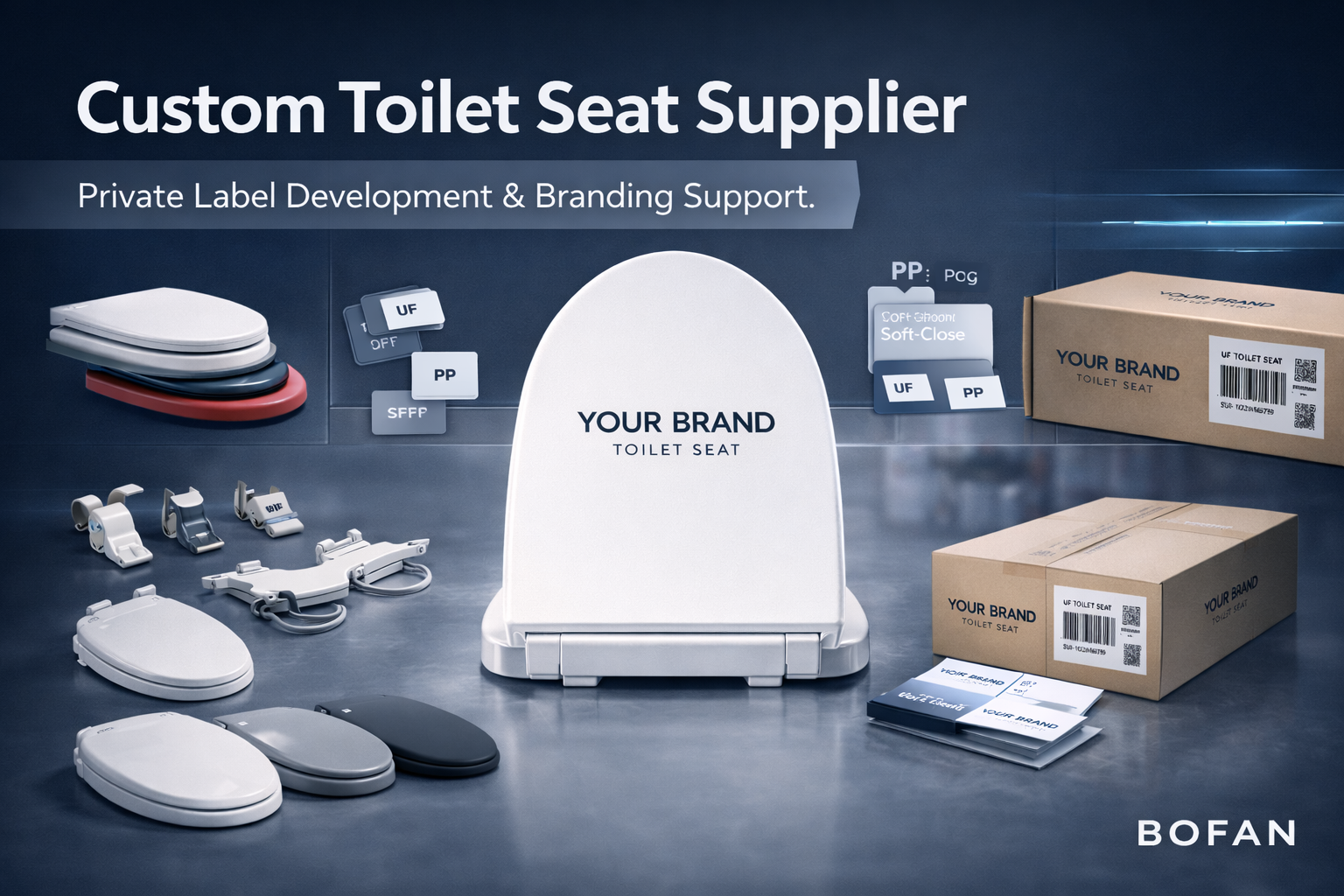
A reliable custom toilet seat supplier can be an important long-term partner for private label brands that want to build differentiated product lines. In today’s market, standard unbranded products are often not enough for brand growth. Buyers need more control over product appearance, packaging, function, and long-term supply consistency.
As a professional toilet seat manufacturer and supplier, BOFAN works with importers, distributors, retailers, e-commerce sellers, and private label buyers on custom toilet seat projects for different markets. For professional buyers, working with the right supplier is not only about price. It is also about product quality, customization capability, packaging execution, and repeat-order stability.
In this guide, we explain what a custom toilet seat supplier does, why private label brands need one, what can be customized, and how to choose the right long-term partner.
What Is a Custom Toilet Seat Supplier?
A custom toilet seat supplier provides toilet seats with product, packaging, or branding customization for buyers who want more than ready-made standard models. In many cases, the supplier may also support OEM, ODM, wholesale, and private label projects.
A custom toilet seat supplier can help buyers adjust:
- material
- shape and size
- hinge function
- color and finish
- logo application
- packaging and accessories
For private label brands, the supplier is not just a product source. It is a development and production partner that helps turn a market idea into a branded product line.
As a custom supply partner, BOFAN supports product selection, sample development, packaging coordination, and bulk production for private label toilet seat projects.
Why Private Label Brands Need a Custom Toilet Seat Supplier
Private label brands usually need more than standard stock products. If too many sellers are offering the same item, it becomes harder to compete on anything other than price.
That is why many brands look for a custom toilet seat supplier. Custom supply gives buyers more room to build product differentiation through material choice, hinge function, appearance, packaging, and overall product positioning.
Another reason is brand identity. A private label brand needs products that match its own style and packaging system. Customization helps make the final product look more consistent with the brand’s market image.
Packaging is also very important. For e-commerce sellers, packaging affects perceived quality and customer experience. For retail brands, packaging affects shelf presentation and product recognition. A custom supplier helps buyers connect product design with packaging execution.
Most importantly, private label brands need long-term consistency. The goal is not only to launch a product once, but to build a repeatable product line that can support future orders and brand growth.
What Can a Custom Toilet Seat Supplier Customize?
One of the biggest advantages of working with a custom supplier is flexibility. Depending on the project, many parts of the toilet seat can be customized.
Material Options
A custom toilet seat supplier may offer different material choices, such as:
- PP toilet seat
- UF toilet seat
- MDF toilet seat
- wooden toilet seat
Each material has a different market position. PP is often practical and cost-effective. UF is often used for a harder surface and a more premium look. MDF and wooden styles are often used in more decorative product lines.
Shape and Size
Different markets use different toilet seat standards. A custom supplier may support:
- round
- elongated
- D-shape
- market-specific fit options
Size, length, width, and hole spacing all matter. If the product does not fit the target market correctly, even a good-looking branded product can fail.
Hinge Functions
Hinge performance is one of the most important practical parts of a toilet seat. A custom project may include:
- standard hinges
- soft close toilet seat hinges
- quick release toilet seat systems
- top-fix or bottom-fix installation options
For many buyers, hinge function is a key part of product positioning and customer satisfaction.
Color, Finish, and Surface Style
Custom toilet seat projects often include adjustments in appearance, such as:
- white
- black
- custom colors
- matte or gloss finish
- wood effect
- printed or decorative surfaces
This is especially important for private label brands that want a stronger visual identity.
Logo and Branding
Branding is one of the most common customization requirements. A supplier may support:
- logo printing
- sticker labels
- laser logo marking
- branded product labels
This allows the product to match the buyer’s own brand rather than appearing as a generic market item.
Packaging and Accessories
Packaging is also a major part of private label development. A custom toilet seat supplier may support:
- retail boxes
- private label cartons
- barcode labels
- instruction manuals
- fitting kits
- shipping marks
At BOFAN, private label custom toilet seat projects often combine material choice, hinge function, and packaging design based on the target market.
What Services Should a Custom Toilet Seat Supplier Provide?
A strong supplier should offer more than product manufacturing alone. It should also help the buyer manage the full project process.
OEM Toilet Seat Service
Many private label brands use OEM toilet seat service to build their own product line. In this case, the supplier produces according to the buyer’s product and branding requirements.
Sample Development Support
Sampling is one of the most important parts of a custom project. Before bulk production, the buyer usually needs to check structure, finish, packaging, and function. A good supplier should be able to prepare samples clearly and efficiently.
Packaging Design Coordination
Packaging coordination is a key service for private label brands. A supplier should be able to work with retail box layouts, carton marks, labels, barcodes, and manuals so the final product is ready for market.
Bulk Production Management
Once the project moves into production, the supplier should be able to maintain stable quality and clear production management across bulk orders.
Export Packing and Shipment Support
For overseas buyers, export support is also important. A custom supplier should understand export carton requirements, loading plans, and shipment coordination.
At BOFAN, custom projects for private label brands often include sample confirmation, artwork review, packaging coordination, and repeat-order management.
What Makes a Good Custom Toilet Seat Supplier?
Not every supplier is equally suitable for private label business. A good custom toilet seat supplier should have several important strengths.
Real Customization Capability
Some suppliers say they can do customization, but their actual capability is limited. A good supplier should be able to turn product, branding, and packaging requirements into real, workable production solutions.
Stable Product Quality
Private label brands depend on consistency. If the first sample is good but later bulk orders change in finish, structure, or packaging, the brand will face complaints and lost trust.
Broad Material and Function Range
A stronger supplier should support different combinations of material and function, such as PP, UF, MDF, soft close, and quick release. This gives private label brands more room to build multiple product lines.
Packaging and Branding Experience
A supplier with private label experience is usually better at handling logos, packaging layouts, barcode positions, manuals, and retail presentation requirements.
Clear Communication and Fast Response
Custom work depends heavily on communication. Artwork changes, sample feedback, packaging adjustments, and delivery arrangements all require a supplier that responds clearly and quickly.
Reliable Delivery for Repeat Orders
Brand buyers usually do not want one successful order. They want a partner that can support repeat business over time. Stable lead times and repeat-order performance matter a lot.
Buyers often prefer suppliers like BOFAN that can combine customization support, packaging execution, and wholesale production in one workflow.
How to Choose the Right Custom Toilet Seat Supplier for a Private Label Brand
Choosing the right supplier requires more than checking quotations. Buyers should evaluate whether the supplier matches their brand model and long-term goals.
Define Your Brand Positioning First
Before choosing a supplier, the buyer should be clear about product level. Is the brand targeting economy, mid-range, or premium buyers? Is the product mainly for retail, e-commerce, or distribution? These questions affect material, finish, hinge type, and packaging needs.
Review Sample Quality Carefully
A sample shows the supplier’s real capability. Buyers should check structure, hinge function, finish quality, packaging execution, and overall consistency.
Confirm MOQ and Lead Time
MOQ and lead time should fit the brand’s launch plan. A supplier may be strong in production, but if the MOQ is too high or the lead time is not practical, it may not fit the project.
Ask About OEM and Private Label Experience
Suppliers with actual OEM and private label experience usually understand branding details much better than suppliers who only sell standard products.
Check Long-Term Cooperation Potential
A good custom supplier should be able to support future expansion, repeat orders, and new SKU development, not just one launch product.
Custom Toilet Seat Supplier vs Standard Toilet Seat Supplier
There is a clear difference between a custom toilet seat supplier and a standard supplier.
A standard toilet seat supplier mainly sells ready-made products. This can be useful for buyers who only want fast purchasing and do not need much product differentiation.
A custom toilet seat supplier, however, is more suitable for private label brands that need logo support, packaging adjustments, material selection, hinge options, and more control over final product presentation.
For long-term brand growth, customization support is often much more important than simply finding a stock product quickly.
Who Usually Works with a Custom Toilet Seat Supplier?
Several types of buyers commonly work with custom toilet seat suppliers.
Private label brands need stronger product differentiation and packaging consistency.
Importers often need custom products that better match their local market.
Distributors may want exclusive or semi-exclusive product lines.
E-commerce sellers often use custom products to reduce direct price comparison and improve listing identity.
Retailers and supermarket suppliers may need private packaging, barcode labeling, and more standardized branded supply.
Sanitary ware brands often need toilet seats that match the positioning of their broader bathroom product range.
As a supplier serving global brand buyers, BOFAN usually works with private label customers, distributors, and retailers that need customized toilet seat solutions.
What Should Private Label Brands Confirm Before Ordering?
Before placing an order, private label brands should confirm the key product and order details clearly.
Product Positioning
The buyer should define whether the product should be economy, mid-range, or premium. This affects every later choice, including material, hinge, finish, and packaging.
Material Choice
The buyer should decide whether the project is better suited for PP, UF, MDF, or another material. The right material should match the target market and intended price level.
Shape and Fit Requirements
The required shape, size, and hole spacing should be confirmed early. This is critical for product compatibility and customer satisfaction.
Hinge Function
The buyer should define whether the product needs standard hinges, soft close function, quick release function, or a specific installation method.
Branding and Packaging Details
Logo files, barcode placement, retail box layouts, manuals, and shipping marks should all be confirmed before bulk production begins.
MOQ, Sample Time, Lead Time, and QC Standard
The buyer should also confirm order quantity, sample timing, production lead time, and inspection standards. These are key for launch planning and risk control.
Can a Custom Toilet Seat Supplier Support OEM and Private Label Projects?
Yes, many professional suppliers support both OEM toilet seat and private label toilet seat projects.
Possible customization may include:
- logo application
- material choice
- shape and size
- hinge type
- finish style
- packaging design
- accessory kits
The depth of customization depends on supplier capability and order volume. Some projects only need branding and packaging support, while others need deeper product development.
At BOFAN, private label custom toilet seat projects are often developed around market positioning, packaging requirements, and long-term repeat-order needs.
How a Typical Custom Toilet Seat Project Works
A typical custom toilet seat project usually follows a clear process.
First, the buyer sends product and branding requirements.
Second, the supplier confirms feasible material, shape, hinge, and packaging options.
Third, the supplier provides a quotation and arranges sample development.
Fourth, the buyer reviews and approves the sample.
Fifth, artwork and packaging details are confirmed.
Sixth, the project moves into bulk production.
Finally, the products are inspected, packed, and shipped according to the agreed terms.
A professional custom toilet seat supplier should be able to manage this process clearly and efficiently.
Conclusion
A custom toilet seat supplier can help private label brands build more differentiated and market-ready toilet seat product lines.
The right supplier should provide more than production. It should also offer customization support, packaging coordination, stable quality, and repeat-order reliability.
As a professional toilet seat manufacturer and supplier, BOFAN focuses on helping private label brands develop reliable custom toilet seat solutions for different markets and business models. Buyers should evaluate not only price, but also sample quality, customization depth, packaging execution, and delivery stability before choosing a long-term partner.