Cost-Effective Toilet Seat Options for Apartment Builders
A cost-effective toilet seat is not necessarily the model with the lowest purchase price. For apartment builders, the best-value option should fit the ceramic correctly, install efficiently, withstand the intended residential use and remain available for future replacements. PP toilet seats are often the practical starting point for standard apartments because they combine moisture resistance, low weight and flexible hinge options. Builders can improve total project value by standardizing one primary model, avoiding unnecessary features, testing the seat on the actual ceramic and comparing installation, maintenance, packaging and replacement costs alongside the quoted unit price.
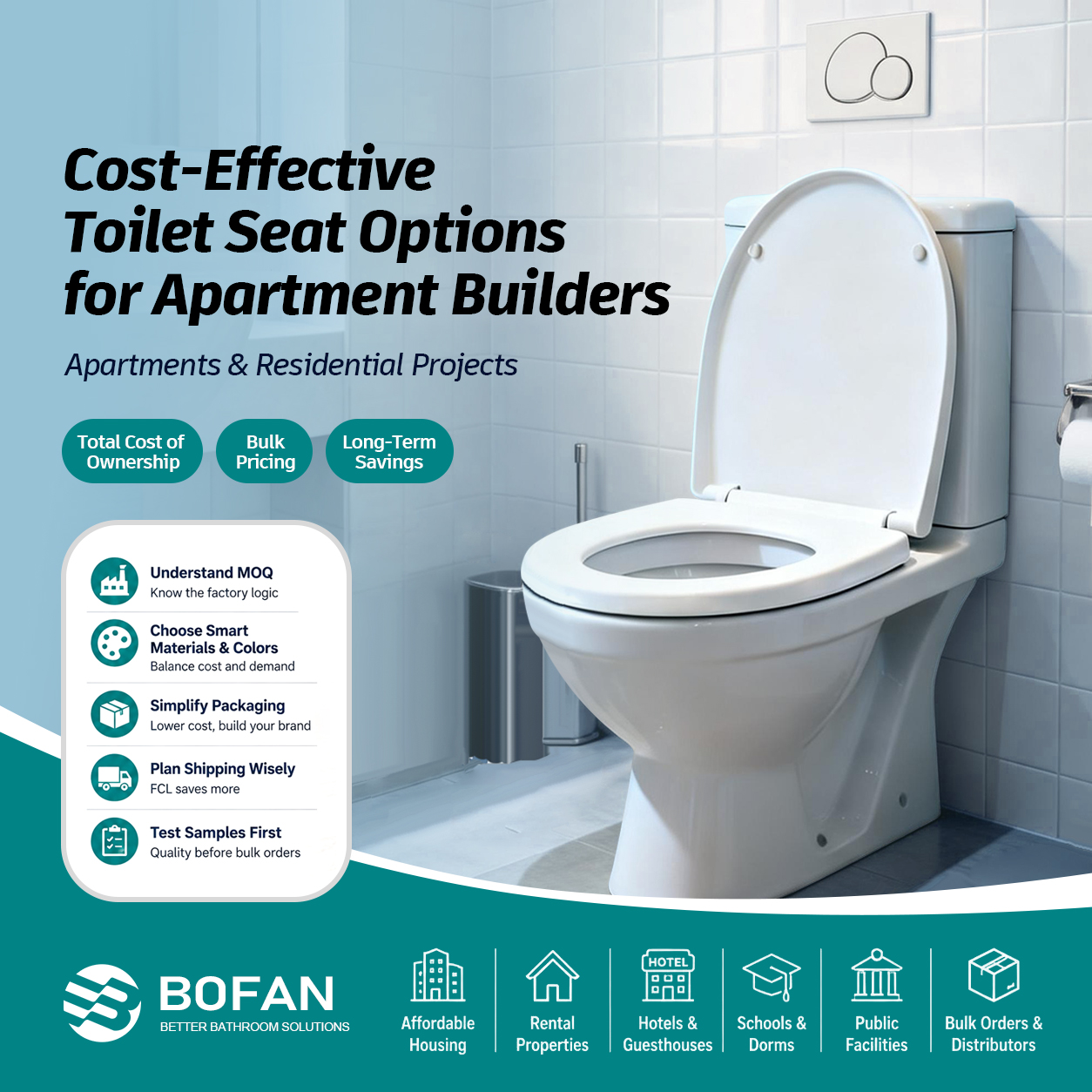
Brief: Apartment construction site transitioning into a completed bathroom, with a white PP toilet seat as the product focus.
What Makes a Toilet Seat Cost-Effective?
A cost effective toilet seat delivers the required function at a controlled total cost over the relevant period of use.
For an apartment builder, total cost may include:
- Product purchase price
- Hinge and fixing configuration
- Inland and international transport
- Carton efficiency
- Site handling
- Installation labor
- Product damage or mismatch
- Defect replacement
- Spare-stock requirements
- Maintenance visits
- Future replenishment
A product with a low factory price may become expensive if it is difficult to install, incompatible with the ceramic or frequently replaced. A more carefully specified seat can produce better project economics even if its initial unit price is slightly higher.
BOFAN’s Apartments & Residential Projects solution focuses on standardized models for developers, contractors, rentals and residential property operators.
Why Is the Cheapest Toilet Seat Not Always the Lowest-Cost Option?
Builders often receive quotations that appear easy to compare, but the products may not have equivalent materials, weights, hinges, fixing systems or packaging.
The cheapest quoted seat may create additional costs in several ways.
Incorrect fit
If the seat does not align with the bowl, installation may be delayed while the project team sorts, modifies or replaces products.
Unstable fixing
A low-cost hinge that does not suit the ceramic or installation method may loosen during use. Each maintenance visit has a labor cost that can exceed the original difference between two seat options.
Unnecessary breakage during handling
Weak packaging or poor carton design can increase damage during transport, warehouse movement or site distribution.
Too many models
Using several low-volume models can make purchasing and replacement management more complicated than using one carefully selected primary model.
No repeat-order reference
If the product specification is incomplete, future replacements may not match the original installation.
For apartment projects, value should therefore be evaluated at building level rather than only by the price of one seat.
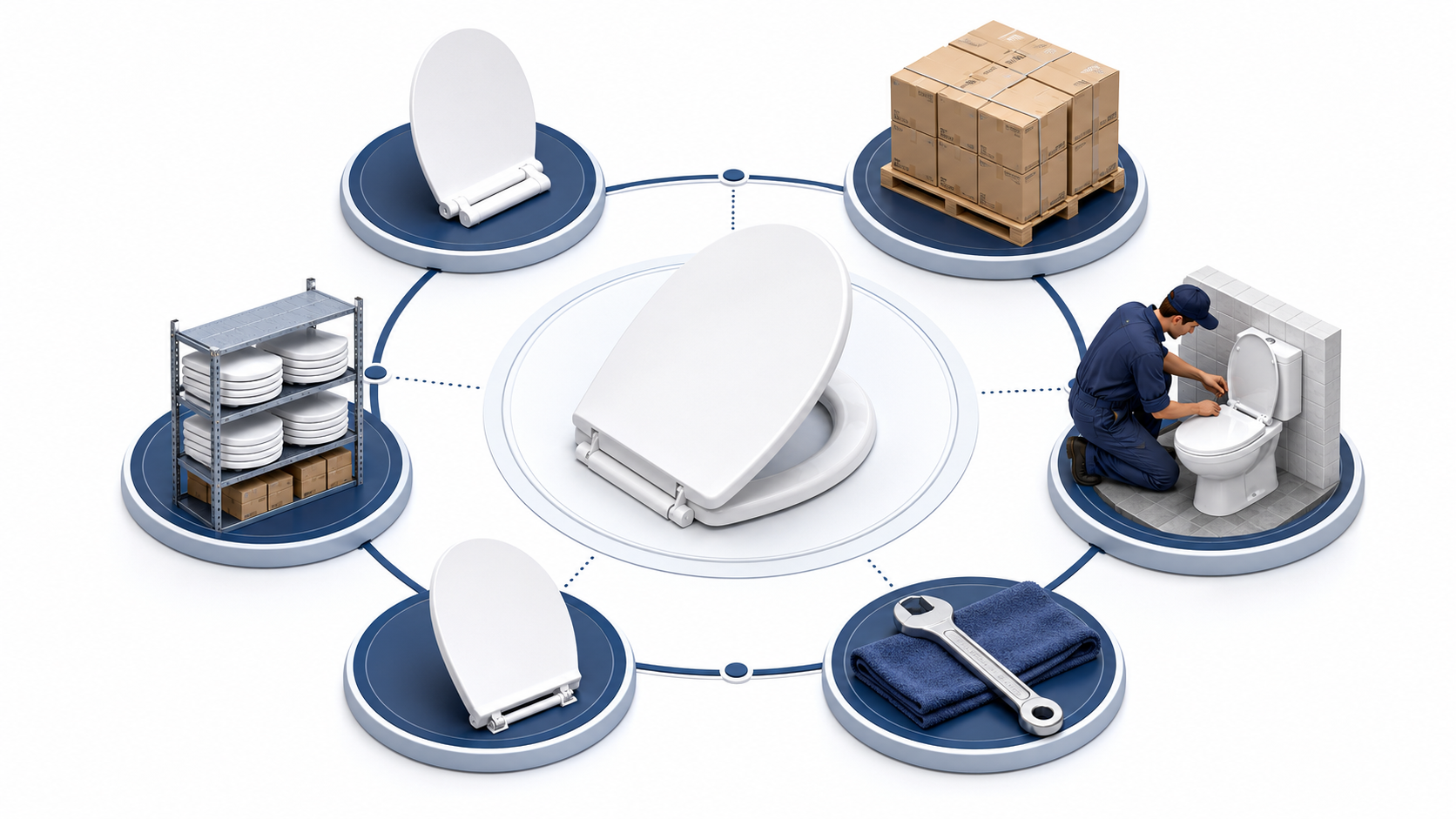
Brief: A circular diagram showing product price, shipping, installation, maintenance, replacement and spare stock.
Which Material Offers the Best Value for Standard Apartments?
PP toilet seats are often a strong value option for standard apartment projects.
PP is a lightweight thermoplastic material with low moisture absorption. In residential bathrooms, this makes it practical where the project needs straightforward cleaning and resistance to normal humidity.
PP seats are available with:
- Standard hinges
- Soft-close hinges
- Quick-release functions
- Top-fix or bottom-fix options
- Round and elongated shapes
- Different weights and structural designs
This variety allows a builder to control features rather than paying for a specification that is unnecessarily high for the project.
However, “PP” alone is not a complete quality specification. Buyers should also review the seat structure, hinge material, fixing system, surface consistency, supported dimensions and inspection requirements.
When Should Builders Consider UF or MDF?
PP may be the starting point for standard apartments, but other materials can be cost-effective when they support a higher property value or a specific design requirement.
UF for upgraded units
UF has a hard, smooth surface and a more substantial premium impression. It may suit condominiums, serviced apartments or upgraded unit packages.
Its initial cost is generally positioned above basic PP, but it can be commercially appropriate where the bathroom finish supports the selling price or rental position of the property.
MDF for decorative residential packages
MDF is useful where a heavier feel, painted surface or decorative finish is important. It may be selected for model apartments, renovation packages or design-led residential units.
Builders deciding between the main residential materials can review MDF or PP toilet seats for residential projects.
The cost-effective choice is the material that fits the property tier. Installing a premium material in every entry-level unit may be unnecessary, while installing the most basic option in a premium development can weaken the intended bathroom presentation.
Should Apartment Builders Choose Standard or Soft-Close Hinges?
Hinges have a major influence on both price and user experience.
A standard hinge is the simpler choice. It can be suitable for affordable housing, basic rentals, low-use bathrooms and projects where acquisition cost has the highest priority.
Soft-close toilet seats use a controlled closing mechanism. They are useful in family apartments and multi-family buildings where slamming noise can disturb nearby rooms.
| Factor | Standard hinge | Soft-close hinge |
|---|---|---|
| Initial cost position | Lower | Higher |
| Closing action | User-controlled | Slow and controlled |
| Noise reduction | Limited | Stronger |
| Component complexity | Simpler | Includes damping mechanism |
| Best fit | Basic and highly cost-sensitive units | Family apartments and upgraded rentals |
| QC focus | Stability and fixing | Stability, fixing and closing consistency |
The cost decision should reflect the property position. A soft-close feature may be worthwhile if it supports the developer’s sales promise or reduces a common resident complaint. It should not be added automatically if the project does not value the feature.
Quick-release toilet seats can improve access around the hinge area during cleaning. Builders should decide whether this maintenance benefit justifies the additional specification for the target property.
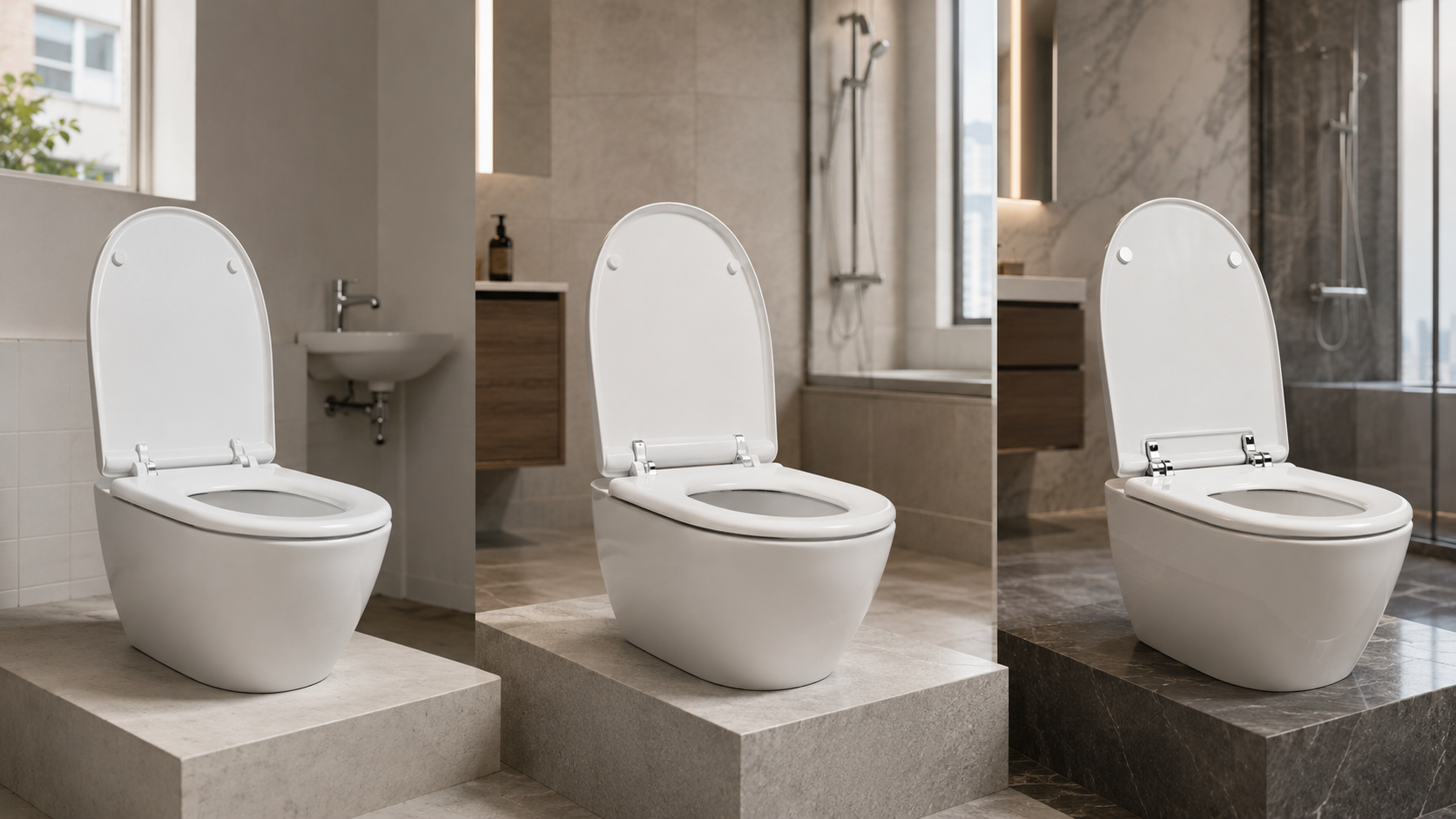
Brief: Three toilet seat configurations labeled Essential, Standard Residential and Upgraded Residential.
How Can Product Standardization Reduce Apartment Construction Costs?
Standardization creates savings beyond factory pricing.
Faster product approval
One approved ceramic and seat combination reduces repeated technical review.
More consistent installation
Installers can learn one fixing process instead of switching between unrelated systems.
Simpler site distribution
Clearly labeled cartons can be distributed by building, floor or apartment type without complex product sorting.
Easier spare-stock planning
Property managers can hold one primary replacement model instead of several visually similar but incompatible products.
Stronger volume negotiation
Combining demand into one or two specifications gives the supplier a clearer production quantity and reduces fragmented purchasing.
More reliable repeat orders
A controlled product code, drawing and approved sample provide a reference for later supply.
The standard should still allow an upgraded option where the project has multiple apartment tiers. Cost control does not require every unit to receive the same product, but each tier should have a documented specification.
What Configurations Are Suitable for Different Apartment Types?
| Apartment type | Practical starting specification | Main reason |
|---|---|---|
| Affordable housing | PP seat with standard hinge | Simple function and controlled acquisition cost |
| Standard rental apartment | PP standard or soft-close | Moisture resistance and replacement practicality |
| Family apartment | PP soft-close | Balance of cost, comfort and reduced slamming |
| Student housing | Reinforced PP with stable fixing | Frequent use and maintenance control |
| Mid-range condominium | PP or UF soft-close | Better user experience and finish |
| Premium apartment | UF or selected MDF soft-close | More premium material and design positioning |
| Renovation program | Compatible PP replacement model | Fit, speed and repeatability |
These are starting points rather than fixed rules. The final specification should follow the ceramic, market expectations and the operator’s maintenance model.
What Hidden Costs Should Builders Check in a Quotation?
A useful quotation comparison should cover more than FOB or EXW unit price.
Product weight and structure
Two visually similar PP seats may use different structures and hinge systems. Buyers should compare the approved sample and written specification rather than the photograph alone.
Hinge and fixing components
Confirm what hardware is included and whether the fixing method suits the ceramic and site access.
Packaging configuration
Check individual packaging, master-carton quantity, carton dimensions and gross weight. Efficient packaging can improve handling, but it must still protect the product.
Sample and testing costs
Clarify how samples will be supplied, approved and documented before mass production.
Defect and claim process
Ask how the supplier records inspection, handles confirmed defects and supports replacement components.
Phased delivery
Large developments may require separate batches. The builder should explain the site schedule so the supplier can assess whether phased production or delivery is feasible.
Replacement continuity
Ask whether the selected model or compatible components can support future repeat orders. No supplier should promise indefinite availability without a defined arrangement, but the question should be addressed before approval.
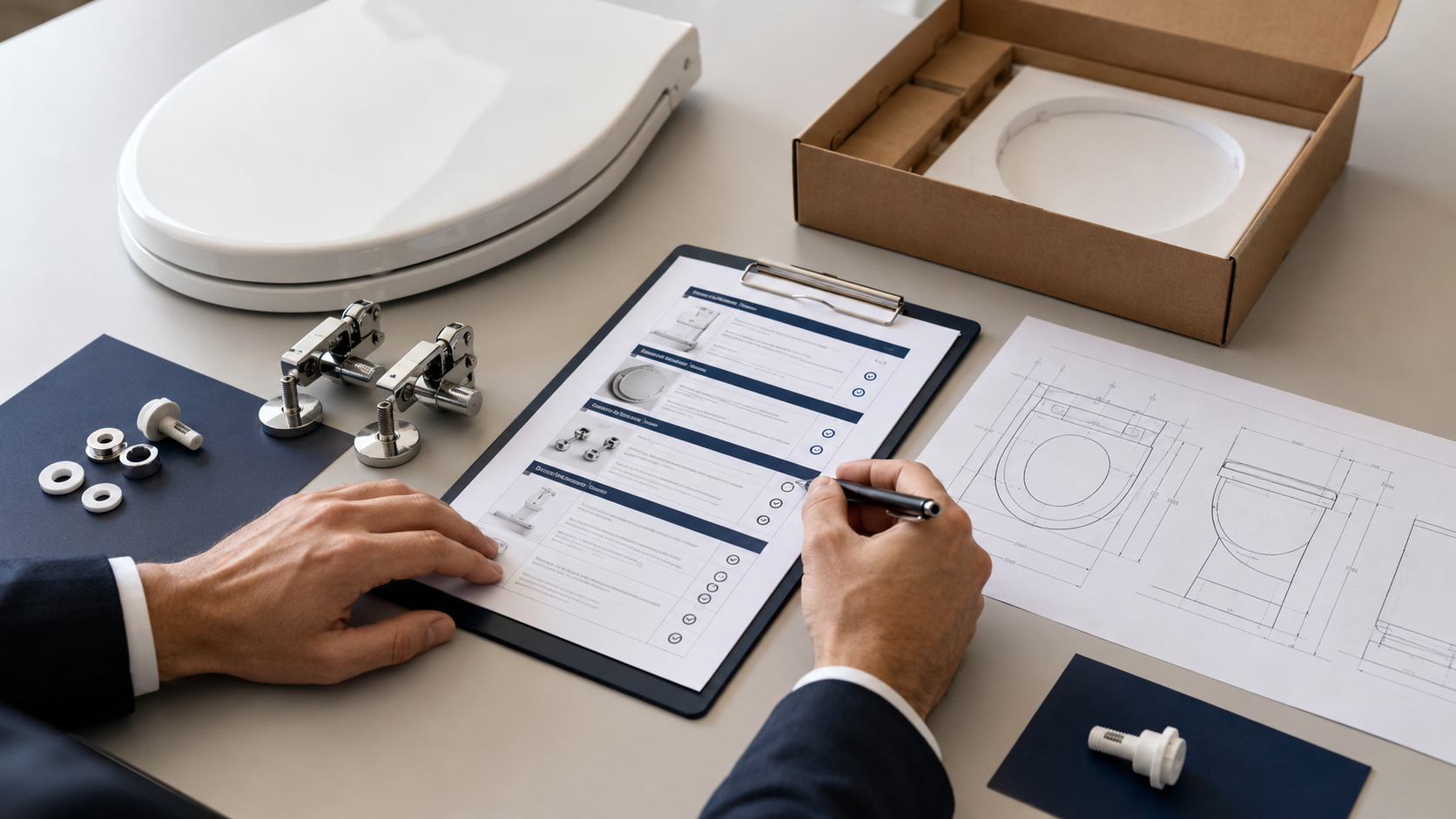
Brief: Project buyer reviewing a supplier quote with product, hinge, packaging, installation and replacement fields.
How Should Builders Validate a Cost-Effective Toilet Seat?
Value cannot be confirmed from a quotation alone. The product should be validated against the real project conditions.
Step 1: Match the actual ceramic
Send the ceramic drawing, brand and model where available. Include bowl length, width and hinge-center distance.
Step 2: Approve the configuration
Confirm material, color, hinge, fixing method and packaging in writing.
Step 3: Install a sample
Install the seat on the actual toilet bowl. Check alignment, stability, lid position, opening clearance and fixing access.
Step 4: Review the installer’s experience
Ask whether the seat is straightforward to position and tighten. A complicated installation can create significant labor costs across many units.
Step 5: Conduct a pilot installation
For larger projects, use a small batch across representative bathrooms before full installation.
Step 6: Retain the approved reference
Keep the signed drawing, approved sample, photographs, packaging details and product code for mass-production and repeat-order comparison.
What Should an Apartment Builder Include in a Bulk RFQ?
To receive a meaningful quotation, the builder should provide:
- Project location and target market
- Type of housing and apartment tier
- Total number of toilet seats
- Expected spare or replacement quantity
- Ceramic drawings or measurements
- Round, elongated or special shape
- Preferred PP, UF or MDF material
- Standard or soft-close hinge
- Quick-release requirement
- Top-fix or bottom-fix installation
- Color and finish
- Logo or project packaging
- Required documents and inspection expectations
- Delivery phases
- Requested trade terms
Buyers can review BOFAN’s complete toilet seat range before preparing the model shortlist.
How Can Builders Compare Two Toilet Seat Quotations Fairly?
Create a comparison sheet with one row for each technical and commercial factor.
| Comparison item | Supplier A | Supplier B |
|---|---|---|
| Material and product structure | ||
| Seat dimensions | ||
| Hinge material and function | ||
| Fixing method | ||
| Included hardware | ||
| Product and carton weight | ||
| Packaging | ||
| Sample approval | ||
| Inspection process | ||
| Unit price and trade term | ||
| Production arrangement | ||
| Replacement support |
If the specifications are not equal, the quoted prices are not directly comparable. Technical clarification should happen before the commercial decision.
How Does BOFAN Support Cost-Controlled Apartment Projects?
BOFAN supplies PP, UF, MDF, standard, soft-close, quick-release, round and elongated toilet seats for OEM, wholesale and project programs.
For apartment builders and projects and contractors, support can include:
- Product selection by property tier
- Compatibility review based on ceramic dimensions
- Standard and upgraded model planning
- Hinge and fixing configuration
- OEM colors, logos and packaging
- Sample confirmation
- Inspection and export packing
- Phased and repeat-order discussion
BOFAN operates three production facilities, including a manufacturing base in Thailand. Exact prices, production timing, trade terms and project documents should be confirmed according to the selected product, quantity and destination.
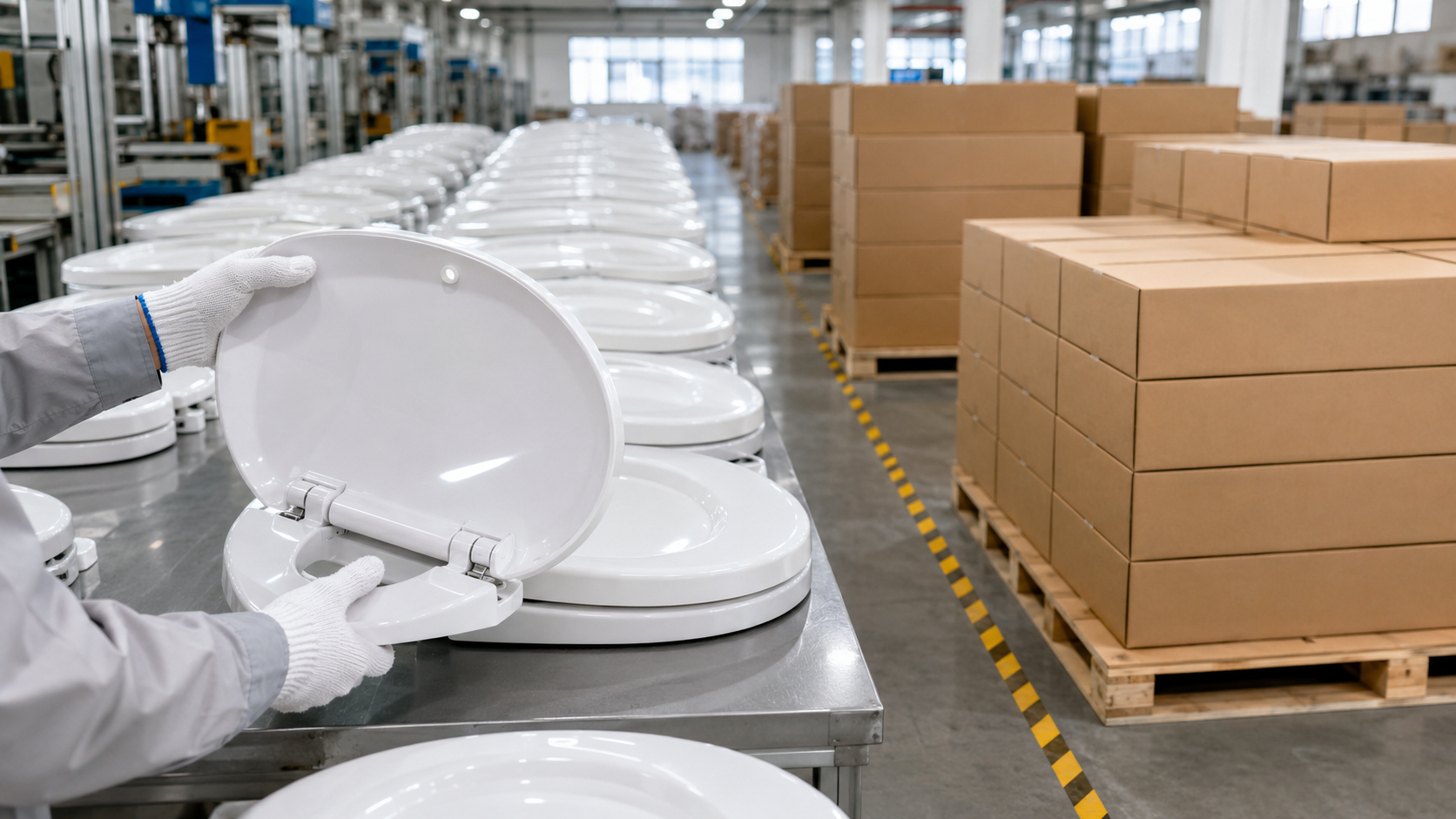
Brief: PP toilet seats moving from production inspection to labeled apartment-project cartons.
Conclusion
The best cost effective toilet seat for an apartment builder is the product that meets the required level of fit, function and durability without adding unnecessary features or creating avoidable maintenance costs.
PP with a project-approved hinge is often the logical starting point for standard apartments. Standard hinges can control initial cost, while soft-close hinges may offer better value in family or upgraded units. UF and MDF can be used selectively where the property tier requires a more premium appearance.
Send BOFAN the ceramic dimensions, project quantity, target market, apartment tier and required hinge function to receive a model recommendation and project quotation.
4. FAQ
What is the most cost-effective toilet seat material for apartments?
PP is often a cost-effective material for standard apartments because it is lightweight, moisture-resistant and available with several hinge configurations. The final value depends on the product structure, fixing stability, compatibility and replacement requirements.
Are standard hinges cheaper than soft-close hinges?
Standard hinges normally have a simpler structure and lower initial cost. Soft-close hinges cost more but may provide additional value through controlled closing and reduced slamming noise in family apartments or upgraded rentals.
How can apartment builders reduce toilet seat costs?
Builders can reduce total costs by standardizing one primary model, verifying fit before mass ordering, limiting unnecessary features and consolidating volume. They should also compare installation, packaging, maintenance and replacement costs rather than focusing only on unit price.
Should affordable housing always use the cheapest toilet seat?
No. The cheapest seat may create higher costs if it fits poorly, loosens, breaks or requires frequent maintenance. Affordable housing needs a simple but correctly specified product that suits the ceramic and expected use.
Why are PP toilet seats suitable for rental apartments?
PP seats resist normal bathroom moisture, are lightweight and can be standardized for replacement programs. Property managers should still choose an appropriate structure, hinge and fixing system for the expected frequency of use.
What should builders send when requesting a bulk quotation?
Builders should provide the project country, quantity, ceramic measurements or drawings, material, hinge function, fixing method, packaging requirements and delivery phases. Clear specifications make quotations more accurate and comparable.
Can BOFAN provide both standard and upgraded apartment models?
Yes. BOFAN supplies PP, UF and MDF seats with standard, soft-close and quick-release options. A project can use a standard PP configuration for core units and a separate upgraded model for premium apartments, subject to model and quantity confirmation.
Table of Contents
- Cost-Effective Toilet Seat Options for Apartment Builders
- What Makes a Toilet Seat Cost-Effective?
- Why Is the Cheapest Toilet Seat Not Always the Lowest-Cost Option?
- Which Material Offers the Best Value for Standard Apartments?
- When Should Builders Consider UF or MDF?
- Should Apartment Builders Choose Standard or Soft-Close Hinges?
- How Can Product Standardization Reduce Apartment Construction Costs?
- What Configurations Are Suitable for Different Apartment Types?
- What Hidden Costs Should Builders Check in a Quotation?
- How Should Builders Validate a Cost-Effective Toilet Seat?
- What Should an Apartment Builder Include in a Bulk RFQ?
- How Can Builders Compare Two Toilet Seat Quotations Fairly?
- How Does BOFAN Support Cost-Controlled Apartment Projects?
- Conclusion
-
4. FAQ
- What is the most cost-effective toilet seat material for apartments?
- Are standard hinges cheaper than soft-close hinges?
- How can apartment builders reduce toilet seat costs?
- Should affordable housing always use the cheapest toilet seat?
- Why are PP toilet seats suitable for rental apartments?
- What should builders send when requesting a bulk quotation?
- Can BOFAN provide both standard and upgraded apartment models?