Bulk Toilet Seat Supply for Real Estate Developers
Bulk toilet seat supply for a real estate project should begin with the ceramic specification, apartment tiers, project quantity and installation schedule—not with unit price alone. Developers should establish one approved model for standard units and, where necessary, a second model for premium or special units. Before mass production, the seat should be tested on the actual toilet bowl and documented with dimensions, hinges, fixings, finish and packaging. MOQ, mixed-model loading, phased delivery, inspection and replacement requirements should then be agreed in writing so that the supplier can support construction, handover and future property maintenance consistently.
Brief: A large residential development under construction, combined with rows of standardized white toilet seats prepared for project delivery.
What Does Bulk Toilet Seat Supply Include?
Bulk toilet seat supply is the organized production and delivery of toilet seats for a construction, renovation or property-development program.
It involves more than purchasing a large number of identical products. A complete project supply arrangement may cover:
- Ceramic compatibility review
- Material and hinge selection
- Standard and premium apartment specifications
- Sample approval
- OEM color, logo or packaging requirements
- Minimum order quantity confirmation
- Production planning
- In-process and final inspection
- Master-carton configuration
- Mixed-model or mixed-material loading
- Phased shipment coordination
- Spare units and replacement components
- Technical records for repeat orders
BOFAN’s toilet seats for projects and contractors are intended for developers, contractors and project-focused sanitary ware companies that require standardized specifications and coordinated bulk supply.
Why Is Project Supply Different From Ordinary Wholesale Buying?
A distributor normally purchases products for inventory and resale. A real estate developer purchases products for installation in a defined building, often against a construction schedule and a specific ceramic range.
That difference changes the buying priorities.
| Wholesale resale | Real estate project supply |
|---|---|
| Product is selected for market demand | Product is selected for a specific ceramic and building |
| Inventory can be sold over time | Products are needed by installation phase |
| Multiple models may support wider sales | Too many models can complicate installation |
| Retail packaging may be important | Site identification and protective packing may be more important |
| Replacement demand comes from customers | Replacement demand comes from one property portfolio |
| Delivery may follow stock cycles | Delivery must coordinate with project progress |
A project mismatch can affect many bathrooms at the same time. For this reason, product approval, installation testing and specification control matter more than a photograph or general product description.
For a broader product-selection discussion, see BOFAN’s guide to the best toilet seats for construction projects.
What Information Is Needed Before Requesting a Bulk Quotation?
A supplier cannot prepare a reliable project proposal from quantity alone. The RFQ should describe both the product and the building program.
Project information
Developers should provide:
- Project country and city
- Type of development
- Number of buildings
- Number of apartments
- Number of bathrooms per apartment
- Total required quantity
- Expected spare quantity
- Apartment tiers
- Construction and handover schedule
- Proposed delivery phases
Ceramic information
The supplier should receive:
- Ceramic brand and model
- Technical drawing where available
- Bowl length and maximum width
- Hinge-center distance
- Shape: round, elongated, D-shape or another design
- Access conditions for top-fix or bottom-fix installation
- Photographs from the top and side
Toilet seat requirements
The developer should confirm:
- PP, UF, MDF or another approved material
- Standard or soft-close hinge
- Quick-release requirement
- Hinge material
- Seat and lid color
- Surface finish
- Logo requirements
- Individual packaging
- Master-carton limits
- Market documents and inspection requirements
A detailed RFQ allows the manufacturer to recommend a compatible configuration instead of quoting an undefined “standard white toilet seat.”
How Should Developers Select Toilet Seats for Different Apartment Tiers?
A large project may contain entry-level units, standard family apartments, premium apartments and common-area restrooms. They do not always require the same product.
However, every additional SKU increases procurement, site-distribution and replacement complexity. The developer should therefore use the smallest practical product range.
| Project area | Practical starting specification | Main buying priority |
|---|---|---|
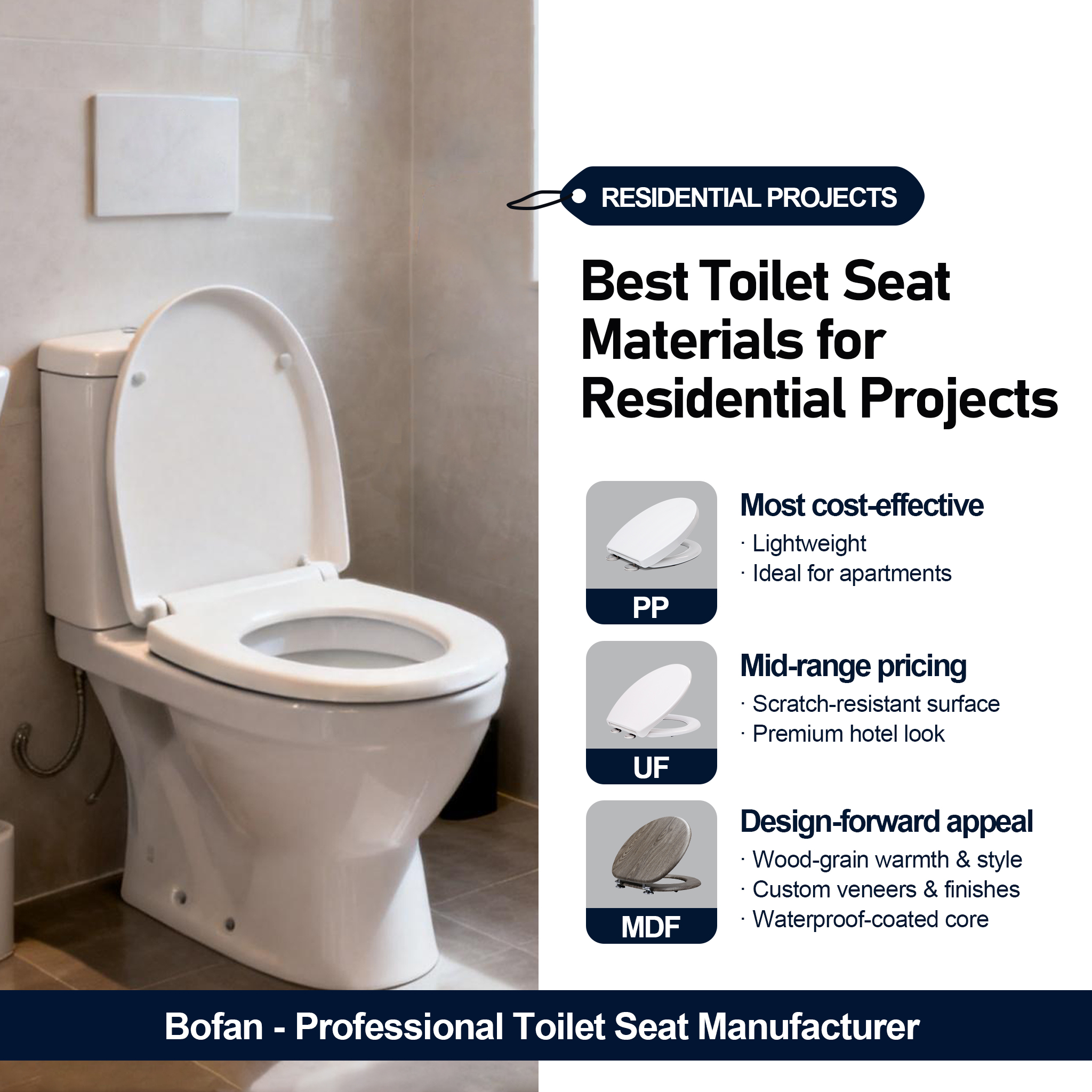
| Affordable housing | PP seat with stable standard hinge | Controlled acquisition cost |
| Standard apartment | PP standard or soft-close seat | Balance of cost and user experience |
| Family apartment | PP soft-close, optional quick release | Reduced slamming and easier cleaning |
| Premium apartment | UF soft-close | Hard surface and upgraded appearance |
| Design-led unit | Selected MDF or UF model | Interior coordination |
| Student housing | Reinforced PP with stable fixing | Frequent-use practicality |
| Common restroom | Project-approved PP or UF model | Maintenance and cleaning |
The developer can review BOFAN’s complete toilet seat range, including PP, UF, MDF, round, elongated, soft-close and quick-release options.
A useful rule is to establish one primary model for most apartments and one approved upgraded model only where the property tier justifies it.
How Should MOQ Be Managed for a Real Estate Project?
MOQ is the minimum quantity a manufacturer can produce or supply under a particular commercial and technical arrangement.
It is affected by:
- Existing versus custom product design
- Material
- Color
- Hinge system
- Packaging
- Logo application
- Raw-material requirements
- Production-line setup
- Mold development
- Number of models in the order
BOFAN supports suitable standard programs from approximately 300 pieces, but the final MOQ must be confirmed for the selected model, material and customization requirements.
A 300-piece standard white product with existing packaging is different from 300 pieces divided across several colors, shapes, hinge systems and branded boxes. Although the total quantity is the same, each variation creates a separate production requirement.
Developers should therefore ask two questions:
- What is the MOQ for the complete order?
- What is the MOQ for each model, color and packaging variation?
The MOQ toilet seat guide provides additional background on how model and material choices influence minimum quantities.
Can Different Models Be Combined in One Shipment?
Different toilet seat models, materials or functions can sometimes be combined in one shipment, subject to production, packaging, carton and loading conditions.
Mixed supply may be helpful when a development contains:
- Standard and premium apartments
- Round and elongated ceramics
- Guest-room and public-restroom specifications
- Standard and soft-close unit packages
- Initial installation stock and spare components
However, mixed loading must be planned carefully. The developer and supplier should agree on:
- Quantity per SKU
- Carton quantity per SKU
- Product labels
- Building or apartment-tier identification
- Carton dimensions
- Gross-weight limits
- Loading sequence
- Packing list detail
- Site unloading sequence
Combining too many low-volume variants can reduce production efficiency and make site distribution harder. Mixed models are valuable only when they reflect a real project need.
Why Is Sample Approval Essential Before Bulk Production?
A catalog image cannot confirm actual fit.
Before approving mass production, the project team should install a sample on the exact ceramic model intended for the development.
The sample review should confirm:
- Seat-to-bowl alignment
- Front and side overhang
- Hinge adjustment range
- Fixing accessibility
- Seat stability
- Opening angle
- Lid position
- Soft-close action, if included
- Quick-release operation, if included
- Color match with the ceramic
- Overall bathroom appearance
A project with several ceramic models should test each approved combination.
The final approved specification should include:
- Product code
- Product drawing
- Ceramic reference
- Material
- Dimensions
- Hinge code
- Fixing components
- Color reference
- Packaging
- Signed sample or approval record
For a large development, a pilot batch can be installed in a sample apartment, show unit or representative floor before the complete order is released.
How Should Bulk Packaging Be Planned?
Packaging must protect the product while remaining practical for transport, warehouse handling and site distribution.
The buyer should confirm:
- Individual bag, inner box or retail box
- Number of seats per master carton
- Carton dimensions
- Gross and net weight
- Hinge and fixing-component placement
- Product code on the carton
- Apartment tier or building reference
- Handling marks
- Pallet requirements
- Country-of-origin marking where required
A retail distributor may prefer consumer-facing color boxes. A developer may prefer simpler project packaging with clear model identification.
The correct choice depends on how the products will move from the factory to the project bathrooms.
Loading efficiency
Carton configuration affects container utilization. Before shipment, the supplier should calculate the estimated number of cartons and confirm whether the order will move as LCL, a full container or another agreed freight arrangement.
The loading plan should never be based solely on theoretical product dimensions. Protective packaging and actual carton dimensions determine shipment volume.
Site distribution
For phased construction, cartons can be identified by building, floor or apartment tier. Clear identification reduces sorting mistakes after unloading.
How Can Phased Delivery Be Coordinated?
Real estate developments are not always ready to receive every product at once. One building may enter the finishing stage while another is still under structural construction.
The project schedule should identify:
- Sample approval date
- Required production-release date
- First installation phase
- Quantity per shipment
- Destination per phase
- Site storage capacity
- Required handover date
- Buffer for inspection and transport
- Responsibility for shipment booking
A phased plan may reduce site-storage pressure, but it requires accurate forecasting. Very small, repeated production batches can also affect efficiency and cost.
The developer should distinguish between:
- One production run with phased dispatch
- Several independent production batches
- One shipment to a central warehouse
- Direct delivery to different projects or countries
The final arrangement should be documented in the purchase order rather than assumed.
What Quality Checks Matter for Bulk Toilet Seat Supply?
Quality requirements should be converted into measurable inspection items.
Relevant checks may include:
- Material and product-code verification
- Dimensions and hinge-center adjustment
- Color and surface consistency
- Visible cracks, scratches or coating defects
- Seat and lid alignment
- Hinge assembly
- Fixing completeness
- Soft-close function
- Quick-release function
- Stability and load testing where specified
- Packaging and carton markings
- Quantity verification
BOFAN publishes available certificates and test reports, including company and product-related documentation. Buyers should identify which standards and reports apply to the selected product and target market rather than assuming that one document covers every model.
How Should Developers Evaluate a Bulk Toilet Seat Supplier?
The supplier should be assessed on project execution, not only quotation price.
Product coverage
Can the manufacturer support PP, UF and MDF, along with the required shapes and hinge functions?
Compatibility support
Does the supplier request ceramic measurements and samples, or does it simply recommend a “universal” model without verification?
Manufacturing control
Can the supplier explain how molding, surface finishing, hinge assembly, inspection and packaging are controlled?
Capacity and scheduling
Can production capacity support the project quantity and proposed phases? Capacity should be assessed against the actual product mix rather than a general company figure.
Documentation
Can the supplier provide drawings, specification sheets, packing details and applicable test documents?
OEM capability
Can colors, logos, packaging or molds be developed where the project requires them?
Replacement planning
Can the approved model, hinge code and technical record be retained for later replenishment discussions?
Communication
Does the supplier document changes clearly and raise compatibility or schedule risks before production?
Real estate developers working through a local sanitary ware partner can also review BOFAN’s solution for distributors and importers.
How Does BOFAN Support Real Estate Development Projects?
BOFAN is a toilet seat manufacturer founded in 1995, with three production facilities in China and Thailand. Its published factory profile covers PP, UF, MDF, molded wood, soft-close, quick-release and custom toilet seat production. More company information is available on the About BOFAN page.
For real estate projects, BOFAN can support:
- Ceramic and dimensional review
- Standard and upgraded SKU planning
- Material and hinge recommendations
- Existing-model and OEM options
- Sample preparation
- Color, logo and packaging coordination
- Bulk production
- Product inspection
- Export packing
- Mixed-model and phased-supply discussion
- Repeat-order specification records
Exact MOQ, price, production time, container quantity and trade terms depend on the selected models, quantities, packaging and destination and must be confirmed for each project.
Conclusion
Reliable bulk toilet seat supply requires three forms of control:
- Product control: fit, material, hinge and finish
- Production control: sample, inspection and packaging
- Project control: quantity, loading and delivery phases
Developers should avoid ordering from an image and unit price alone. The better process is to define the ceramic, standardize a small product range, approve installed samples and document the supply plan before mass production.
To request a project quotation, send BOFAN the project country, ceramic drawings or dimensions, required quantity, apartment tiers, hinge requirements, packaging needs and proposed delivery phases.
4. FAQ
What information is needed for a bulk toilet seat quotation?
A developer should provide the project location, quantity, ceramic drawings or dimensions, material, hinge function, fixing method, packaging and delivery phases. These details allow the supplier to assess compatibility, MOQ and production planning accurately.
What is the MOQ for bulk toilet seat supply?
MOQ depends on the model, material, color, hinge, packaging and level of customization. BOFAN can support suitable standard programs from approximately 300 pieces, but the final MOQ must be confirmed for each SKU and project specification.
Can different toilet seat models be mixed in one container?
Different models, materials and hinge functions may be combined in one shipment when production and packaging conditions allow. The buyer should confirm the quantity per SKU, carton dimensions, loading sequence and product labels before ordering.
Should real estate developers approve a sample before mass production?
Yes. The sample should be installed on the actual project ceramic to check fit, stability, hinge adjustment, appearance and function. An approved drawing and sample record should then become the reference for bulk production.
How many toilet seat models should one apartment project use?
A project should use the smallest practical number of models. One primary model and one justified upgraded or special model are often easier to install, stock and replace than several unrelated specifications.
Can bulk toilet seats be delivered in separate project phases?
Phased supply may be possible when the production and delivery plan is agreed in advance. The developer should provide quantities, destinations, required dates and site-storage conditions for every phase.
What should be checked before a bulk toilet seat shipment?
Buyers should check dimensions, material, color, surface, hinges, fixings, closing functions, packaging, carton labels and quantities. Any market-specific test or documentation requirements should be confirmed for the selected model before production.
Table of Contents
- Bulk Toilet Seat Supply for Real Estate Developers
- What Does Bulk Toilet Seat Supply Include?
- Why Is Project Supply Different From Ordinary Wholesale Buying?
- What Information Is Needed Before Requesting a Bulk Quotation?
- How Should Developers Select Toilet Seats for Different Apartment Tiers?
- How Should MOQ Be Managed for a Real Estate Project?
- Can Different Models Be Combined in One Shipment?
- Why Is Sample Approval Essential Before Bulk Production?
- How Should Bulk Packaging Be Planned?
- How Can Phased Delivery Be Coordinated?
- What Quality Checks Matter for Bulk Toilet Seat Supply?
- How Should Developers Evaluate a Bulk Toilet Seat Supplier?
- How Does BOFAN Support Real Estate Development Projects?
- Conclusion
-
4. FAQ
- What information is needed for a bulk toilet seat quotation?
- What is the MOQ for bulk toilet seat supply?
- Can different toilet seat models be mixed in one container?
- Should real estate developers approve a sample before mass production?
- How many toilet seat models should one apartment project use?
- Can bulk toilet seats be delivered in separate project phases?
- What should be checked before a bulk toilet seat shipment?