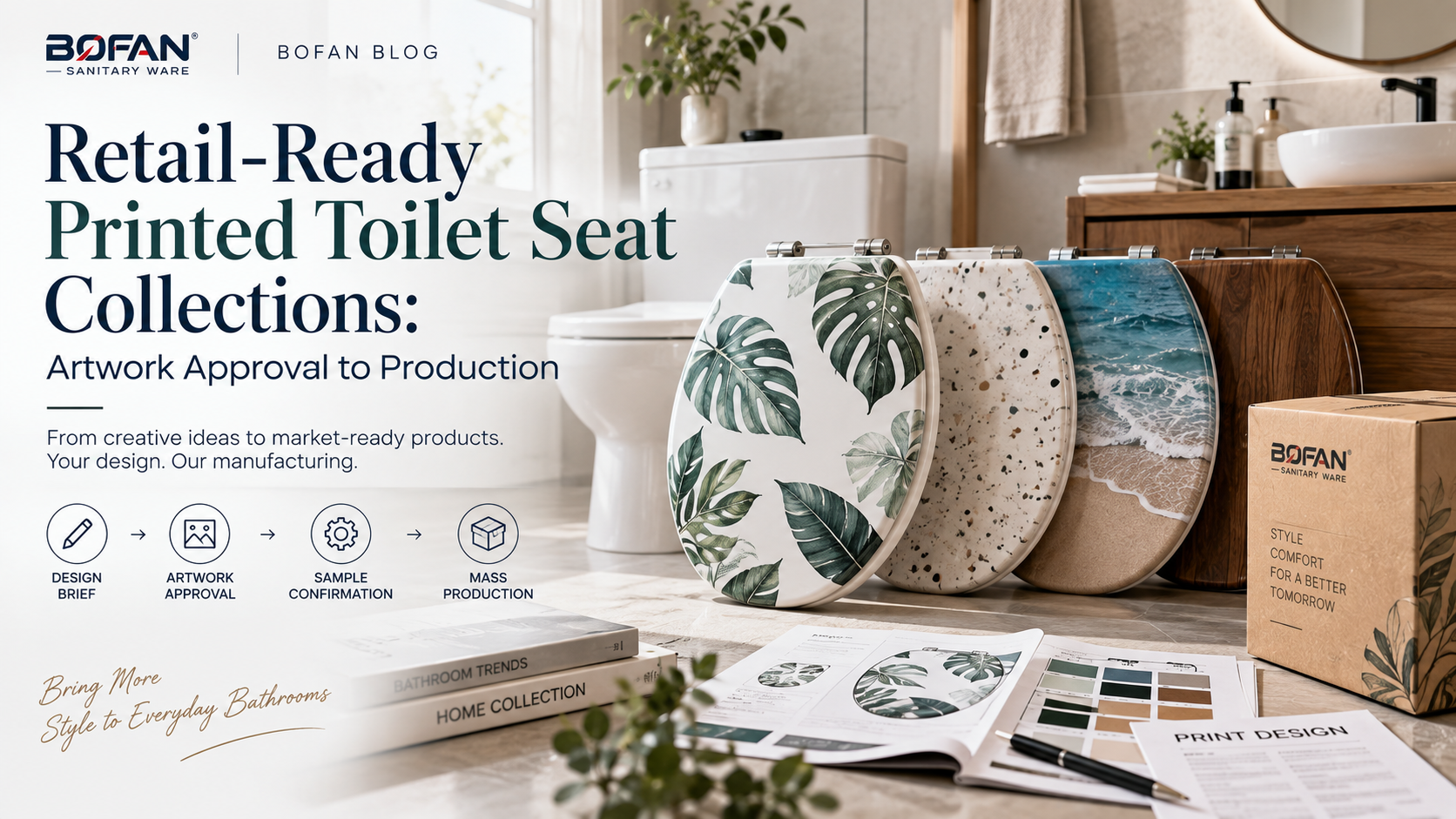
Coleções de Assentos para Sanitários Impressos Prontas para Varejo: Aprovação de Arte até Produção
Assentos de sanita impressos podem ajudar um varejista ou marca de casa de banho a criar uma coleção reconhecível sem desenvolver uma forma totalmente nova de assento. Um programa controlado de arte pode adicionar designs sazonais, padrões ligados ao estilo de vida, acabamentos decorativos premium ou diferenciação de marca própria a plataformas de produtos já estabelecidas em PP, MDF, madeira moldada ou UF selecionada.
Contudo, a arte não é simplesmente um ficheiro de imagem adicionado no final da produção. Ela afeta a superfície do produto, o processo de impressão, o resultado cromático, a embalagem, a estrutura de SKUs, a quantidade mínima de encomenda (MOQ) e o cronograma de aprovação.
Uma coleção de assentos de sanita impressos pronta para o varejo exige um único processo controlado, desde o briefing de design até à produção em massa.
Comece com a Plataforma de Produto
Antes de rever a arte, confirme o produto ao qual ela será aplicada.
Defina:
Material do Produto
Formato e dimensões do assento
Acabamento superficial
Dobradiça e kit de fixação
Função de fechamento suave ou liberação rápida
Canal de varejo pretendido
Formato de Embalagem
Posicionamento de Produto
Quantidade esperada do pedido
Data prevista de lançamento
O mesmo desenho pode ter aparência diferente num assento brilhante em madeira moldada, numa superfície fosca em PP ou noutro substrato. A arte deve ser desenvolvida especificamente para a plataforma de produto real, e não apenas para uma maquete digital plana.
Preparar corretamente os arquivos de arte
O comprador deve fornecer arquivos-fonte limpos e aprovados, bem como instruções de marca claras.
Entradas úteis de arte incluem:
Arte vetorial, sempre que disponível
Arquivos de imagem de alta resolução
Instruções para repetição de padrão
Arquivos de logotipo
Referências de cores da marca
Referências Pantone, quando aplicável
Orientação frontal, lateral e traseira
Área de impressão
Texto ou ícones obrigatórios
Confirmação de direitos autorais ou de uso
Arquivos de arte para embalagem
Dados do código de barras
O fornecedor deve confirmar se a arte pode ser reproduzida utilizando o processo selecionado e se quaisquer áreas, cores ou detalhes exigem ajustes.
Definir posição e orientação da impressão
Um assento de vaso sanitário não é um painel plano. Curvas, bordas, áreas das dobradiças, aberturas e zonas de amortecimento afetam a colocação da arte.
Confirmar:
Colocação da arte na tampa
Colocação da arte no anel do assento
Se o desenho se estende pelas bordas
Direção do padrão
Orientação frontal e traseira
Folga na área das dobradiças
Zonas de exclusão para impressão
Localização do logotipo
Tolerância de centralização
Expectativas de consistência de cor
Se o assento e a tampa devem corresponder exatamente
Um padrão repetitivo deve ser analisado ao redor da forma do produto. Um design que parece equilibrado em uma tela pode parecer desalinhado após a moldagem ou acabamento.
Aprove uma amostra física
Não aprovar produtos impressos utilizando apenas um PDF, uma renderização ou uma imagem na tela.
O comprador deve analisar uma amostra física representativa da produção para:
Aparência da cor
Nitidez da estampa
Alinhamento do Molde
Cobertura nas bordas
Suavidade da superfície
Acabamento brilhante ou fosco
Aparência da área de dobradiça
Função do produto
Aparência da limpeza e manuseio
Apresentação da embalagem
Se a coleção incluir vários designs, aprove cada design ou um padrão definido de cores aprovadas e qualidade de impressão antes da produção em massa.
Coordenar a aprovação de arte-final e embalagem
A caixa de varejo deve mostrar com precisão o produto no seu interior.
Confirmar:
Foto ou ilustração do produto
Nome do desenho
SKU
Código de Barras
Formato do Produto
Função da dobradiça
Descrição do material
Informações de compatibilidade
Marcação do país de origem
Instruções
Rótulos de Aviso
Quantidade de Cartões
Marcas de expedição na caixa externa
Não imprima as caixas de varejo até que a arte-final final do produto, o código de barras e os nomes de SKU sejam aprovados. Uma alteração no design impresso após a produção das caixas pode gerar estoque de embalagens inutilizáveis.
Criar um fluxo de trabalho de aprovação claro
Um projeto controlado de assento impresso pode seguir esta sequência:
O comprador fornece o briefing do produto e os arquivos de arte-final.
O fornecedor confirma a plataforma do produto e a viabilidade da impressão.
O comprador aprova o layout de posicionamento e a direção de cores.
O fornecedor prepara uma amostra física ou representativa da produção.
O comprador aprova a aparência e a funcionalidade do produto.
A arte final da embalagem é definida.
O comprador confirma o código de barras, as etiquetas e as marcas nas caixas.
A especificação de produção é congelada.
A produção em grande escala e a inspeção prosseguem.
A amostra aprovada e a versão da arte final são arquivadas para pedidos repetidos.
Cada aprovação deve ter um número de versão e uma data. Isso evita confusão quando há múltiplos designs, logotipos revisados ou diferentes SKUs envolvidos.
Inspecionar Produtos Impressos Durante a Produção
Assentos de sanita impressos devem ser verificados quanto ao desempenho do produto e à consistência visual.
Itens de inspeção podem incluir:
Modelo correto do produto
Versão correta da arte-final
Posição da cor e do padrão
Qualidade da superfície
Cobertura nas bordas
Código da dobradiça e do kit de fixação
Função de Fechamento Suave
Função de Liberação Rápida
Arte final da embalagem
Precisão do código de barras
Quantidade de Cartões
Rastreabilidade por lote
Um fornecedor não deve substituir um ficheiro de impressão antigo ou um padrão visualmente semelhante sem aprovação prévia do comprador.
Planejar a Coleta para Reposição
Uma gama impressa pode tornar-se difícil de gerir se cada design tiver embalagem, hardware ou especificação de produto diferentes.
Para simplificar o reabastecimento:
Padronizar plataformas de produtos sempre que possível.
Utilizar códigos controlados de arte gráfica.
Manter um único código de barras por SKU.
Registrar as versões da arte gráfica de embalagem.
Confirmar a quantidade mínima de pedido (MOQ) com base no design e na embalagem.
Separar os padrões descontinuados dos designs principais.
Manter amostras aprovadas para comparação em novos pedidos.
Registrar quaisquer tolerâncias de cor ou impressão acordadas com o comprador.
Uma coleção voltada ao varejo deve ser fácil de identificar pela equipe de distribuição, armazém e atendimento ao cliente — não apenas atraente em uma foto do produto.
Como a BOFAN apoia coleções de assentos para sanitários impressos
A BOFAN pode discutir programas de assentos para sanitários impressos e decorativos em plataformas selecionadas de produtos, incluindo análise de ilustrações, preparação de amostras, configuração de dobradiças, embalagem para varejo e controle de especificações para pedidos repetidos.
A viabilidade final da impressão depende do material do produto selecionado, da ilustração, da quantidade, do acabamento, da embalagem e do processo de aprovação.
CTA: Enviar ilustração para aprovação
Planejando uma coleção de assentos para sanitários impressos? Envie à BOFAN sua meta de produto, arquivos de ilustração, material preferido, quantidade esperada, requisitos de dobradiça e diretrizes de embalagem. Podemos analisar opções práticas para aprovação de amostras e produção.
Perguntas Frequentes
Quais arquivos são os mais adequados para ilustrações em assentos para sanitários impressos?
Prefere-se ilustrações vetoriais ou arquivos-fonte de alta resolução. O comprador também deve fornecer referências de cor, instruções de posicionamento e comprovação dos direitos de uso.
É possível utilizar a mesma ilustração em diferentes materiais de assentos para sanitários?
Pode ser possível, mas o resultado visual e o processo podem variar conforme o material e o acabamento. Cada plataforma de produto pretendida deve ser analisada e amostrada.
Por que uma amostra física é necessária?
Uma amostra física verifica a cor da impressão, o posicionamento, o acabamento superficial, a cobertura das bordas e a aparência do produto no assento real.
É possível utilizar dobradiças de fechamento suave numa coleção de assentos sanitários impressos?
Sim, modelos impressos adequados podem utilizar configurações de fechamento suave e liberação rápida. O produto exato e o sistema de dobradiça devem ser aprovados em conjunto.
O que deve ser mantido para pedidos repetidos?
Conservar a amostra aprovada, a versão da arte-final, o modelo do produto, os códigos das dobradiças e do kit de fixação, a arte-final da embalagem, o código de barras, os dados da caixa e a referência de inspeção.
Sumário
- Coleções de Assentos para Sanitários Impressos Prontas para Varejo: Aprovação de Arte até Produção
- Comece com a Plataforma de Produto
- Preparar corretamente os arquivos de arte
- Definir posição e orientação da impressão
- Aprove uma amostra física
- Coordenar a aprovação de arte-final e embalagem
- Criar um fluxo de trabalho de aprovação claro
- Inspecionar Produtos Impressos Durante a Produção
- Planejar a Coleta para Reposição
- Como a BOFAN apoia coleções de assentos para sanitários impressos
-
Perguntas Frequentes
- Quais arquivos são os mais adequados para ilustrações em assentos para sanitários impressos?
- É possível utilizar a mesma ilustração em diferentes materiais de assentos para sanitários?
- Por que uma amostra física é necessária?
- É possível utilizar dobradiças de fechamento suave numa coleção de assentos sanitários impressos?
- O que deve ser mantido para pedidos repetidos?