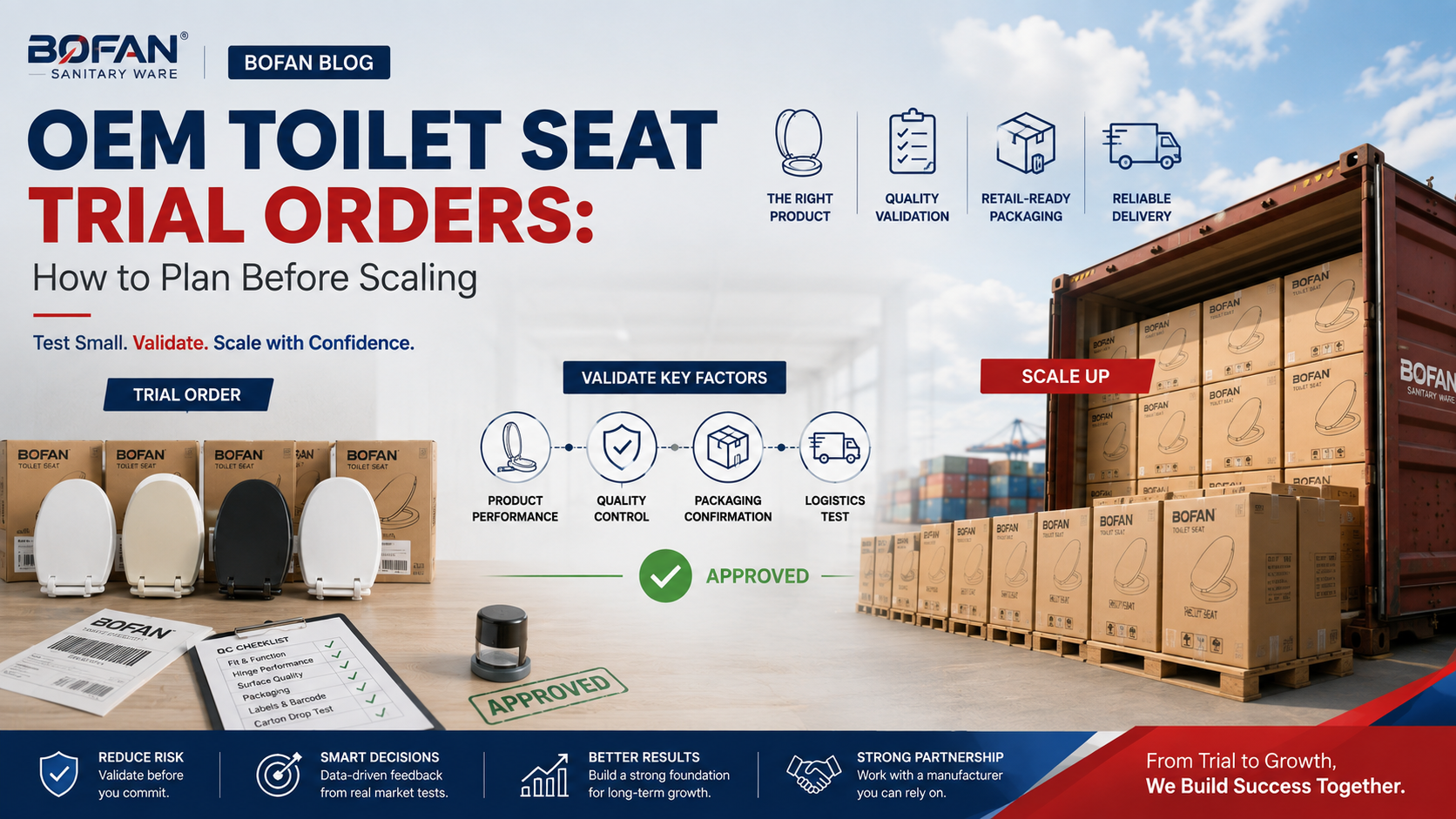
How to Structure a Trial Order Before Scaling an OEM Toilet Seat Program
A sample can show whether a toilet seat looks right. A trial order shows whether the supplier, product, packaging and delivery process can work in the real market.
For US importers, distributors, retailers and bathroom brands, a trial order is the bridge between development and a larger purchasing commitment. It should not be treated as a small version of a bulk order with no defined purpose.
A useful trial order validates the decisions that matter before volumes, packaging commitments and retail rollout increase.
Decide What the Trial Must Prove
Before discussing quantity, define the purpose of the trial.
A trial order may be used to verify:
Product fit and customer acceptance
Material and finish
Hinge, soft-close and quick-release performance
Ceramic compatibility
Packaging protection
Barcode and label accuracy
Freight and warehouse handling
Retail or e-commerce listing readiness
Supplier communication and document control
Actual production consistency
Delivery performance
Return or complaint risk
The scope should match the buyer’s next decision. If the buyer needs to decide whether to place a 40HQ program, the trial should produce evidence relevant to that decision.
Select the Right Product Configuration
Do not test too many uncontrolled variables in one trial.
For a first order, it is usually better to define a manageable product range with:
Approved seat shape
One or two priority materials
Identified hinge and fixing kit
Controlled colors
Final or near-final packaging
Clear SKU identification
Agreed instructions
Known carton quantity
If the buyer tests a new material, a new hinge, a new print design, new packaging and a new fixing system at the same time, it becomes difficult to identify the cause of any problem.
For an existing product transfer, lock the key reference points:
Factory model
Buyer SKU
Material
Seat and lid weight
Hinge code
Fixing-kit code
Buffer configuration
Color reference
Packaging reference
Barcode and label version
Set a Trial Quantity That Produces Useful Evidence
The right trial quantity depends on the product, sales channel and expected scale.
A trial should be large enough to test:
Production consistency
Packaging operation
Carton handling
Warehouse receiving
Customer or installer feedback
A small sales launch, where relevant
Inspection and defect-rate measurement
However, it should not create excess inventory before the product is commercially validated.
The factory should clearly state the MOQ impact of the selected product, color, printed packaging and hardware. A trial quantity may be below the most efficient production level, so the buyer should understand whether a unit-price adjustment, standard packaging or limited color range is required.
Freeze the Trial Specification Before Production
Create one controlled trial-order specification containing:
| Control item | What should be recorded |
|---|---|
| Buyer SKU | Buyer-facing code and product name |
| Factory model | Factory reference for repeat orders |
| Material | Exact material and grade requirement where applicable |
| Product dimensions | Outer dimensions, inner opening and fixing range |
| Hinge | Code, finish and function |
| Fixing kit | Top-fix or bottom-fix component set |
| Functions | Soft-close, quick release or other requirements |
| Color and finish | Approved sample or Pantone reference |
| Packaging | Individual pack, carton pack and artwork version |
| Labeling | Barcode, country-of-origin mark and warnings |
| Inspection | Sampling plan and functional checks |
| Delivery | Trade term, destination and requested shipment window |
The purchase order, approved sample and packaging artwork must match this record. If something changes, record the change rather than relying on email descriptions alone.
Include Production-Representative Samples
A hand-built development sample is not enough to approve a trial order.
Before bulk trial production, request a production-representative sample with the intended:
Material
Hinge and damper
Fixing kit
Color or print
Packaging
Instructions
Hardware bag
Barcode and labeling
The buyer should inspect the product both unpacked and after packaging. For a toilet seat, the installation check should use the intended ceramic or an approved representative fixture whenever possible.
Build a Simple Trial Inspection Plan
The inspection plan should focus on the product risks that could affect repeat orders.
Typical checks include:
Product dimensions and shape
Surface appearance
Color and gloss
Hinge alignment
Soft-close movement
Quick-release engagement
Fixing-kit completeness
Buffer position
Seat stability after installation
Carton print and barcode
Packaging protection
Carton weight and dimensions
Quantity per carton
Batch identification
The buyer and supplier should agree whether inspection will take place during production, before shipment or both. For high-value retail programs, a pre-shipment inspection may be appropriate before the balance payment or release for shipment.
Test the Logistics and Receiving Process
A trial order should test the complete supply chain, not only the factory.
Review:
Booking and shipment documents
Carton dimensions and actual CBM
Palletization
Container or LCL handling
Warehouse receiving
Barcode scanning
Damage rate on arrival
Hardware-bag loss or carton breakage
Put-away requirements
E-commerce fulfillment needs
Actual transit timing
For an Amazon FBA or retailer program, ensure that carton labels, pallet labels, product labels and delivery appointments follow the relevant warehouse rules before shipment.
Collect Sales, Installation and Return Feedback
Once the trial reaches the market, collect feedback by SKU and issue type.
Useful information includes:
Units received
Units sold
Installation questions
Ceramic compatibility issues
Soft-close or hinge feedback
Product returns
Surface complaints
Packaging damage
Missing hardware
Listing or barcode issues
Customer rating themes
Reorder demand
Separate product defects from installation, compatibility and listing problems. A return caused by an incorrect product-size listing needs a different correction from a return caused by hinge failure.
Set a Clear Scale-Up Gate
Before moving to a larger order, hold a review covering:
Trial quantity and sales result
Product quality findings
Inspection results
Packaging performance
Delivery performance
Warehouse feedback
Installation or customer feedback
Returns and claims
Final SKU assortment
Required product or packaging changes
New MOQ and pricing
Forecast and required shipment date
The next purchase order should only use the corrected and approved specification. Do not scale an unresolved trial issue across several thousand units.
Common Trial-Order Mistakes
Avoid these common problems:
Ordering before product and packaging are defined
Treating a photo sample as production approval
Testing too many product variables at once
Using a trial quantity too small to reveal production variation
Ignoring warehouse and barcode requirements
Failing to record the approved hinge and fixing kit
Changing artwork after packaging production has started
Not collecting return reasons by SKU
Reordering from verbal assumptions rather than the approved specification
Allowing component substitutions without approval
How BOFAN Supports OEM Trial Orders
BOFAN can support trial-order planning for PP, UF and molded-wood toilet seat programs. Depending on the selected project, support may include product and hinge review, sample preparation, packaging discussion, inspection coordination, carton information and repeat-order specification control.
CTA: Request an OEM Trial Order Plan
Preparing a new toilet seat program for the US market? Send BOFAN your selected product type, target quantity, sales channel, packaging format, destination and planned launch date. We can help review a practical trial-order structure before you scale.
FAQ
What is an OEM toilet seat trial order?
It is a controlled initial production order used to validate product quality, packaging, delivery and market fit before a larger purchasing commitment.
Is a sample enough before placing a bulk toilet seat order?
A sample confirms initial appearance and function. A trial order provides stronger evidence of production consistency, packaging performance and supply-chain execution.
How many SKUs should a first trial order include?
Use a manageable assortment. It is usually better to test a few controlled SKUs than many different variables that make feedback difficult to interpret.
Should retail packaging be used for the trial order?
If the packaging will be used in the final program, it should be tested during the trial. This helps identify artwork, barcode and protection issues before scale-up.
What should trigger a larger repeat order?
The buyer should review sales, quality, packaging, delivery, returns, required corrections, MOQ and final specification before approving scale-up.
Table of Contents
- How to Structure a Trial Order Before Scaling an OEM Toilet Seat Program
- Decide What the Trial Must Prove
- Select the Right Product Configuration
- Set a Trial Quantity That Produces Useful Evidence
- Freeze the Trial Specification Before Production
- Include Production-Representative Samples
- Build a Simple Trial Inspection Plan
- Test the Logistics and Receiving Process
- Collect Sales, Installation and Return Feedback
- Set a Clear Scale-Up Gate
- Common Trial-Order Mistakes
- How BOFAN Supports OEM Trial Orders
- FAQ