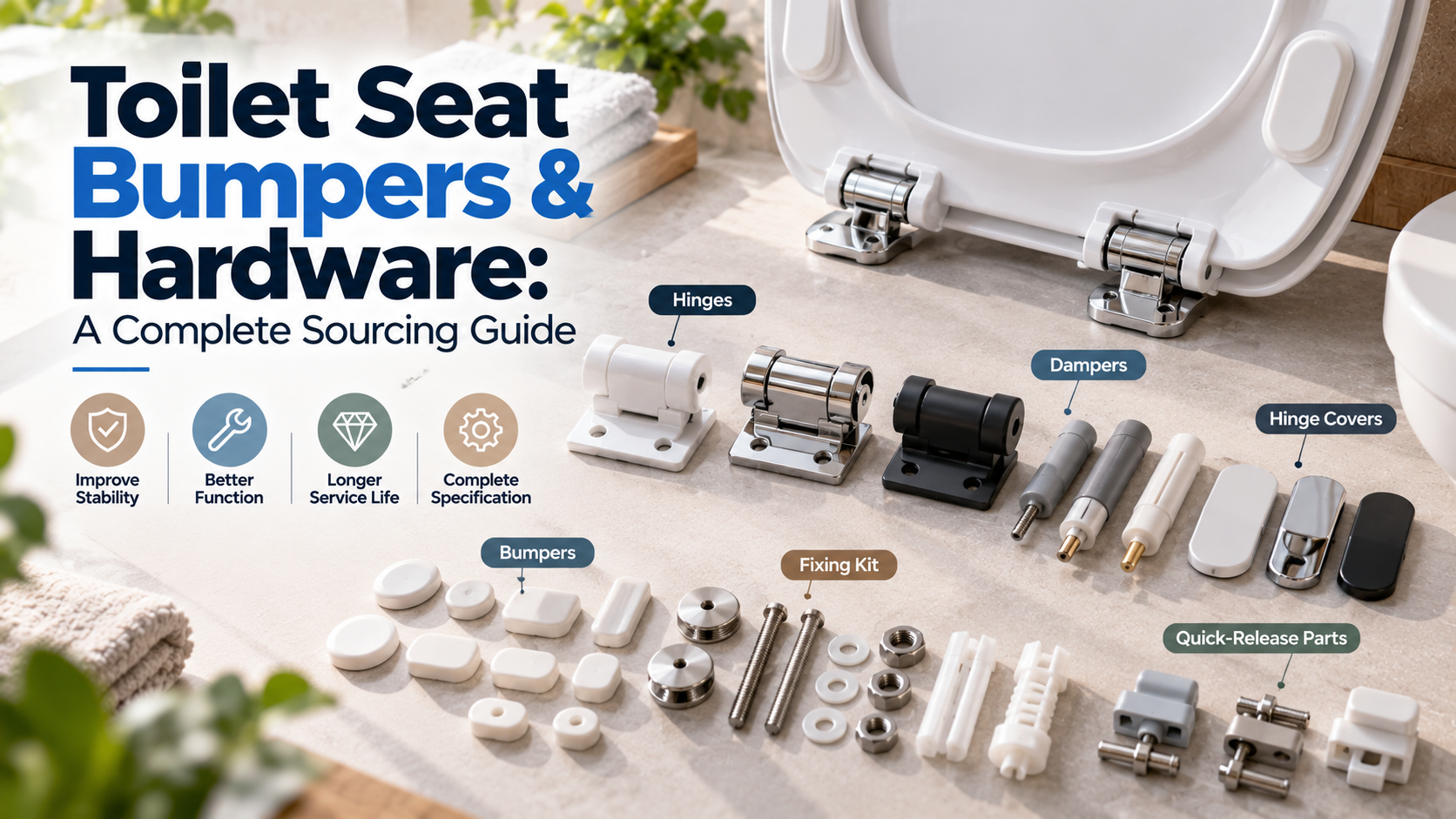
Toilet Seat Bumpers & Hardware: A Complete Sourcing Guide
A toilet seat may look like a simple product, but its performance depends heavily on small components.
Bumpers, hinges, fixing kits, screws, nuts, expansion plugs and quick-release parts affect how the seat closes, stays aligned, fits the ceramic and performs after installation. For OEM buyers, distributors and private-label brands, these parts should be included in the controlled product specification—not treated as minor accessories.
This guide explains the key toilet seat hardware components and how to source them correctly.
Why Toilet Seat Hardware Matters
A seat and lid can have an attractive surface finish, but poor hardware can lead to customer complaints such as:
Seat movement after installation
Loose hinges
Misaligned lid or seat ring
Poor soft-close action
Missing fixing components
Bumpers that detach or contact the bowl incorrectly
Difficulty installing the product
Damage during transport
The hardware system must match the exact product shape, material, weight and intended ceramic.
Main Toilet Seat Hardware Components
| Component | Main function | Buyer should confirm |
|---|---|---|
| Hinge | Connects the seat and lid to the fixing system | Material, code, finish and function |
| Damper | Controls soft-close movement | Lid-only or dual soft-close configuration |
| Fixing kit | Secures the seat to the ceramic | Top-fix or bottom-fix method and adjustment range |
| Bumpers | Support the seat and lid against the bowl | Material, position, attachment and contact points |
| Hinge covers | Improve appearance and protect visible hinge areas | Colour, finish and fit |
| Bolts and nuts | Secure the fixing system | Material, corrosion resistance and thread type |
| Expansion plugs | Support top-fix installation | Hole-size compatibility and installation method |
| Quick-release parts | Allow easier removal for cleaning | Locking security and reattachment process |
The complete assembly should be approved together with the toilet seat.
What Are Toilet Seat Bumpers?
Toilet seat bumpers are the small pads or buffers positioned under the seat ring and sometimes the lid.
Their main purposes are to:
Create contact between the seat and ceramic
Help reduce movement
Protect the toilet bowl surface
Reduce impact noise
Support the correct seat position
Help keep the seat ring level after installation
Bumpers can be made from different rubber, plastic or elastomer materials. The right choice depends on the product weight, surface finish, bowl shape and required appearance.
Bumper Position Is Not a Minor Detail
A bumper can be correctly attached but still perform poorly if it is in the wrong position for the intended bowl.
During sample approval, check:
Contact points on the ceramic
Seat-ring level after installation
Front and rear support
Side stability
Buffer compression during normal use
Whether the lid or seat ring touches the ceramic unexpectedly
Appearance of visible bumpers
Risk of detachment during cleaning
For a new ceramic or proprietary bowl shape, the supplier should review buffer placement with the installed sample.
Hinge Types for Toilet Seats
Toilet seat hinges are available in many configurations.
Common options include:
Standard-close hinges
Soft-close hinges
Lid-only soft-close hinges
Dual soft-close hinges
Quick-release hinges
Top-fix hinges
Bottom-fix hinges
Adjustable hinges
Metal hinges
Plastic hinges
Decorative hinge covers
A buyer should select the hinge according to the product program rather than relying on a general phrase such as “premium metal hinge.”
Top-Fix vs Bottom-Fix Toilet Seat Hardware
The fixing method must suit the toilet bowl.
| Fixing method | How it works | Typical buyer consideration |
|---|---|---|
| Top fix | Installed from above the ceramic | Useful where underside access is limited |
| Bottom fix | Bolt and nut are secured below the ceramic | Common where underside access is available |
| Adjustable fix | Allows movement within a defined hole-distance range | Useful when compatibility range is required |
| Quick-mount fix | Designed for easier installation or removal | Must be tested for stability and user clarity |
The factory should confirm the fixing-kit code, hole-size range and adjustment range for the selected model.
Hinge Material and Finish
Hinge material affects appearance, cost, corrosion performance and long-term function.
Possible configurations include:
Plastic hinge body
Zinc-alloy hinge
Stainless steel components
Chrome-coloured finish
Matte black finish
White or colour-matched hinge cover
Brushed decorative finish
For retail programs, visible hinge appearance may be part of the design. For commercial or project supply, stability, serviceability and repeatability may be more important.
The purchase order should identify the exact approved configuration.
Soft-Close Hardware
A soft-close toilet seat requires a hinge and damper system matched to the product.
Confirm:
Whether the lid, seat ring or both close slowly
Damper and hinge configuration
Product material and weight
Closing behaviour on an installed sample
Alignment after repeated operation
Availability of replacement components
Approval required before any damper change
A soft-close hinge that performs well on a PP seat may need a different configuration for UF, MDF or moulded-wood products.
Quick-Release Hardware
Quick-release hardware lets the seat and lid be removed for easier cleaning.
For a quick-release design, test:
Locking strength after installation
Ease of removal
Ease of reattachment
Hinge alignment after repeated release
Compatibility with the selected fixing kit
Customer instructions
Carton protection around the hinge area
The quick-release feature should not create unwanted play or movement after the product is reinstalled.
How to Specify Toilet Seat Hardware in an RFQ
A useful RFQ should include a hardware section.
Request confirmation of:
Factory model
Hinge code
Hinge material and finish
Soft-close or standard-close function
Quick-release requirement
Fixing-kit code
Top-fix or bottom-fix method
Adjustment range
Bumper material and position
Visible-component colour
Spare-parts requirement
Test expectations
Sample-approval process
Change-control requirement
This makes it much easier to compare supplier quotations fairly.
Hardware and Bumper Checks Before Bulk Production
Before mass production, approve:
Installed seat stability
Hinge and fixing-kit identity
Bumper position and ceramic contact
Seat and lid alignment
Soft-close behaviour, if required
Quick-release function, if required
Fixing-kit completeness
Instruction-sheet accuracy
Packaging protection for hardware
Approved sample and component-change rules
The final inspection should compare the production product with the approved configuration, not only with a product photo.
How BOFAN Supports Toilet Seat Hardware Selection
BOFAN supports toilet seat programs across PP, UF, MDF and wooden ranges, including top-fix, bottom-fix, soft-close, quick-release and adjustable-hardware options.
For qualified OEM and private-label projects, the team can help review the selected ceramic, hinge, fixing kit, bumper layout, sample plan and packaging needs.
Final hardware suitability, test method and repeat-order component control should be confirmed for the exact model and destination market.
CTA: Request a Toilet Seat Hardware Review
Need help matching a toilet seat hinge, fixing kit or bumper layout to your product? Send BOFAN your ceramic information, seat model, required function, quantity and target market for review.
FAQ
What are toilet seat bumpers for?
Bumpers support the seat against the ceramic, reduce movement and impact, protect the bowl surface and help maintain the correct installed position.
Can bumpers be changed after sample approval?
Any bumper change can affect seat height, stability, contact points and appearance. It should be reviewed and approved before production.
What is the difference between top-fix and bottom-fix hardware?
Top-fix hardware is installed from above the toilet bowl. Bottom-fix hardware is secured from below the ceramic. The right option depends on bowl access and product design.
Why should buyers record the hinge code?
The hinge code helps control function, appearance and repeat-order consistency. It prevents unapproved substitutions.
What should be included in a toilet seat hardware specification?
Include the hinge, damper, fixing kit, bumper layout, visible finish, adjustment range, sample approval, test requirements and change-control rules.
Table of Contents
- Toilet Seat Bumpers & Hardware: A Complete Sourcing Guide
- Why Toilet Seat Hardware Matters
- Main Toilet Seat Hardware Components
- What Are Toilet Seat Bumpers?
- Bumper Position Is Not a Minor Detail
- Hinge Types for Toilet Seats
- Top-Fix vs Bottom-Fix Toilet Seat Hardware
- Hinge Material and Finish
- Soft-Close Hardware
- Quick-Release Hardware
- How to Specify Toilet Seat Hardware in an RFQ
- Hardware and Bumper Checks Before Bulk Production
- How BOFAN Supports Toilet Seat Hardware Selection
- FAQ