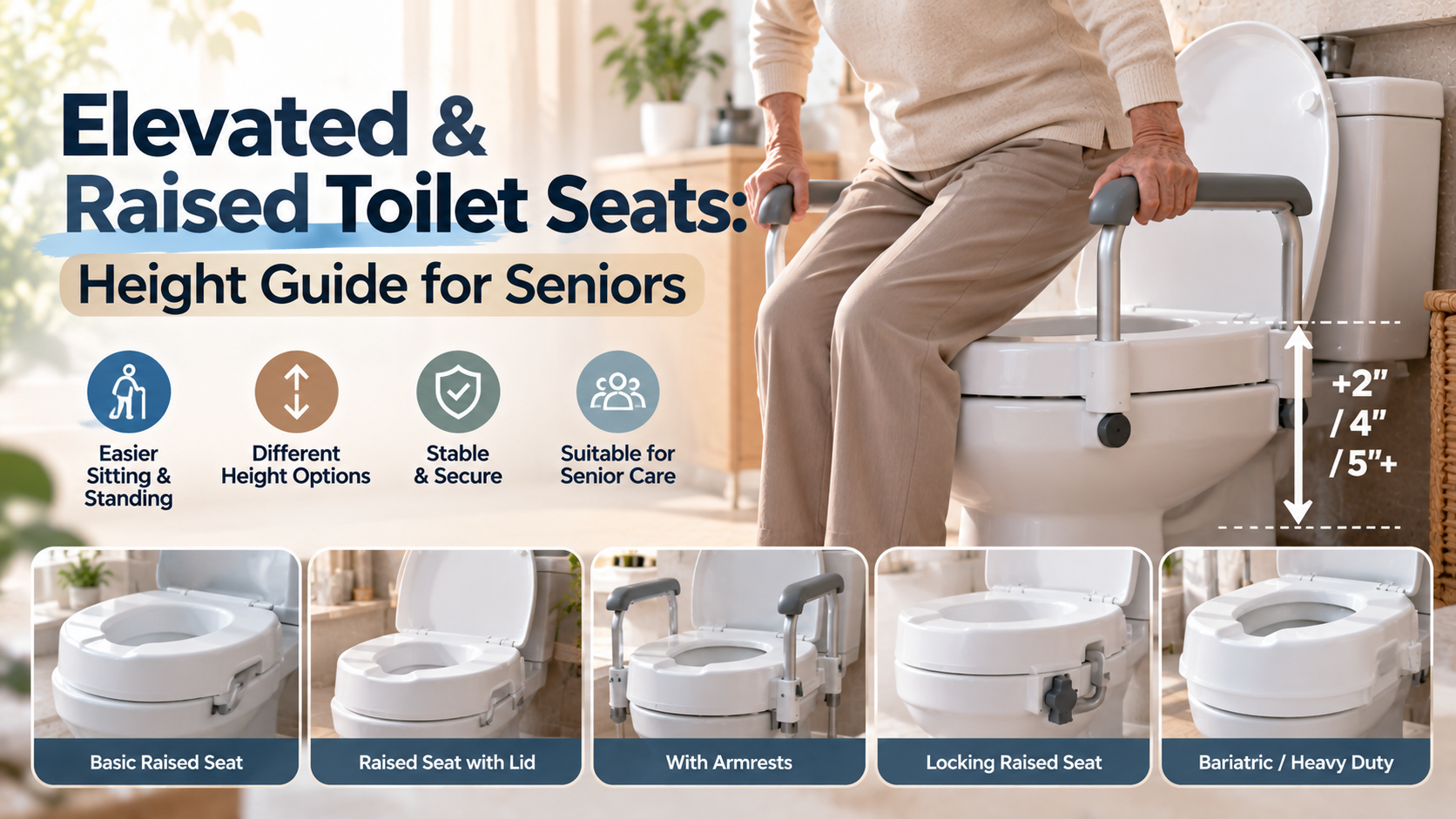
Elevated & Raised Toilet Seats: Height Guide for Seniors
A raised toilet seat is designed to increase the sitting height above a standard toilet bowl. It is commonly used in senior-care, rehabilitation, home-care and accessibility product programs where users may find sitting down or standing up more difficult.
For distributors, healthcare suppliers and private-label buyers, the category needs careful specification. Height alone does not determine whether a product is suitable. The toilet shape, locking method, arm support, user weight capacity, cleaning design and intended care environment all matter.
This guide explains how to compare elevated and raised toilet seat products before sourcing or adding them to a catalogue.
What Is a Raised Toilet Seat?
A raised toilet seat—also called an elevated toilet seat or toilet seat riser—is an accessory that sits on or attaches to a toilet bowl to increase the effective seat height.
It is different from a standard replacement toilet seat.
A standard toilet seat replaces the existing seat and lid. A raised toilet seat is generally an assistive product intended to help users transfer on and off the toilet more easily.
Common product formats include:
Basic raised toilet seat
Raised toilet seat with lid
Raised toilet seat with armrests
Locking raised toilet seat
Elongated raised toilet seat
Round raised toilet seat
Bariatric or heavy-duty raised seat
Bedside commode or shower-commode chair
The intended use should be defined before a buyer selects a product.
Elevated Toilet Seat vs Raised Toilet Seat
The terms are often used interchangeably.
| Term | Usual meaning | Buyer focus |
|---|---|---|
| Raised toilet seat | A seat riser that increases toilet height | Height, fit, locking and user support |
| Elevated toilet seat | Another common name for a raised seat | Same technical checks as a raised seat |
| Toilet seat riser | A product placed on or fixed to an existing bowl | Bowl compatibility and stability |
| Commode chair | A freestanding or mobile toileting support product | Frame, wheels, arms, seat and weight capacity |
A supplier’s catalogue wording may vary, so buyers should compare product drawings and specifications rather than relying only on the title.
How Much Height Is Needed?
Raised toilet seats are often offered in several height options. The correct height depends on the user, the existing toilet height, mobility needs and professional guidance where required.
A sourcing brief should identify:
Existing toilet seat height
Required added height
User group
Use setting: home, rehabilitation, nursing facility or hospital
Whether armrests are needed
Whether the user needs a lid
Required weight capacity
Round or elongated bowl compatibility
Cleaning and maintenance expectations
Do not position one height as suitable for every user. A product should be selected for the intended use case and reviewed against the relevant customer or clinical requirements.
Why Arms and Handles Matter
Some raised toilet seats include integrated arms or handles. These can provide a handhold during transfer, but they also change the product footprint, packaging size and installation requirements.
Check:
Arm spacing
Arm height
Connection strength
Ease of cleaning around the arms
Whether arms are removable
User access from each side
Product stability when pressure is applied
Carton protection during transport
For project or care-facility buyers, arm support should be evaluated as part of the complete transfer environment, not as a decorative add-on.
Round vs Elongated Bowl Compatibility
Raised seats are often made for either round or elongated toilet bowls. A product described as “universal” still needs a compatibility check.
Confirm:
Bowl length
Bowl width
Front profile
Rear ceramic platform
Rim shape
Locking or fixing contact points
Clearance to the cistern
Lid opening clearance
Existing toilet-seat attachment points, where relevant
A raised seat may appear to fit the rim but still move during use if the locking points or contact surfaces are not compatible with the intended bowl.
Locking and Stability Are Core Requirements
A raised toilet seat must remain stable when installed correctly.
Depending on the product design, stability may come from:
Side locking brackets
Front locking systems
Under-rim contact points
Adjustable clamps
Fixed mounting hardware
A freestanding commode frame
The supplier should provide clear installation instructions and identify the bowls or dimensions the product is designed to fit.
For buyer approval, check:
Product movement during normal use
Clamp or lock engagement
Contact with the ceramic
Reinstallation after cleaning
Ease of operation for the intended user group
Damage risk to the bowl surface
Secure condition after repeated installation cycles
Weight Capacity Must Be Model-Specific
Do not use a general “heavy duty” label without checking the specific model.
Weight capacity depends on the product structure, material, locking design, arm support and intended installation. A bariatric product should not be assumed to be simply a standard raised seat with a higher number on the carton.
For any product marketed to higher-weight users, buyers should request:
Model-specific rated capacity
Test method or supporting evidence
Product drawing
Material description
Locking or frame design
Intended use statement
Installation requirements
Packaging and traceability information
The final claim used on retail packaging should match the approved product evidence and target market requirements.
Raised Toilet Seat Materials
Raised toilet seats are commonly produced with easy-clean plastic seating components, but the product may also include metal frames, arm supports, clamps, rubber contact points or other hardware.
| Component | Why it matters |
|---|---|
| Seat body | Affects comfort, cleaning and structural design |
| Locking hardware | Affects fit and stability |
| Armrests | Affect transfer support and product footprint |
| Rubber contact points | Help protect the bowl and reduce movement |
| Metal frame, if included | Affects weight capacity and corrosion protection |
| Lid | Affects hygiene and retail presentation |
| Packaging | Protects the product and instructions during shipping |
A buyer should approve the complete product assembly, not only the visible seat body.
Packaging and Instructions for Senior-Care Products
Clear instructions are essential for a raised toilet seat program.
The package should state the approved information for the exact model, such as:
Compatible bowl type or size range
Installation method
Locking steps
Cleaning guidance
User warnings where required
Product weight capacity, if approved
Whether a lid or arms are included
Product dimensions
Storage instructions
Contact or after-sales information
Avoid generic instructions that do not match the actual locking mechanism or bowl-fit requirements.
Raised Toilet Seat Sourcing Checklist
Before placing an order, confirm:
Product type: riser, armrest model, commode or bariatric product
Added height and overall dimensions
Round or elongated bowl compatibility
Locking or fixing system
Armrest requirement
Lid requirement
Model-specific weight capacity and evidence
Materials and cleanability
Sample installation on representative ceramic
Packaging, instructions and label requirements
Inspection plan
Change-control procedure
How BOFAN Supports Accessibility Toilet Seat Discussions
BOFAN supports toilet seat programs for distributors, bathroom brands and project buyers across PP, UF, MDF and wooden product ranges. For accessibility-related projects, the team can help review the intended toilet shape, installation method, hinge or fixing requirements, packaging and sample process.
For raised, medical or bariatric products, final product suitability, rated capacity, testing and applicable market requirements should be confirmed for the exact model and use case.
CTA: Discuss an Accessibility Toilet Seat Program
Planning an elevated or accessibility toilet seat range? Send BOFAN your target market, product type, bowl information, required features, quantity and packaging format. We can help review the product-sourcing path.
FAQ
What is the difference between a raised toilet seat and a standard toilet seat?
A standard toilet seat replaces the existing seat. A raised toilet seat is an assistive product designed to increase the effective sitting height above the toilet bowl.
Are elevated toilet seats and raised toilet seats the same?
The terms are commonly used interchangeably. Buyers should check the actual product drawing, added height, bowl fit and locking system.
How do buyers choose the correct raised toilet seat height?
Confirm the existing toilet height, desired added height, intended user group, care setting and professional requirements where applicable.
Do raised toilet seats fit every toilet bowl?
No. Buyers should verify round or elongated compatibility, bowl dimensions, rim shape and locking-system contact points.
What should be checked before a bulk order?
Check bowl fit, stability, locking method, arms, lid, model-specific capacity, materials, instructions, packaging and installed sample approval.
Table of Contents
- Elevated & Raised Toilet Seats: Height Guide for Seniors
- What Is a Raised Toilet Seat?
- Elevated Toilet Seat vs Raised Toilet Seat
- How Much Height Is Needed?
- Why Arms and Handles Matter
- Round vs Elongated Bowl Compatibility
- Locking and Stability Are Core Requirements
- Weight Capacity Must Be Model-Specific
- Raised Toilet Seat Materials
- Packaging and Instructions for Senior-Care Products
- Raised Toilet Seat Sourcing Checklist
- How BOFAN Supports Accessibility Toilet Seat Discussions
- FAQ