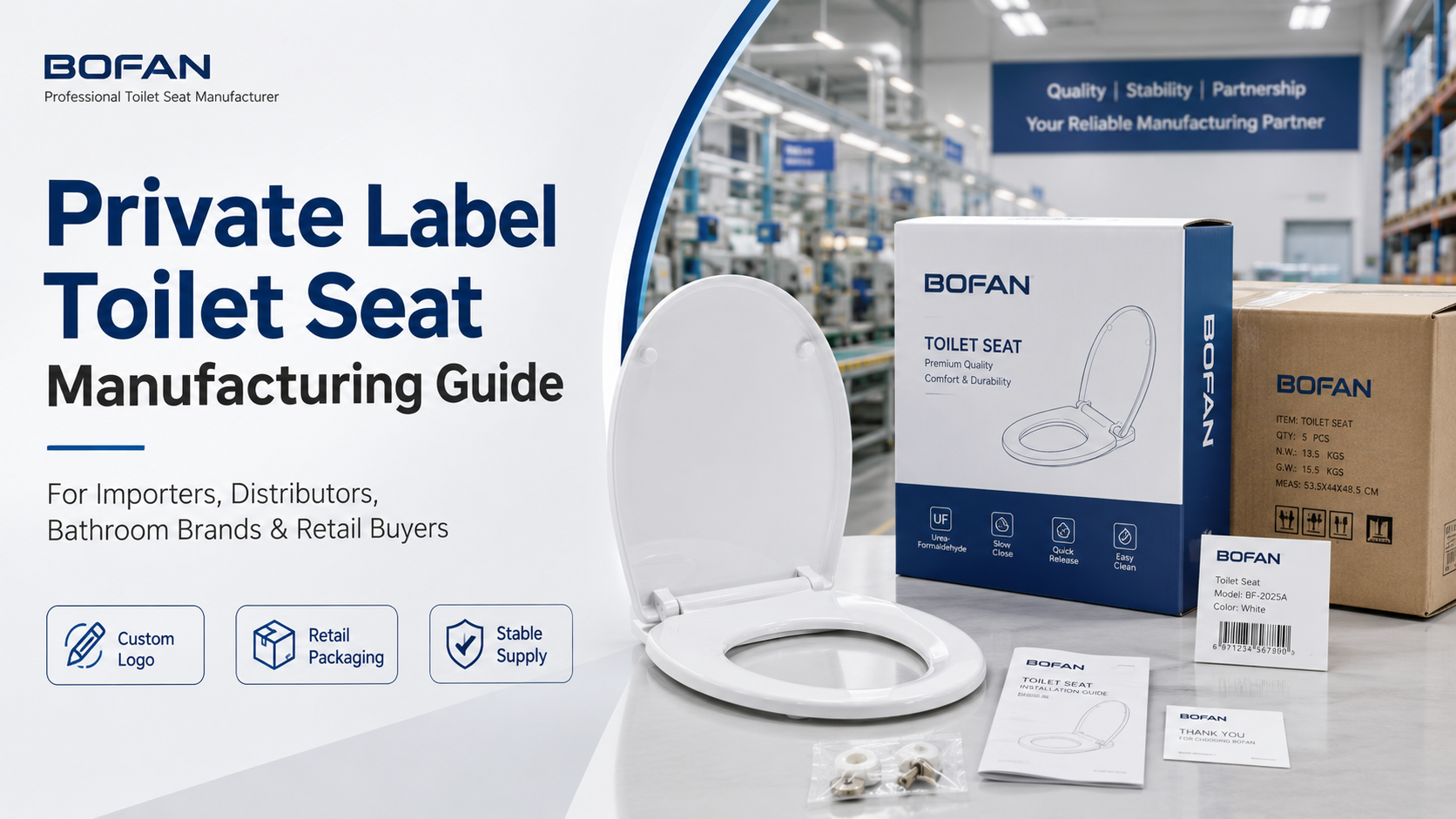
Private Label Toilet Seat Manufacturing Guide for B2B Buyers
For importers, distributors, sanitary ware brands, retail buyers, and OEM buyers, a private label toilet seat is more than a standard product with a logo. It is a complete brand-based purchasing project involving product selection, material decisions, mold options, hinge structure, surface finish, packaging design, quality control, and long-term supply stability.
As the bathroom products market becomes more competitive, many B2B buyers no longer want to sell only generic toilet seats. They want products that carry their own brand identity, fit their target market, and support stable repeat orders. A reliable toilet seat manufacturer can help buyers build a private label product line from concept to mass production.
This guide explains how private label toilet seat manufacturing works, what can be customized, how the production process is managed, and how to choose the right supplier for your business.
What Is a Private Label Toilet Seat?
A private label toilet seat is manufactured by a professional toilet seat factory but sold under the buyer’s own brand name. The manufacturer produces the product, while the buyer controls the brand, logo, packaging, sales channel, and market positioning.
For example, an importer may choose an existing MDF, UF, or PP toilet seat model from a factory, add their own logo, customize the packaging, and sell it through distributors or retail channels. A sanitary ware brand may also develop a more customized model with specific dimensions, hinges, surface finish, and packaging requirements.
Private label projects are commonly used by:
- Importers and wholesalers
- Sanitary ware distributors
- Bathroom brands
- Supermarkets and retail chains
- E-commerce sellers
- OEM buyers
- Project suppliers and contractors
The key advantage is that buyers can build their own product identity without investing in a full manufacturing facility.
Private Label vs OEM vs ODM Toilet Seat
In toilet seat manufacturing, buyers often hear three terms: private label, OEM, and ODM. They are related, but they are not exactly the same.
A private label toilet seat usually starts from an existing factory model. The buyer customizes the logo, packaging, color, labels, and sometimes hinges or surface finish. This is suitable for buyers who want to launch products quickly.
An OEM toilet seat is produced according to the buyer’s specific requirements. The buyer may provide drawings, dimensions, structure requirements, color standards, packaging files, or technical specifications. This is suitable for established brands, distributors, and project buyers.
An ODM toilet seat is developed based on the manufacturer’s own design and development capability. The factory provides product concepts or ready-made designs, and the buyer selects suitable models for branding and sales.
For many B2B buyers, a private label project is the most efficient starting point because it offers a balance between customization, cost control, and speed to market.
Why B2B Buyers Choose Private Label Toilet Seats
Build Your Own Brand
Selling generic toilet seats often limits profit margins and makes it difficult to build customer loyalty. With a private label toilet seat program, buyers can create a recognizable brand in their market. This is especially important for distributors, sanitary ware brands, and retail buyers who want to strengthen their long-term channel value.
Private label products allow buyers to control how the product is presented, including logo, packaging, product description, barcode, manual, and carton marks. This creates a more professional image for wholesale, retail, and project sales.
Improve Product Differentiation
Many toilet seats look similar from the outside, but B2B buyers can create differentiation through material, weight, surface finish, hinge type, soft close function, quick release design, packaging style, and market-specific sizing.
For example, a retail buyer may prefer a glossy white MDF toilet seat with color box packaging. A hotel project buyer may prefer a durable UF toilet seat with soft close hinges. An importer targeting price-sensitive markets may choose PP toilet seats with simple packaging.
Private label manufacturing allows buyers to match products with their exact sales channels.
Control Quality and Supply Stability
When buyers work directly with a manufacturer, they can better control product quality, inspection standards, packaging requirements, and delivery schedules. This is important for repeat orders and long-term business.
A reliable manufacturer should not only produce the toilet seat, but also help buyers confirm technical details, prevent production mistakes, and maintain consistency across batches.
Common Materials for Private Label Toilet Seats
Material selection is one of the most important decisions in a private label toilet seat project. Different materials affect cost, appearance, durability, product weight, market positioning, and end-user experience.
MDF and Molded Wood Toilet Seats
MDF and molded wood toilet seats are widely used in retail and traditional bathroom markets. They usually provide a solid feel, good weight, and smooth painted surface. These products can be made in glossy white, black, wood grain, decorative patterns, or other customized finishes.
MDF toilet seats are suitable for buyers who want a heavier, more premium feel compared with lightweight plastic products. They are commonly used by importers, distributors, supermarkets, and sanitary ware brands.
Customization options may include:
- Glossy or matte finish
- White, black, or custom colors
- Printed patterns
- Wood grain effect
- Soft close hinges
- Bottom fixing or adjustable hinges
- Retail color box packaging
UF / Duroplast Toilet Seats
UF, also known as duroplast, is a high-quality material often used for premium toilet seats. It has a ceramic-like appearance, good hardness, strong scratch resistance, and easy-clean surface. UF toilet seats are popular in Europe, high-end retail channels, hotel projects, and sanitary ware brand programs.
UF toilet seats are suitable for buyers who focus on durability, appearance, and long-term product performance. They are often combined with soft close hinges and quick release functions.
Typical advantages include:
- Hard and smooth surface
- Ceramic-like look
- Good scratch resistance
- Easy cleaning
- Suitable for modern bathrooms
- Stronger premium positioning
PP Toilet Seats
PP toilet seats are lightweight, moisture-resistant, and cost-effective. They are commonly used in large-volume projects, price-sensitive markets, and basic retail channels.
For importers and distributors, PP toilet seats can be a practical choice when the target market requires competitive pricing and stable supply. They can also be customized with different colors, hinges, packaging, and private label branding.
PP toilet seats are suitable for:
- Economy product lines
- Bulk distribution
- Public housing projects
- Entry-level retail programs
- Price-sensitive markets
Wooden Finish and Decorative Toilet Seats
Decorative toilet seats are often used for retail, e-commerce, and special design markets. These may include wood grain, marble effect, printed designs, or customized surface patterns.
For private label buyers, decorative toilet seats can help create visual differentiation and attract consumers in retail environments.
What Can Be Customized for a Private Label Toilet Seat?
A successful private label toilet seat project usually includes several customization areas. The more clearly buyers define these requirements, the faster the manufacturer can provide an accurate quotation and sample plan.
Logo Customization
Logo customization is the most basic part of a private label toilet seat project. Depending on the product material, surface finish, and branding requirement, the logo may be applied in different ways.
Common logo options include:
- Logo printed on the product
- Brand label on the toilet seat
- Sticker label
- Logo on the hinge card or instruction manual
- Logo printed on color box packaging
- Logo on master carton
- Barcode or SKU label with brand information
For retail buyers and sanitary ware brands, logo placement must be clear, consistent, and aligned with the packaging design. For distributors, a simple brand label and carton mark may be enough for wholesale channels.
Packaging Customization
Packaging is one of the most important elements for private label toilet seat programs. It affects product presentation, retail readiness, logistics protection, and customer trust.
Common packaging options include:
- Brown carton
- Color box
- Retail display box
- Shrink packaging
- Barcode label
- SKU label
- Instruction manual
- Warning label
- Multi-language packaging
- Customized carton marks
- Pallet packaging for bulk shipment
For supermarkets and retail chains, packaging often needs to include barcode, product specifications, installation instructions, material information, safety warnings, and brand design. For importers and wholesalers, carton strength and shipping protection may be more important.
BOFAN can support B2B buyers with customized packaging solutions based on sales channel requirements, including retail-ready packaging and export carton arrangements.
Color and Surface Finish Customization
Color and surface finish help buyers match their brand positioning and market demand. The most common color is glossy white, but private label buyers may also request black, matte finish, wood grain, marble effect, or other decorative surfaces.
Common options include:
- Glossy white
- Black shining
- Matte colors
- Wood grain finish
- Marble effect
- Printed pattern
- Customized surface design
For bathroom brands and retail buyers, consistent color control is important. The sample approval stage should confirm color, gloss level, surface smoothness, and overall visual effect before mass production.
Size and Shape Customization
Toilet seat size and shape must match the target market. A product that fits well in one market may not fit standard toilets in another region.
Common shapes include:
- Round
- Elongated
- D-shape
- U-shape
- Square shape
- Universal fit models
For North America, round and elongated toilet seats are common. For Europe and other markets, D-shape and special designs may be required. Buyers should provide drawings, product photos, or target toilet dimensions when requesting a quote.
Hinge Customization
Hinges are a key part of toilet seat performance. They affect installation, user experience, durability, and perceived product quality.
Common hinge options include:
- Standard hinge
- Soft close hinge
- Quick release hinge
- Adjustable hinge
- Metal hinge
- Plastic hinge
- Bottom fixing hinge
- Top fixing hinge
- Pull-off removable design
For premium products, soft close and quick release hinges are often preferred. Soft close hinges improve user experience by allowing the seat and lid to close slowly and quietly. Quick release hinges make cleaning easier by allowing users to remove the seat from the toilet pan.
For commercial or project use, hinge strength and fixing stability are especially important. Buyers should confirm hinge material, fixing method, adjustment range, and cycle test requirements.
Private Label Toilet Seat Manufacturing Process
A professional private label toilet seat project should follow a clear manufacturing process. This helps reduce communication mistakes, control quality, and ensure the final product matches the buyer’s expectations.
Step 1: Requirement Confirmation
The project starts with requirement confirmation. At this stage, the buyer and manufacturer discuss the basic product direction and technical requirements.
Buyers should prepare:
- Target market
- Product material
- Toilet seat shape
- Size or drawing
- Hinge type
- Color requirement
- Logo requirement
- Packaging style
- Order quantity
- Destination port
- Certification or testing requirements
- Target price range
- Expected delivery schedule
This step is important because the same toilet seat model can have different costs depending on material, hinge, packaging, and order quantity.
Step 2: Product Selection or Custom Development
After confirming the requirements, the manufacturer will usually suggest suitable existing models or discuss custom development.
There are two common project paths.
The first path is to use an existing model. This is faster, more cost-effective, and suitable for private label buyers who want to enter the market quickly. The buyer can customize logo, packaging, color, hinge, and carton marks based on the selected model.
The second path is custom development. This may involve new molds, special dimensions, unique shape, customized hinge structure, or buyer-provided drawings. This path is suitable for OEM buyers, sanitary ware brands, and project customers with specific technical requirements.
Step 3: Mold Confirmation
Molds are essential in toilet seat production, especially for UF, PP, and some customized models. If the buyer selects an existing mold, the project can move faster and reduce tooling cost. If a new mold is required, the factory needs to evaluate drawings, structure, size, material, and production feasibility.
Mold-related factors include:
- Product shape
- Product size
- Material type
- Seat and lid structure
- Fixing hole position
- Hinge compatibility
- Surface design
- Expected production volume
For B2B buyers, using an existing mold is often the best option for the first order. New mold development is more suitable when the buyer has a stable long-term plan or a unique brand product line.
Step 4: Quotation and Cost Evaluation
Once the product details are clear, the manufacturer can provide a quotation. The price of a private label toilet seat depends on many factors, including material, hinge type, packaging, logo method, quantity, and testing requirements.
Main cost factors include:
- MDF, UF, PP, or wooden finish material
- Seat size and weight
- Soft close or standard hinge
- Quick release function
- Surface finish
- Logo application method
- Color box or plain carton
- Order quantity
- New mold requirement
- Inspection and testing requirements
- Shipping terms such as EXW or FOB
A professional supplier should explain the quotation clearly instead of only providing a unit price. This helps buyers compare options and choose the most suitable product configuration.
Step 5: Sample Making
Sample making is a critical step before mass production. The sample allows the buyer to check appearance, size, hinge function, surface finish, logo position, and packaging concept.
For private label projects, samples may include:
- Product sample
- Color sample
- Logo sample
- Hinge sample
- Packaging mockup
- Carton label sample
Buyers should review the sample carefully and provide clear feedback. Any changes to logo, color, hinge, or packaging should be confirmed before production starts.
Step 6: Sample Approval
After the sample is checked, the buyer provides approval or requests modifications. This approval should cover both product and packaging details.
Key points to confirm include:
- Product size
- Shape and fit
- Surface quality
- Color and gloss
- Hinge function
- Soft close speed
- Quick release operation
- Logo position
- Packaging artwork
- Carton marks
- Barcode or label information
A clear sample approval process helps avoid disputes during mass production.
Step 7: Mass Production
After sample approval and order confirmation, the factory begins mass production. The exact production process depends on the material.
For MDF or molded wood toilet seats, the process may include board preparation, shaping, sanding, surface coating, painting, curing, drilling, hinge assembly, inspection, and packing.
For UF toilet seats, the process usually involves compression molding, trimming, polishing, hinge assembly, function testing, inspection, and packaging.
For PP toilet seats, the process usually involves injection molding, trimming, hinge installation, inspection, and packing.
During production, the factory should control product dimensions, surface appearance, hinge installation, color consistency, and packaging accuracy.
Step 8: Quality Control and Testing
Quality control is essential for B2B buyers because private label products represent the buyer’s brand in the market. A quality issue can affect customer trust, repeat orders, and retail relationships.
Common inspection points include:
- Raw material inspection
- Product size inspection
- Surface inspection
- Color consistency check
- Hinge installation check
- Soft close function test
- Quick release function test
- Load capacity test
- Stability and fixing test
- Packaging inspection
- Carton mark inspection
- Final random inspection
For retail buyers and brand customers, additional testing may be required depending on market requirements. These may include hinge cycle testing, surface durability testing, load performance testing, or chemical compliance checks.
A professional toilet seat manufacturer should have a clear inspection process before shipment.
Step 9: Packing and Shipment
After final inspection, the products are packed according to the approved packaging plan. Packing should protect the product during storage, loading, and transportation.
For private label toilet seat orders, packaging accuracy is especially important because products may go directly to retail warehouses, distributors, or project sites.
Packing details may include:
- Inner packaging
- Color box
- Instruction manual
- Barcode label
- Carton label
- Master carton
- Pallet arrangement
- Container loading plan
BOFAN can support export shipments based on buyer requirements, including EXW and FOB Ningbo arrangements.
Key Factors That Affect Private Label Toilet Seat Cost
The cost of a private label toilet seat is not determined by material alone. Buyers should evaluate the full product configuration.
Material
UF, PP, MDF, and wooden finish toilet seats have different cost structures. UF is often used for premium positioning, PP for cost-effective programs, and MDF or molded wood for solid-feel retail products.
Hinge Type
Standard hinges are more economical, while soft close and quick release hinges increase cost but improve product value. Metal hinges may also cost more than plastic hinges, depending on the design and material.
Product Weight and Size
Larger and heavier products usually require more material and may increase shipping cost. This is especially important for MDF and molded wood toilet seats.
Packaging
Retail color box packaging costs more than plain carton packaging, but it is often necessary for supermarkets, retail chains, and e-commerce channels.
Logo Method
Different logo methods have different setup costs. Simple labels are usually more economical, while printing, special brand plates, or custom packaging artwork may require additional preparation.
Order Quantity
Higher order quantities usually help reduce unit cost because material purchasing, production setup, packaging printing, and labor can be spread over more units.
Mold Requirement
Using an existing mold is faster and more cost-effective. New mold development requires tooling cost and longer lead time.
Testing Requirement
If the buyer requires additional test reports, compliance documentation, or special inspection standards, this may affect both cost and lead time.
How to Choose a Reliable Private Label Toilet Seat Manufacturer
Choosing the right supplier is one of the most important decisions in a private label toilet seat project. Buyers should not only compare price. They should evaluate manufacturing capability, quality control, customization support, and communication efficiency.
Manufacturing Experience
A reliable supplier should understand toilet seat materials, molds, hinges, surface treatment, assembly, testing, and export packaging. Experience helps reduce mistakes and improve project efficiency.
Product Range
A strong manufacturer should offer multiple material options, such as MDF, UF, PP, molded wood, and decorative toilet seats. This allows buyers to build different product lines for different market segments.
OEM and Private Label Capability
Buyers should check whether the supplier can support logo customization, packaging customization, color options, hinge selection, carton marks, and buyer-specific product requirements.
A good supplier should be able to support both simple private label projects and more detailed OEM programs.
Mold and Development Capability
For sanitary ware brands and OEM buyers, mold capability is important. The supplier should be able to evaluate product drawings, existing mold options, and new mold feasibility.
Quality Control System
The manufacturer should have a clear inspection process from raw materials to final packing. Buyers should ask how the factory checks dimensions, surface quality, hinge function, soft close performance, and packaging accuracy.
Export Experience
Importers and distributors need suppliers who understand international shipment requirements, export cartons, loading arrangements, documents, and market-specific product expectations.
Communication and Project Management
Private label projects involve many details. A reliable supplier should respond clearly, confirm specifications carefully, follow up samples, and provide production updates when needed.
Poor communication can lead to wrong logo placement, packaging errors, incorrect hinge selection, or delayed shipment.
What Buyers Should Prepare Before Requesting a Quote
To receive a faster and more accurate quotation, buyers should prepare as much information as possible before contacting the manufacturer.
A useful inquiry should include:
- Target market
- Product material
- Toilet seat shape
- Size or drawing
- Product photos if available
- Hinge type
- Soft close or standard close requirement
- Quick release requirement
- Logo file
- Logo placement requirement
- Packaging type
- Color requirement
- Estimated order quantity
- Destination port
- Required certifications or testing
- Target delivery schedule
- Target price range if available
For example, instead of only asking, “What is your price for toilet seats?”, a better inquiry would be:
“We are looking for a private label toilet seat for the North American market. Material: MDF or UF. Shape: elongated. Function: soft close. Packaging: retail color box with our logo and barcode. Quantity: 3,000 pcs. Destination port: Vancouver. Please quote FOB Ningbo.”
This type of inquiry allows the manufacturer to provide a much more useful quotation.
Why Work with BOFAN for Private Label Toilet Seat Manufacturing?
BOFAN supports B2B buyers with private label, OEM, and customized toilet seat manufacturing solutions. For importers, distributors, sanitary ware brands, retail buyers, and OEM buyers, BOFAN can help develop toilet seat programs from product selection to sample approval, packaging customization, mass production, quality inspection, and export shipment.
BOFAN can support different toilet seat materials, including MDF, molded wood, UF, PP, and wooden finish options. Buyers can customize product shape, color, logo, hinge, packaging, carton marks, and other project details based on their target market.
For private label projects, BOFAN can help buyers with:
- Existing model selection
- Material recommendation
- Logo customization
- Packaging customization
- Soft close and quick release hinge options
- OEM and ODM project support
- Sample making and approval
- Mass production management
- Quality inspection
- Export packaging and shipment support
Whether you are launching a new private label toilet seat line or expanding an existing bathroom product program, BOFAN can provide practical manufacturing support for long-term B2B cooperation.
FAQ About Private Label Toilet Seat Manufacturing
What is the MOQ for a private label toilet seat?
The MOQ depends on the material, model, logo method, packaging requirement, and production schedule. Existing models with simple branding usually require lower MOQ than fully customized products or new mold projects.
Can I use BOFAN’s existing toilet seat models for my own brand?
Yes. Buyers can select suitable existing models and customize logo, packaging, color, hinge type, carton marks, and other branding details. This is a common and efficient way to start a private label toilet seat project.
Can BOFAN customize packaging for retail chains?
Yes. BOFAN can support customized packaging such as color boxes, barcode labels, instruction manuals, warning labels, carton marks, and retail-ready packaging based on buyer requirements.
What materials are available for private label toilet seats?
Common material options include MDF, molded wood, UF / duroplast, PP, and wooden finish toilet seats. The right material depends on the target market, product positioning, cost requirement, and sales channel.
Can I request samples before bulk production?
Yes. Sample approval is an important step in private label toilet seat manufacturing. Buyers can check the product, hinge function, logo position, surface finish, color, and packaging before mass production.
How long does private label toilet seat production take?
Production lead time depends on the model, order quantity, packaging, logo customization, material, and whether a new mold is required. Existing models with standard packaging are usually faster than fully customized OEM projects.
What information should I send to get a quotation?
Buyers should send the target market, material, size, shape, hinge type, logo requirement, packaging requirement, order quantity, destination port, and any testing or certification requirements.
Conclusion
A private label toilet seat project is not only about placing a logo on a product. It involves material selection, product structure, molds, hinges, surface finish, packaging, quality control, and supplier reliability.
For B2B buyers, the right manufacturing partner can help reduce project risk, improve product consistency, and build a stronger branded product line. Importers, distributors, sanitary ware brands, retail buyers, and OEM buyers should work with a supplier that understands both toilet seat production and international B2B purchasing requirements.
If you are looking for a reliable private label toilet seat manufacturer, BOFAN can help you develop customized toilet seat solutions with logo, packaging, material selection, hinge options, OEM support, and mass production management.
Contact BOFAN to discuss your next private label toilet seat project and get a customized quotation.
Table of Contents
- Private Label Toilet Seat Manufacturing Guide for B2B Buyers
- What Is a Private Label Toilet Seat?
- Private Label vs OEM vs ODM Toilet Seat
- Why B2B Buyers Choose Private Label Toilet Seats
- Common Materials for Private Label Toilet Seats
- What Can Be Customized for a Private Label Toilet Seat?
- Private Label Toilet Seat Manufacturing Process
- Key Factors That Affect Private Label Toilet Seat Cost
- How to Choose a Reliable Private Label Toilet Seat Manufacturer
- What Buyers Should Prepare Before Requesting a Quote
- Why Work with BOFAN for Private Label Toilet Seat Manufacturing?
-
FAQ About Private Label Toilet Seat Manufacturing
- What is the MOQ for a private label toilet seat?
- Can I use BOFAN’s existing toilet seat models for my own brand?
- Can BOFAN customize packaging for retail chains?
- What materials are available for private label toilet seats?
- Can I request samples before bulk production?
- How long does private label toilet seat production take?
- What information should I send to get a quotation?
- Conclusion