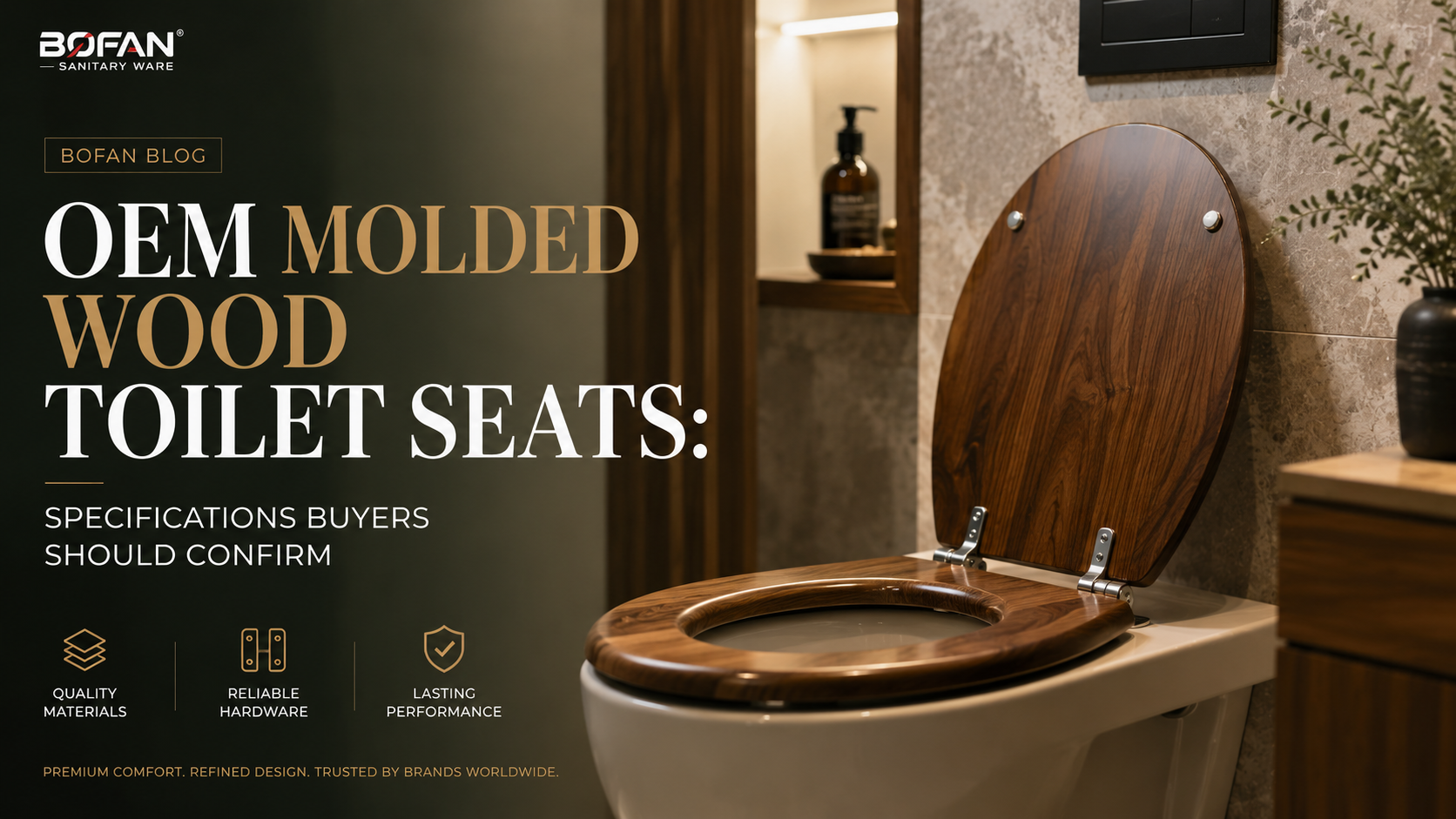
OEM Molded Wood Toilet Seats: Specifications Buyers Should Confirm
Molded wood toilet seats remain an important category for bathroom brands, home-improvement retailers, distributors and private-label programs. They offer a substantial feel, broad decorative possibilities and a familiar premium position in many markets.
However, a molded wood toilet seat should not be purchased using only a photo, shape name and unit price. The product is a complete system: board structure, coating, hinge, fixing kit, buffers, compatibility range, packaging and quality controls all influence the customer experience.
Before approving an OEM molded wood toilet seat program, buyers should confirm the following specifications.
Confirm What “Molded Wood” Means for the Selected Product
“Molded wood” can describe different constructions and finishing approaches. The buyer should ask the supplier to identify the actual product structure and approved material specification.
Confirm:
Board construction and intended product use
Seat and lid thickness
Product weight
Edge profile
Surface finishing process
Gloss, matte or decorative finish
Moisture-resistance approach
Colour reference
Applicable material declarations or supporting documents
Do not assume every wooden-looking toilet seat has the same surface durability, weight or moisture resistance. The approved sample should represent the production material and finish.
Match the Seat to the Intended Ceramic
A seat may look compatible in a catalogue but be unsuitable for the buyer’s ceramic.
Provide or confirm:
Bowl length and width
Mounting-hole spacing
Mounting-hole diameter
Rear platform shape
Top-fix or bottom-fix access
Seat overhang and side alignment
Buffer contact points
Clearance from the cistern or wall
Product shape: round, elongated, D-shape or custom profile
For a sanitary ware brand, use the actual ceramic drawing and, where possible, an installation sample. For replacement or retail programs, clearly define the compatibility range instead of calling every adjustable product “universal.”
Specify the Hinge and Fixing Kit
The hinge system determines how the seat looks, functions and installs.
The specification should identify:
Hinge code
Hinge material and finish
Standard-close or soft-close mechanism
Quick-release requirement
Top-fix or bottom-fix hardware
Bolt, washer, nut or expansion-plug configuration
Adjustment range
Hinge cover
Buffer configuration
Spare-part requirements
A molded wood seat is usually heavier than a basic PP model. The selected hinge and fixing kit should be reviewed for the actual product weight and intended ceramic.
Define Surface-Finish Expectations
The surface is often the first thing a retail customer notices.
The buyer should approve:
Colour or Pantone reference
Gloss level or matte effect
Printed pattern or decorative design
Edge coverage
Paint consistency
Surface smoothness
Visible defects that are not acceptable
Scratch, stain or cleaner-resistance requirements where needed
For printed or decorative collections, approve a physical production-representative sample. Digital artwork alone does not show how a pattern, colour or gloss will appear on the finished product.
Review Soft Close and Quick Release as a System
If the product includes soft close or quick release, test it with the exact molded wood seat and lid configuration.
Check:
Seat-ring closing behaviour
Lid closing behaviour
Smooth movement and final closure
Hinge alignment
Quick-release engagement
Seat stability after refitting
Opening resistance
Noise
Function after repeated operation
The damper and hinge should not be approved separately from the product. Seat weight, hinge geometry, installation and temperature can influence functional performance.
Confirm Packaging Before Bulk Production
Molded wood seats need packaging that protects the finish, hinge and hardware.
Confirm:
Individual retail box, plain box or bulk pack
Internal supports
Surface-protection material
Hardware-bag position
Hinge protection
Carton quantity
Maximum carton weight
Carton dimensions and CBM
Barcode and country-of-origin marking
Private-label artwork
Installation instructions
Outer-carton shipping marks
A loose fixing bag or exposed hinge can scratch a glossy or decorative surface during transit. A packed sample should be inspected before production packaging is approved.
Set Product and Inspection Controls
Before production, the buyer and supplier should agree on the controls that matter to the program.
Typical controls include:
| Control item | Buyer confirmation |
|---|---|
| Product shape | Approved drawing or sample |
| Material and weight | Controlled product specification |
| Finish | Approved colour and surface reference |
| Hinge | Exact hinge and damper code |
| Fixing kit | Exact top-fix or bottom-fix component set |
| Function | Soft-close and quick-release checks |
| Installation | Ceramic-fit and stability check |
| Packaging | Approved artwork and packed sample |
| Batch control | Buyer SKU, factory model and traceability record |
If the supplier proposes a component substitution, the buyer should approve it in writing after reviewing the effects on function, appearance, compatibility and repeat-order continuity.
OEM Molded Wood Toilet Seat Checklist
Before placing a bulk order, confirm:
The material and surface finish are defined.
The product fits the intended ceramic.
The exact hinge and fixing kit are recorded.
Soft close and quick release are tested on the complete seat.
Buffers contact the ceramic correctly.
The colour, gloss and decorative pattern are approved.
Packaging protects the surface and hardware.
Instructions match the supplied fixing kit.
Barcodes and labels are approved.
The production-representative sample is signed off.
Inspection controls are agreed.
Repeat-order specifications and change control are documented.
How BOFAN Supports Molded Wood OEM Programs
BOFAN supports molded wood toilet seat programs with selected shapes, colours, finishes, soft-close options, quick-release options and private-label packaging.
For qualified OEM projects, the team can review ceramic information, product configuration, hinge requirements, packaging and sample plans before bulk production.
CTA: Request a Molded Wood Toilet Seat Catalog
Send BOFAN your target ceramic, required shape, finish, hinge function, expected quantity and packaging format. We can help identify suitable molded wood toilet seat options for your program.
FAQ
Are molded wood toilet seats suitable for private-label programs?
Yes. Suitable options can be developed with controlled product specifications, hinges, packaging and branding. Availability depends on the selected model and order quantity.
Why must the hinge be confirmed for a molded wood seat?
Product weight and structure affect the hinge and damper system. The hinge should be approved with the complete seat, lid and intended fixing kit.
Can a molded wood toilet seat use soft close and quick release?
Suitable models can combine these functions. The exact configuration should be tested and approved on the selected product.
What should a buyer check before approving packaging?
Check product protection, hardware-bag location, hinge protection, carton weight, barcode, instructions, labels and the appearance of a fully packed sample.
Table of Contents
- OEM Molded Wood Toilet Seats: Specifications Buyers Should Confirm
- Confirm What “Molded Wood” Means for the Selected Product
- Match the Seat to the Intended Ceramic
- Specify the Hinge and Fixing Kit
- Define Surface-Finish Expectations
- Review Soft Close and Quick Release as a System
- Confirm Packaging Before Bulk Production
- Set Product and Inspection Controls
- OEM Molded Wood Toilet Seat Checklist
- How BOFAN Supports Molded Wood OEM Programs
- FAQ