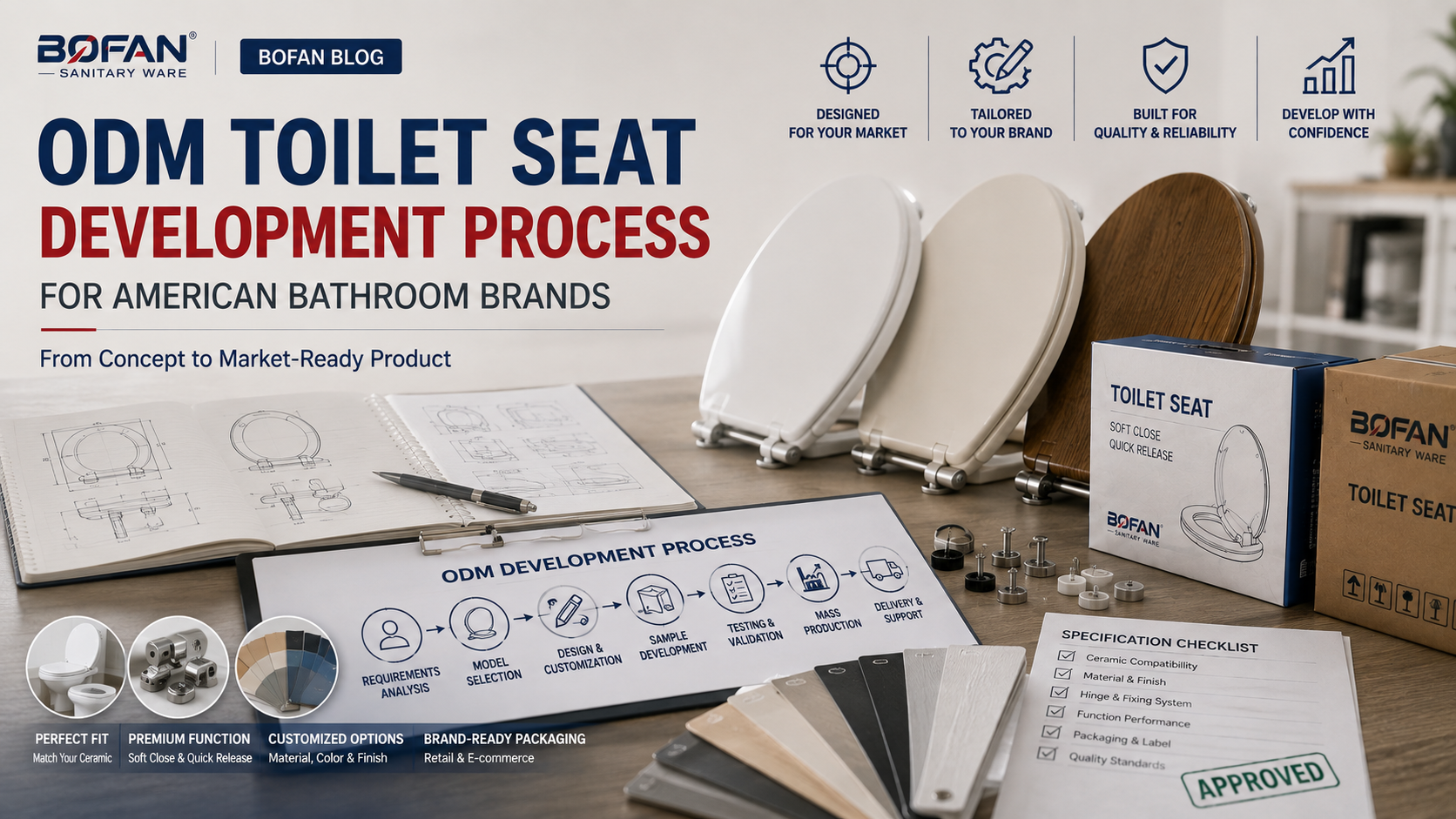
ODM Toilet Seat Development Process for American Bathroom Brands
For an American bathroom brand, an ODM toilet seat project is not simply choosing a model from a supplier catalogue and adding a logo.
A successful program must connect the product to the intended ceramic, market position, installation method, price range, packaging, retail channel and future replenishment plan. The supplier may contribute existing product platforms, materials, hinge options and development experience, but the final result still needs a controlled specification that the brand can approve and repeat.
This guide explains how American bathroom brands can structure an ODM toilet seat development project before placing a bulk order.
What ODM Means in a Toilet Seat Program
ODM means the manufacturer provides an existing or adaptable product platform that can be configured for the buyer’s program.
Depending on the project, the buyer may select or customize:
Product shape and size
PP, UF, MDF or molded-wood material
Soft-close or standard hinge function
Quick-release function
Top-fix or bottom-fix hardware
Hinge finish
Color, gloss or matte finish
Printed or decorative surface
Buffer configuration
Retail packaging
Instructions
Barcode and private-label artwork
ODM is often faster and lower risk than developing a completely new product from the beginning. However, it still requires careful confirmation of compatibility, materials, product details and approved components.
Start With the Ceramic and Customer Use Case
The toilet bowl is part of the product system.
Before selecting an ODM seat, provide as much information as possible about the intended ceramic:
Bowl length and width
Mounting-hole spacing
Mounting-hole diameter
Rear platform shape
Top or underside fixing access
Bowl shape: round, elongated, D-shape or proprietary profile
Clearance to cistern or wall
Product photos with measurements
Technical drawing, if available
Physical ceramic sample or reference model
A toilet seat can look visually suitable but still have poor alignment, inadequate buffer contact or limited adjustment once installed. The factory should review fit before the brand approves a final model.
The customer use case also matters. A residential entry-level range, premium showroom collection, hotel program and home-improvement retail item may require different material, hinge, packaging and price decisions.
Define the Product Position Before Choosing Materials
A brand should decide what role the product will play in its assortment.
For example:
| Product position | Typical development focus |
|---|---|
| Entry-level retail | Competitive cost, simple installation, standard packaging |
| Mid-range bathroom collection | Improved finish, soft close, coordinated ceramic fit |
| Premium range | UF or decorative molded-wood options, refined hinge appearance, retail presentation |
| Project or hospitality supply | Stability, repeatability, spare-parts control and practical packaging |
| E-commerce program | Clear compatibility information, durable packaging and customer-friendly instructions |
PP, UF, MDF and molded wood have different visual, functional and commercial characteristics. Material selection should be based on the target market and product role, not only a comparison of unit prices.
Select the Hinge and Fixing System as Part of the Product
The hinge system affects function, installation experience, appearance and product cost.
Confirm:
Soft-close or standard-close function
Lid-only, seat-only or both-part soft close
Quick-release requirement
Hinge material and finish
Top-fix or bottom-fix installation
Fixing-kit code
Adjustment range
Buffer position
Product stability after installation
Spare-parts requirements
A product should not be approved with an unspecified “metal hinge” or “soft-close hinge.” Record the exact hinge and fixing-kit configuration. This protects repeat orders and prevents unapproved component substitutions later.
Review Existing Models Before Requesting New Tooling
Many ODM projects can begin with an existing product platform.
Ask the supplier:
Which existing models match the ceramic and target price range?
Which materials are available for the selected shape?
Which hinge and fixing options are already compatible?
What modifications are practical?
Is a custom color, print or packaging possible without new tooling?
Does the project require a new mold?
What are the sample, tooling and production lead times?
What MOQ applies to the product, color and packaging?
If a new mold is needed, confirm the tooling scope, ownership, expected sample process and revision procedure before development begins.
Create One Controlled Product Specification
A controlled specification turns an ODM discussion into a repeatable product program.
It should include:
Buyer SKU and product name
Factory model
Ceramic reference
Product dimensions
Material
Product weight where relevant
Hinge and fixing-kit codes
Soft-close and quick-release functions
Color and surface finish
Buffer configuration
Packaging format
Instructions
Barcode and labels
Required test or inspection points
Approved sample reference
Change-control requirement
The purchase order, sample approval and final inspection should all refer to this specification.
Approve a Production-Representative Sample
A sample should represent the actual bulk product as closely as possible.
Check:
Ceramic fit and alignment
Product dimensions
Surface finish
Color accuracy
Seat and lid movement
Soft-close behavior
Quick-release operation
Fixing-kit completeness
Stability after installation
Buffer contact
Hinge appearance
Packaging protection
Instruction-sheet accuracy
For printed, custom-color or decorative products, approve the physical sample rather than relying only on a digital image or Pantone reference.
Develop Packaging Alongside the Product
Private-label packaging should be prepared before bulk production, but not finalized before the product details are stable.
Confirm:
Individual packaging format
Carton quantity and maximum weight
Hardware-bag protection
Product surface protection
Brand artwork
Barcode placement
Country-of-origin mark
Warning labels
Installation instructions
Outer-carton shipping marks
Retail or FBA requirements
The packaging must protect the exact product configuration. A heavier molded-wood model or a quick-release hinge may need different internal protection from a standard PP seat.
Set Clear Quality and Change-Control Rules
Before bulk production, agree on the controls that matter to the brand.
These may include:
Material confirmation
Product dimensions
Hinge and fixing-kit identity
Surface and color checks
Soft-close functional checks
Installation and stability review
Packaging inspection
Batch traceability
Pre-shipment inspection requirement
Approval needed before any component change
If the factory proposes a change to a hinge, damper, fixing kit, buffer, material or packaging component, assess the effect on product performance, compatibility, cost, test evidence and spare-parts continuity before approval.
Plan for Replenishment From the Start
ODM development is not complete when the first order ships.
For future orders, keep records of:
Approved sample
Factory model
Buyer SKU
Hinge and fixing codes
Packaging artwork version
Barcode version
Color reference
Inspection record
Batch information
Spare-part requirements
Any approved changes
This makes repeat orders easier to control and reduces the risk that the next shipment differs from the original approved program.
How BOFAN Supports ODM Toilet Seat Development
BOFAN supports ODM toilet seat programs for bathroom brands, distributors and retail buyers across PP, UF and molded-wood product ranges.
Depending on the selected project, support may include:
Existing-model review
Ceramic compatibility discussion
Material and hinge selection
Soft-close and quick-release options
Sample preparation
Private-label packaging coordination
Product specification control
Production and inspection discussion
Repeat-order change management
Final product compatibility, testing and lead time should be confirmed for the selected model, quantity, packaging and destination.
CTA: Book an ODM Product Development Review
Developing a toilet seat range for your bathroom brand? Send BOFAN your ceramic drawing, product target, material preference, hinge requirements, expected quantity and sales channel. Our team can help identify a suitable ODM development path.
FAQ
What is the difference between ODM and OEM toilet seats?
ODM normally starts from a manufacturer’s existing product platform that can be configured for the buyer. OEM may involve a buyer-controlled design or more specific development requirements. The exact scope should be confirmed in the project agreement.
Can an ODM toilet seat be matched to a specific ceramic?
A supplier can review ceramic drawings, measurements, photos or samples to assess fit. Final compatibility should be confirmed with an installed sample.
Can a bathroom brand add its logo to an ODM toilet seat?
Private-label branding may be possible through packaging, instructions, labels and selected product-decoration options, depending on the model and order quantity.
Do ODM toilet seats require new tooling?
Not always. Existing models may be suitable. New tooling may be needed if the shape, dimensions or structural requirements differ from available platforms.
What should be approved before bulk production?
The brand should approve the product specification, material, hinge and fixing system, finish, sample, packaging artwork, labels, instructions and required inspection controls.
Table of Contents
- ODM Toilet Seat Development Process for American Bathroom Brands
- What ODM Means in a Toilet Seat Program
- Start With the Ceramic and Customer Use Case
- Define the Product Position Before Choosing Materials
- Select the Hinge and Fixing System as Part of the Product
- Review Existing Models Before Requesting New Tooling
- Create One Controlled Product Specification
- Approve a Production-Representative Sample
- Develop Packaging Alongside the Product
- Set Clear Quality and Change-Control Rules
- Plan for Replenishment From the Start
- How BOFAN Supports ODM Toilet Seat Development
- FAQ