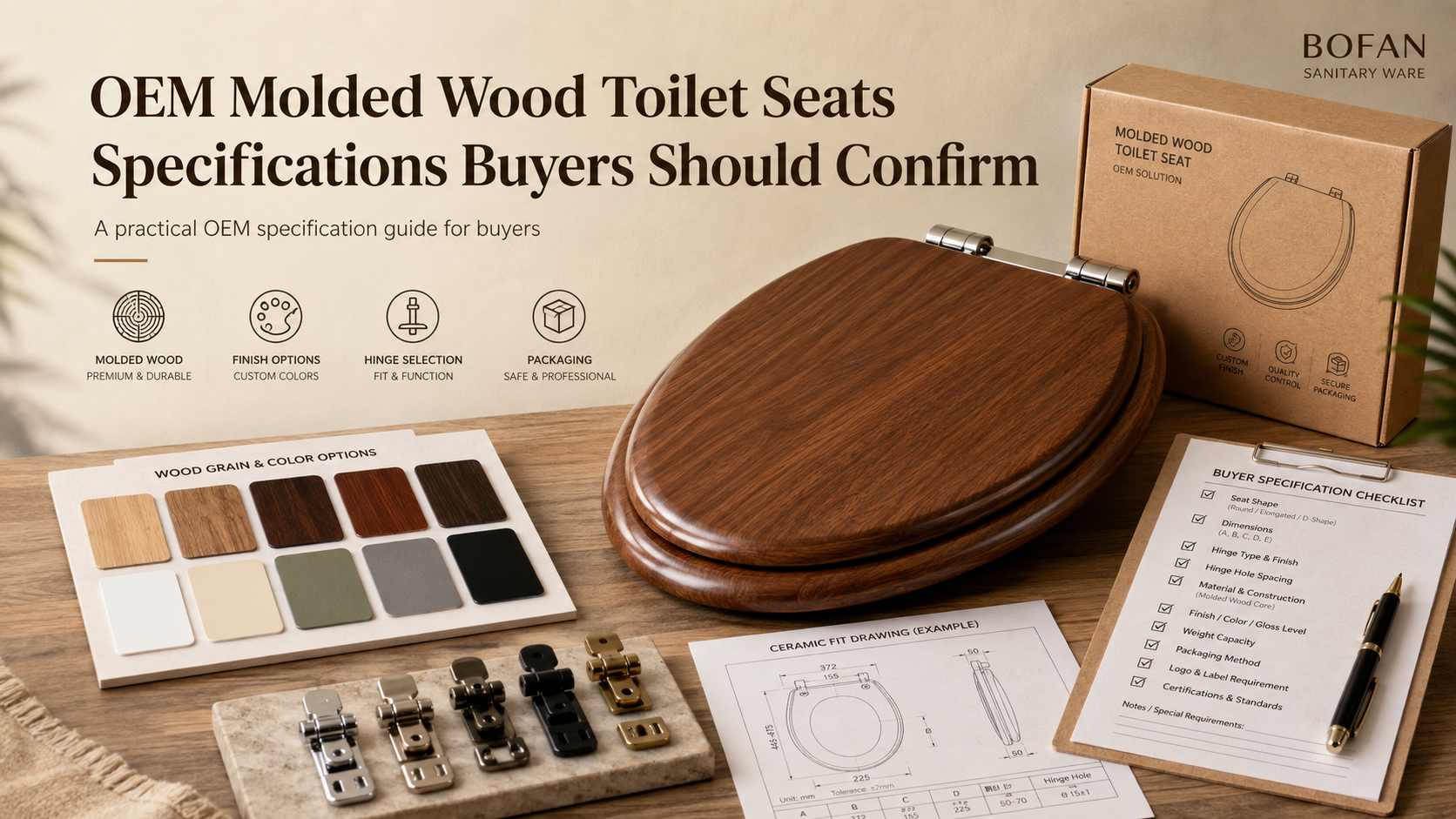
OEM Molded Wood Toilet Seats: Specifications Buyers Should Confirm
Molded wood toilet seats can work well for retail, sanitary ware brands and decorative bathroom collections. However, buyers should not request a quotation based only on a photo or the description “wooden toilet seat.”
For an OEM program, the final product depends on the selected shape, board construction, coating, hinge system, fixing method, packaging and target ceramic. A clear written specification helps prevent a sample from looking right while the production order uses different components or packaging.
Start With the Intended Market and Product Position
The first question is not simply “Which wooden seat is cheapest?” It is: what role will this product play in the buyer’s range?
State the intended:
- Market and sales channel
- Retail, e-commerce, distributor or sanitary ware brand program
- Price tier: entry, core or premium
- Product shape and target toilet range
- Initial order quantity and expected repeat volume
- Required launch date
- Private-label or neutral-packaging requirement
A decorative molded wood seat for a home-improvement retailer may require strong shelf packaging and a broad compatibility range. A seat designed for a ceramic brand may require closer matching to a specific toilet bowl and bathroom collection.
BOFAN’s MDF and wooden toilet seat range can support different material, finish and hinge configurations for OEM programs.
Confirm What “Molded Wood” Means in Your Specification
Buyers often use “wood,” “MDF,” “molded wood” and “wooden toilet seat” interchangeably. These terms should be clarified before approval.
A molded wood toilet seat is generally formed from wood-based material under pressure, then finished with a protective coating. Its performance and appearance depend on the selected structure, finishing process and hardware—not only the material name.
Confirm:
- Seat and lid construction
- Product thickness
- Approximate product weight
- Surface profile and edge shape
- Finish type
- Required color or decorative design
- Whether the seat is intended to look painted, matte, glossy or wood-grain styled
- Required resistance to moisture, stains and everyday cleaning
For a buyer comparing decorative options, molded wood versus solid wood toilet seats is a useful starting point. The final OEM decision should still be based on the approved sample and production specification.
Define the Shape and Ceramic Compatibility
A molded wood product should be approved against its intended toilet bowl. A seat can appear to have the correct outline but still create problems if the mounting-hole spacing, hinge adjustment or buffer contact is unsuitable.
Provide the factory with:
- Toilet brand and model, if available
- Bowl length and width
- Mounting-hole spacing and hole diameter
- Distance from fixing holes to bowl front
- Top-view and underside photographs
- Rear ceramic platform dimensions
- Whether the underside is accessible for installation
- Required seat overhang or coverage expectation
For a new bathroom collection, a technical drawing or actual ceramic sample gives a more reliable approval basis than photos alone.
Specify the Hinge and Fixing System
The hinge affects product experience, installation, durability and price. It should be written into the approved specification rather than left as a generic “soft-close hinge.”
Confirm:
| Specification area | What to define |
|---|---|
| Closing function | Standard close or soft close |
| Release feature | Fixed seat or quick release |
| Installation | Top fix or bottom fix |
| Hinge material | Plastic, zinc alloy, stainless steel or approved alternative |
| Hinge finish | White, chrome, matte black or other approved finish |
| Adjustment range | Required range for intended ceramic |
| Fixing kit | Bolts, nuts, washers, expansion plugs and tools |
| Performance check | Required functional and installed-use checks |
If customers expect easier cleaning, a quick-release toilet seat may be appropriate. If quiet closing is part of the retail proposition, specify a soft-close toilet seat configuration with a confirmed hinge code.
Approve the Surface, Color and Decoration
The surface is one of the most visible elements of a molded wood toilet seat. Color variation, printing, gloss level or coating defects can become retail complaints even when the seat remains functional.
Your approval file should state:
- Color reference or approved physical sample
- Gloss, matte or textured finish
- Printing or decorative artwork
- Logo position and application method
- Acceptable color variation
- Surface-defect standard
- Required product markings
- Cleaning and stain-resistance expectations
For printed collections, approve the artwork, physical sample and packaging together. A screen image alone does not confirm the final color appearance on the finished product.
Confirm Packaging Before Production
A good seat can still arrive damaged, scratched or incomplete if the packaging is not appropriate for the channel.
Specify:
- Neutral box, sleeve, printed box or full retail packaging
- Individual protective materials
- Hardware-bag position
- Installation instruction requirement
- Barcode and product-label placement
- Retailer SKU information
- Master-carton quantity
- Carton dimensions and maximum weight
- Pallet requirement
- Shipping marks
- Parcel-shipping protection, if sold online
For a private-label program, the buyer should provide controlled logo files, barcode information, approved wording and artwork version numbers before final packaging approval.
Use a Production-Representative Approval Sample
A development sample should reflect the same material, coating, hinges, fixings and packaging intended for production.
Before releasing bulk production, check:
- Overall dimensions and shape
- Seat and lid alignment
- Surface finish and color
- Hinge operation
- Soft-close or quick-release function
- Installation on intended ceramic
- Buffer contact and stability
- Fixing-kit completeness
- Packaging condition
- Barcode and instruction accuracy
The buyer’s own acceptance criteria should be recorded in writing. BOFAN’s quality-control process can support product, hinge, surface and packaging review, but the selected project requirements should always be confirmed separately.
OEM Molded Wood Toilet Seat Checklist
Before requesting a final quotation, confirm:
- Target market and sales channel
- Product shape and ceramic-fit information
- Construction, thickness and finish
- Color, printing or decorative requirement
- Hinge and fixing specification
- Soft-close and quick-release requirement
- Packaging and labeling requirement
- Quantity by SKU and color
- Inspection and document expectations
- Trade term, destination and required delivery timing
How BOFAN Supports Molded Wood OEM Programs
BOFAN can help buyers select a molded wood model, review ceramic compatibility, confirm hinge and packaging choices, and establish a production-ready specification before quotation.
For a molded wood OEM proposal, send your target market, product photos or drawings, ceramic information, material preference, required functions, packaging brief and estimated quantity.
FAQ
What is an OEM molded wood toilet seat?
It is a molded wood seat supplied according to an agreed buyer specification, which may include shape, finish, hinge, branding, packaging and quality requirements.
Can molded wood toilet seats use soft-close hinges?
Yes, if the selected seat structure and hinge system are compatible. The hinge code and performance requirement should be approved before production.
Can I add my logo to a molded wood toilet seat?
Yes. Logo placement, application method, artwork and packaging requirements should be confirmed in the approved OEM specification.
Is molded wood suitable for retail packaging?
Yes, provided the product is protected correctly and the packaging is designed for the intended shipping and retail channel.
What should I provide for a quotation?
Provide the target market, seat shape, material preference, ceramic dimensions if available, hinge requirement, packaging requirement, quantity and delivery destination.
Table of Contents
- OEM Molded Wood Toilet Seats: Specifications Buyers Should Confirm
- Start With the Intended Market and Product Position
- Confirm What “Molded Wood” Means in Your Specification
- Define the Shape and Ceramic Compatibility
- Specify the Hinge and Fixing System
- Approve the Surface, Color and Decoration
- Confirm Packaging Before Production
- Use a Production-Representative Approval Sample
- OEM Molded Wood Toilet Seat Checklist
- How BOFAN Supports Molded Wood OEM Programs
- FAQ