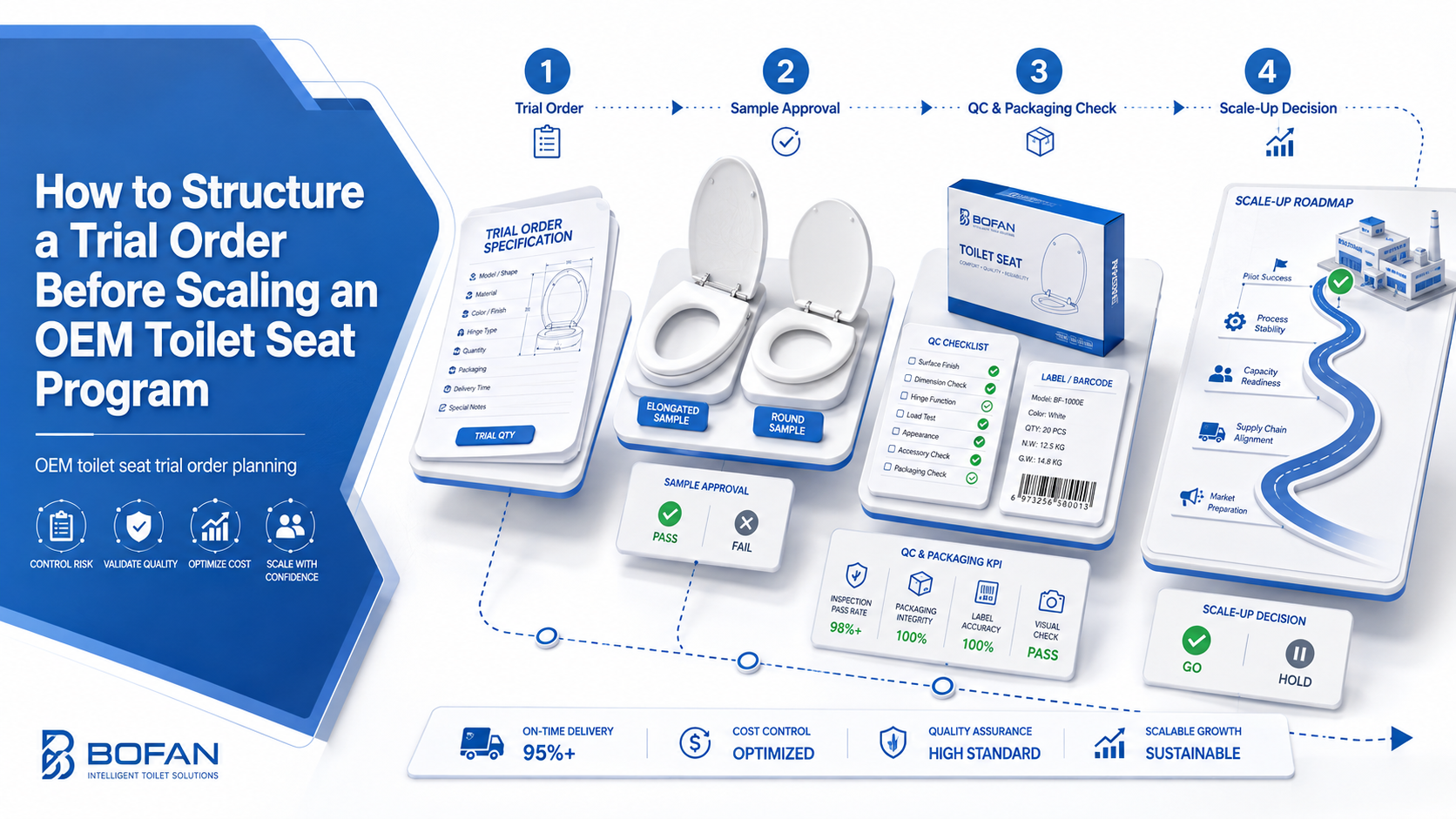
A trial order should validate the right commercial and operational questions before a buyer commits to a wider OEM toilet seat program. It is not simply a smaller version of a full order.
A well-structured trial checks product-market fit, ceramic compatibility, hinge performance, packaging, inspection, shipping condition and reorder feasibility. The best first order uses a controlled number of SKUs and clear pass-or-fail criteria.
Define What the Trial Must Prove
Before selecting a quantity, define the decision the trial will support.
Common trial objectives include:
-
Testing a new material or product tier
-
Verifying ceramic fit
-
Confirming retail packaging
-
Testing consumer response
-
Qualifying a new supplier
-
Validating an e-commerce product
-
Checking a mixed-SKU assortment
-
Confirming lead time and delivery execution
-
Establishing a repeat-order specification
A trial order should not attempt to test every product, color, hinge and package at once. That usually produces fragmented inventory and unclear conclusions.
Use a Focused SKU Structure
For most new OEM programs, start with a limited assortment that represents the target market.
A practical trial may include:
-
One core shape
-
One or two proven colors
-
One agreed hinge system
-
One packaging format
-
One price tier
-
One clear customer or channel target
For example, a distributor may test one elongated soft-close UF SKU and one round PP SKU. A retailer may test one value product and one premium product using a consistent packaging structure.
Each SKU should have a defined role. Avoid adding options only because they are available.
Confirm the Production Basis Before Ordering
A trial order must still be production-controlled. Confirm:
-
Factory model number
-
Material
-
Dimensions
-
Product weight where relevant
-
Color and finish
-
Hinge code
-
Fixing kit
-
Packaging version
-
Barcode and label content
-
Master-carton quantity
-
Carton dimensions and weight
-
Inspection standard
-
Required documents
-
Trade term
-
Delivery destination
An attractive development sample is not enough if it does not represent the production components, hinge and packaging used for the trial order.
Approve Product, Packaging and Installation Samples
The approval stage should record exactly what is approved.
The buyer should review:
-
Product appearance
-
Seat and lid alignment
-
Surface finish
-
Color
-
Hinge movement
-
Soft-close function
-
Quick-release operation
-
Fixing completeness
-
Installation on intended ceramic
-
Retail packaging
-
Instructions
-
Barcode placement
-
Shipping-mark content
Where possible, test the product on the actual ceramic or within the intended compatibility range. For retail and e-commerce programs, approve a packed sample—not only product photos or artwork files.
Set Measurable Trial KPIs
A trial order should have a review framework before production begins.
| Trial area | Example review question |
|---|---|
| Product fit | Does the seat install correctly on the intended bowl? |
| Hinge performance | Does soft close operate consistently after installation? |
| Packaging | Does the product arrive without damage or hardware loss? |
| Retail execution | Are barcode, labels and instructions correct? |
| Quality | Does inspection match the approved sample and checklist? |
| Supply execution | Was production and shipment completed as agreed? |
| Commercial response | Does the selected SKU meet the expected price and demand level? |
| Reorder readiness | Are records ready for repeat production? |
The exact KPI should match the program. A retailer may focus on sell-through and packaging compliance, while a sanitary ware brand may prioritize ceramic fit and collection appearance.
Keep Quality Control Proportional but Clear
A trial order should have defined quality control even when the quantity is limited.
Confirm:
-
Inspection stage
-
Sample size or AQL approach
-
Critical, major and minor defects
-
Surface standard
-
Functional checks
-
Packaging checks
-
Reporting format
-
Third-party inspection responsibility
-
Shipment-release authority
BOFAN’s production process includes product, hinge, surface and packaging checks. The buyer should still state its own acceptance requirements for the selected configuration.
Plan the Commercial Terms for Scale-Up
A trial order should not create uncertainty about what happens if it succeeds.
Before placing the order, discuss:
-
MOQ for the trial and repeat order
-
MOQ by model, color and packaging version
-
Whether packaging can be reused
-
Artwork ownership and change-control process
-
Sample-credit policy, if applicable
-
Lead time for repeat production
-
Price validity
-
Forecast expectations
-
Capacity reservation, if needed
-
Payment terms
-
Tooling status where relevant
The goal is not to force a long-term commitment before testing. It is to ensure that the buyer understands the commercial conditions of the next decision.
Avoid Common Trial-Order Mistakes
Common mistakes include:
-
Testing too many SKUs at once
-
Changing the product after approving packaging
-
Approving a handmade sample without confirming production equivalence
-
Skipping ceramic-fit verification
-
Using unapproved artwork
-
Ordering an impractical quantity for every SKU
-
Leaving barcode information until the end
-
Defining quality only as “high quality”
-
Comparing supplier pricing under different trade terms
-
Treating trial results as conclusive without agreed KPIs
A smaller order is not automatically lower risk if the product specification remains undefined.
[Image 3 — good vs poor trial plan]
Brief: Side-by-side comparison of a focused two-SKU OEM trial with clear KPIs versus an overloaded multi-SKU trial with unclear requirements.
Alt text: Focused OEM toilet seat trial order structure.
Recommended Trial-to-Scale Workflow
-
Define the market, channel and trial objective.
-
Select a focused SKU range.
-
Confirm product, hinge, ceramic fit and packaging.
-
Approve production-representative samples.
-
Set inspection and delivery requirements.
-
Place the trial order with written specifications.
-
Review product, packaging, shipment and market feedback.
-
Record corrections.
-
Decide whether to reorder, revise or stop.
-
Lock the repeat-order specification before scaling.
How BOFAN Supports OEM Trial Orders
BOFAN can help buyers structure an initial program around existing PP, UF or molded-wood models, selected hinge systems, controlled packaging and planned repeat-order conditions.
For a trial-order discussion, submit:
-
Target market and channel
-
Intended ceramic or seat shape
-
Material preference
-
Hinge requirements
-
Estimated quantity
-
Packaging requirement
-
Required delivery timing
-
Quality and document expectations
-
Expected scale-up volume
This allows BOFAN to recommend a trial structure that is commercially realistic and technically controlled.
FAQ
What is an OEM toilet seat trial order?
It is a controlled first order used to validate product fit, quality, packaging, delivery and commercial suitability before a wider program is launched.
How many SKUs should a first trial order include?
Use the fewest SKUs needed to test the commercial assumption. One to three focused SKUs is usually easier to evaluate than a fragmented range.
Should a trial order use custom packaging?
It can, especially when retail presentation is central to the test. However, the buyer should first confirm packaging MOQ, artwork approval, barcode data and repeat-order conditions.
Can a trial order use existing factory models?
Yes. Existing models can reduce development complexity and help buyers test demand before investing in deeper customization or new tooling.
What should happen after a successful trial order?
The buyer and factory should review trial KPIs, record any corrections, confirm repeat-order MOQ and lead time, then lock the approved production specification before scaling.
Table of Contents
- Define What the Trial Must Prove
- Use a Focused SKU Structure
- Confirm the Production Basis Before Ordering
- Approve Product, Packaging and Installation Samples
- Set Measurable Trial KPIs
- Keep Quality Control Proportional but Clear
- Plan the Commercial Terms for Scale-Up
- Avoid Common Trial-Order Mistakes
- Recommended Trial-to-Scale Workflow
- How BOFAN Supports OEM Trial Orders
- FAQ