MDF or PP Toilet Seats for Residential Projects? A Practical Buyer’s Guide
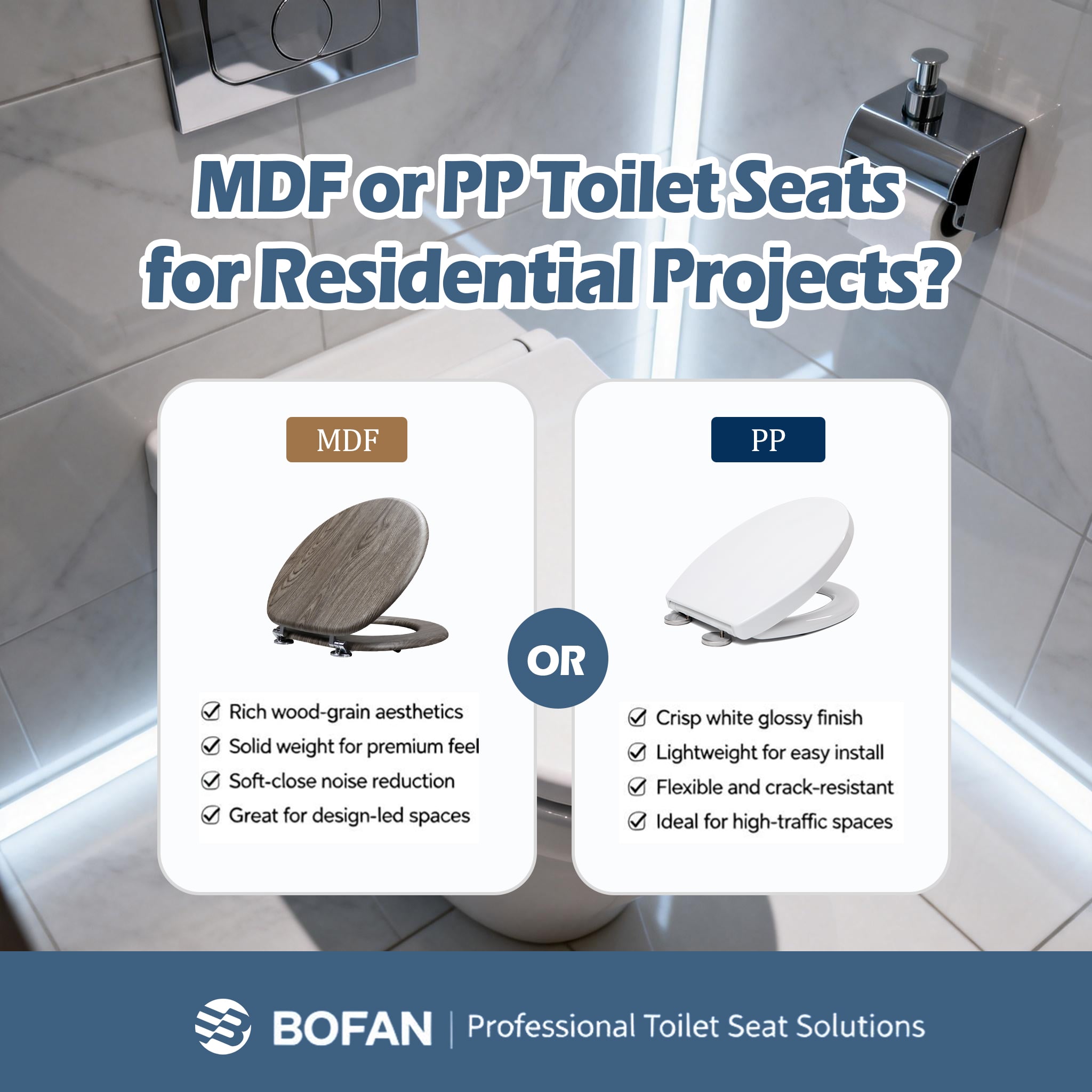
Choosing between an MDF or PP toilet seat for a residential project depends on the building type, bathroom environment, maintenance plan, target price level, and expected resident experience. MDF toilet seats are often selected when a project needs a heavier feel, decorative finish, and more premium bathroom presentation. PP toilet seats are usually the more practical option when moisture resistance, easy cleaning, lightweight handling, and cost control matter most. For many developers, the best decision is not to use one material everywhere, but to match the specification to the apartment tier and operating model.
For a general material comparison, read BOFAN’s MDF vs Plastic Toilet Seat Comparison Guide.
What Is the Difference Between an MDF and a PP Toilet Seat?
An MDF toilet seat is made from engineered wood fibre material that is molded and finished with a protective surface layer. It is commonly used for painted, printed, wood-effect, or decorative toilet seat designs. Its heavier weight often creates a more solid and substantial user impression.
A PP toilet seat is made from polypropylene, a practical plastic material widely used in residential, rental, and volume-based toilet seat programs. PP is lightweight, moisture-resistant, and easy to maintain in daily bathroom use.
The material difference affects more than appearance. It influences cleaning requirements, transportation, installation, replacement planning, price positioning, and the long-term suitability of the product for a specific residential project.
MDF vs PP Toilet Seat: Quick Comparison for Project Buyers
| Selection factor | MDF Toilet Seat | PP Toilet Seat |
|---|---|---|
| Overall impression | Heavier, more substantial, decorative | Clean, lightweight, practical |
| Surface options | Painted, printed, wood-effect, veneer-style | Standard colors, gloss or matte plastic finishes |
| Moisture resistance | Depends on coating and edge sealing quality | Strong resistance to moisture |
| Daily maintenance | Requires correct surface care | Easy to clean and maintain |
| Unit-cost positioning | Mid-range to premium | Budget to mid-range |
| Installation handling | Heavier to transport and install | Lightweight and easy to handle |
| Best fit | Renovation and design-led residential projects | Rental, volume housing, humid-area projects |
| Replacement management | Better for chosen premium units | Efficient for standardized maintenance programs |
The correct choice should be based on the total project cost, not only the factory price. A lower-priced product may still create higher costs later if it does not suit the bathroom environment or maintenance process.
When Is an MDF Toilet Seat a Better Choice for Residential Projects?
MDF toilet seats are often selected when the bathroom design is part of the property’s value proposition. In owner-occupied apartments, renovation projects, and mid-range residential developments, residents may notice the visual and tactile difference between a heavier MDF seat and a standard plastic seat.
MDF Works Well for Design-Led Bathroom Packages
Developers commonly use material upgrades to distinguish standard units from upgraded units. An MDF toilet seat can support this positioning because it offers more possibilities for decorative finishes and a warmer, more substantial look.
For example, a renovation project with coordinated wood-look flooring, vanity units, and bathroom accessories may choose a painted white, oak-effect, or printed MDF toilet seat to keep the visual language consistent.
MDF Can Improve Perceived Product Value
A toilet seat is a small item, but it is touched every day. A heavier seat can make the bathroom feel more finished and less basic. This does not mean MDF is automatically necessary for every project, but it can support a more premium resident experience where appearance and finish are important.
MDF Requires the Right Bathroom Conditions
MDF should be specified carefully for bathrooms with persistent humidity, weak ventilation, or poor cleaning control. A quality surface finish and reliable edge protection are important because the performance of an MDF toilet seat depends on how well its protective finish remains intact over time.
MDF is usually a suitable option for:
- Owner-occupied apartments
- Residential renovation programs
- Mid-range and upper-mid-range housing
- Model apartments and show units
- Decorative retail or private-label product ranges
- Bathrooms with normal ventilation and controlled maintenance
For available decorative and project-oriented options, see MDF and Wooden Toilet Seats.
When Is a PP Toilet Seat a Better Choice for Residential Projects?
PP toilet seats are often the most efficient choice for large apartment programs because they balance practical performance, maintenance simplicity, and cost control.
They are particularly useful when a developer, property manager, or distributor needs a standardized toilet seat specification that can be installed across many units and replaced easily when required.
PP Is Well Suited to Rental Housing
Rental apartments are managed differently from owner-occupied homes. Property managers normally prioritize straightforward cleaning, easy replacement, consistent stock availability, and a practical price point.
A PP toilet seat is lightweight and easy for maintenance teams to handle. It can be used as a standardized replacement item across many bathrooms, helping reduce the complexity of holding multiple spare parts.
PP Performs Well in Humid Bathroom Environments
Bathrooms with regular steam, water splashing, or high ambient humidity require careful material selection. PP does not rely on a coated wood-based core, so it is generally a safer option where moisture exposure is a major concern.
This is especially relevant for:
- Coastal residential developments
- Student accommodation
- Compact apartments with limited ventilation
- Rental housing with frequent tenant turnover
- Entry-level multi-unit housing
- Bathrooms used by families or children
PP Supports Cost-Controlled Standardization
For developers working with fixed construction budgets, PP toilet seats offer a practical route to keep specifications consistent without sacrificing basic usability.
The key is to avoid treating all PP seats as identical. Buyers should still specify shape, hinge type, fixing system, seat thickness, surface finish, packaging, and target market dimensions. A well-specified PP toilet seat can be a reliable residential product rather than simply a low-cost alternative.
Explore BOFAN’s PP Toilet Seats for standard, soft-close, quick-release, round, and elongated project options.
Which Material Is Better for Multi-Unit Housing?
For multi-unit housing, the answer depends on the project’s operating model.
If the project is a rental apartment program, affordable housing development, student accommodation, or high-volume residential build, PP is usually the more practical starting point. It is easier to maintain, easier to replace, and more suitable for moisture-sensitive environments.
If the project is an owner-occupied apartment building, a residential renovation, or a development with a more premium interior standard, MDF may be appropriate for selected units or upgraded bathroom packages.
A useful specification strategy is to create two product tiers:
| Project tier | Suggested solution | Typical buyer priority |
|---|---|---|
| Standard residential units | PP toilet seat with reliable standard or soft-close hinge | Cost control, moisture resistance, maintenance |
| Upgraded residential units | MDF toilet seat with decorative finish and soft-close hinge | Appearance, feel, resident perception |
| Rental replacement program | Standardized PP seat with compatible fixing system | Fast replacement and inventory control |
| Renovation collection | MDF or selected PP finish matched to bathroom style | Visual consistency and retail appeal |
This approach gives developers flexibility without creating an unnecessarily complex purchasing system.
Why Hinge and Installation Specifications Matter as Much as Material
Material selection is only one part of the decision. A poorly matched hinge or fixing system can cause more complaints than the seat material itself.
Before placing a project order, buyers should confirm:
- Round or elongated toilet bowl shape
- Toilet bowl length, width, and hinge-center distance
- Top-fix or bottom-fix installation requirement
- Standard, soft-close, or quick-release hinge
- Hinge material and durability expectations
- Required seat thickness and load expectation
- Packaging format for project delivery
- Replacement-SKU requirements for future maintenance
Soft-close hinges can improve the residential experience by reducing noise from slamming. Quick-release designs can also support easier cleaning, especially for rental properties and managed apartments.
For high-volume projects, the supplier should document the chosen specification clearly. This helps ensure that future repeat orders and replacement orders match the original installation.
How Should Developers Build a Standard Toilet Seat Specification?
A strong residential toilet seat specification should be simple enough to manage but detailed enough to avoid installation mistakes.
Start by separating the project into categories: standard units, upgraded units, accessible units if relevant, and replacement stock. Then select one approved specification for each category.
For example:
- Standard apartment unit: white PP seat, soft-close hinge, standard packaging.
- Premium apartment unit: painted MDF seat, soft-close hinge, upgraded finish.
- Rental maintenance stock: white PP seat, standard shape, replacement-friendly fixing.
- Show unit or renovation package: decorative MDF seat coordinated with bathroom finishes.
This system helps the developer control cost while ensuring the building does not look inconsistent from one apartment to another.
What Should Buyers Ask Before Requesting a Quotation?
To receive an accurate quotation and product recommendation, buyers should share more than the desired material.
A useful inquiry should include:
- Target country or market
- Project type: rental, owner-occupied, renovation, student housing, or apartment development
- Required quantity and delivery timing
- Toilet bowl drawings, photos, or key dimensions
- Preferred material: MDF, PP, or both
- Hinge requirement: standard, soft-close, quick-release, or adjustable
- Installation method: top-fix or bottom-fix
- Color, finish, logo, and packaging requirements
- Whether repeat orders or replacement supply will be needed
The more clearly these factors are defined at the start, the easier it is to avoid mismatched products and unexpected installation issues later.
BOFAN Toilet Seat Solutions for Apartments and Residential Projects
BOFAN supplies MDF, PP, UF, soft-close, quick-release, round, and elongated toilet seat options for OEM, wholesale, and project buyers. For residential programs, the focus is not simply on supplying a toilet seat, but on helping buyers select a configuration that fits their property type, budget level, maintenance model, and market requirements.
For apartment and residential projects, BOFAN can support product selection, material options, hinge configuration, market-specific dimensions, OEM branding, packaging, and coordinated supply planning.
Learn more about BOFAN’s Apartments & Residential Projects solutions.
Conclusion: MDF or PP Toilet Seat for Residential Projects?
MDF and PP toilet seats both have a clear place in residential projects.
Choose MDF when the project needs a more decorative finish, a heavier user feel, and a more premium bathroom presentation. Choose PP when the priority is moisture resistance, practical maintenance, standardized replacement, and cost efficiency.
For many apartment developers, the strongest approach is to use PP as the core standard solution and MDF for upgraded units, renovation packages, or design-led residential projects.
If you are sourcing toilet seats for an apartment development, share your project type, target market, required quantity, toilet dimensions, and preferred price level. BOFAN can recommend a suitable MDF or PP toilet seat configuration for your project.
FAQ
Is MDF or PP better for apartment toilet seats?
Neither material is universally better. MDF is often chosen for a heavier feel and more decorative finish, while PP is usually preferred for moisture resistance, easy cleaning, and cost-controlled apartment programs. The right option depends on the property type, bathroom environment, and maintenance plan.
Which toilet seat material is best for rental apartments?
PP toilet seats are usually a practical choice for rental apartments because they are lightweight, moisture-resistant, and easy to replace. Rental property managers can standardize one PP model across multiple units to simplify cleaning, maintenance, and spare-stock management.
Can MDF toilet seats be used in residential bathrooms?
Yes. A well-manufactured MDF toilet seat can be suitable for normal residential bathrooms, especially where appearance and a more premium finish are important. Buyers should confirm the surface coating and edge protection when the bathroom has high humidity or weak ventilation.
Are PP toilet seats suitable for multi-unit housing projects?
Yes. PP toilet seats are commonly suitable for multi-unit housing because they support standardized specifications, efficient installation, and practical maintenance. Buyers should still confirm bowl shape, hinge spacing, fixing method, and required hinge function before ordering.
Should apartment developers choose soft-close hinges?
Soft-close hinges can be a useful upgrade for residential projects because they reduce slamming noise and improve the daily user experience. Whether they are necessary depends on the project’s price positioning, resident expectations, and maintenance budget.
What information does a toilet seat supplier need for a residential project quotation?
A supplier normally needs the target market, project quantity, toilet bowl dimensions or photos, required material, hinge type, fixing method, packaging needs, and requested delivery timing. These details help the supplier recommend a compatible toilet seat and prepare an accurate quotation.
Can one residential project use both MDF and PP toilet seats?
Yes. Developers can use PP toilet seats for standard or rental units and MDF toilet seats for upgraded apartments, show units, or renovation packages. Using two defined product tiers can help balance budget control with a differentiated bathroom finish.
Table of Contents
- MDF or PP Toilet Seats for Residential Projects? A Practical Buyer’s Guide
- What Is the Difference Between an MDF and a PP Toilet Seat?
- MDF vs PP Toilet Seat: Quick Comparison for Project Buyers
- When Is an MDF Toilet Seat a Better Choice for Residential Projects?
- When Is a PP Toilet Seat a Better Choice for Residential Projects?
- Which Material Is Better for Multi-Unit Housing?
- Why Hinge and Installation Specifications Matter as Much as Material
- How Should Developers Build a Standard Toilet Seat Specification?
- What Should Buyers Ask Before Requesting a Quotation?
- BOFAN Toilet Seat Solutions for Apartments and Residential Projects
- Conclusion: MDF or PP Toilet Seat for Residential Projects?
-
FAQ
- Is MDF or PP better for apartment toilet seats?
- Which toilet seat material is best for rental apartments?
- Can MDF toilet seats be used in residential bathrooms?
- Are PP toilet seats suitable for multi-unit housing projects?
- Should apartment developers choose soft-close hinges?
- What information does a toilet seat supplier need for a residential project quotation?
- Can one residential project use both MDF and PP toilet seats?