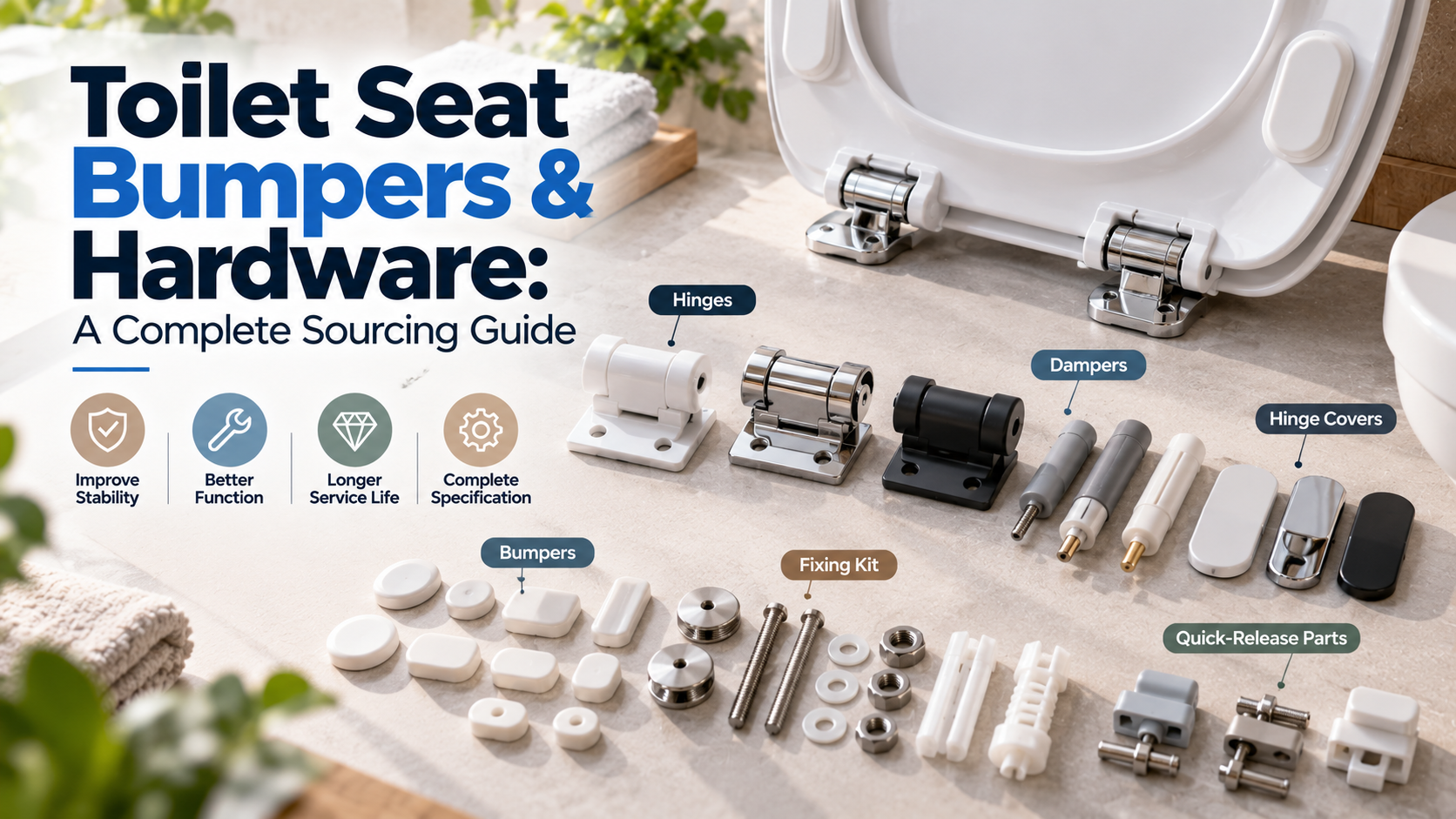
Toilet Seat Bumpers & Hardware: A Complete Sourcing Guide
A toilet seat is not defined only by its material, shape and color. Its bumpers, hinges, fixing kit and other small components determine how the product fits the ceramic, how stable it feels after installation and how reliably it performs over time.
For OEM brands, distributors and private-label buyers, these details should be specified before a sample is approved. A seat may look correct in a catalogue photo but still move sideways, sit unevenly, close poorly or create repeat-order problems if the hardware configuration is unclear.
This guide explains what buyers should review when sourcing toilet seat hardware and bumpers.
Why Toilet Seat Hardware Matters
Hardware is the connection between the toilet seat and the ceramic bowl. It affects:
Installation method
Compatibility with the mounting holes
Adjustment range
Seat alignment
Stability during use
Soft-close performance
Quick-release operation
Appearance of the finished installation
Availability of replacement parts
Repeat-order consistency
Common customer complaints often relate to hardware rather than the seat material itself:
“The toilet seat keeps moving.”
“The lid is not aligned with the bowl.”
“The fixing bolts are too short.”
“The soft-close action is uneven.”
“One bumper is not touching the ceramic.”
“The quick-release button is difficult to use.”
A buyer should therefore treat the hinge, fixing kit and bumper layout as part of the complete product specification.
Main Toilet Seat Hardware Components
| Component | Main function | What buyers should confirm |
|---|---|---|
| Hinge | Connects seat and lid to the ceramic | Material, finish, opening range and configuration |
| Damper | Controls soft-close motion | Function, cycle expectation and replacement policy |
| Fixing kit | Secures the hinge to the toilet bowl | Top-fix or bottom-fix method, bolt size and adjustment range |
| Bumpers | Support the seat and lid against the ceramic | Quantity, position, material and contact points |
| Hinge cover | Covers visible hinge components | Color, finish, fit and branding requirement |
| Bolts and nuts | Fasten the seat to the bowl | Material, thread size and corrosion resistance |
| Expansion plugs | Provide top-fix anchoring in mounting holes | Hole-size compatibility and holding performance |
| Quick-release mechanism | Allows seat removal for cleaning | Locking security and ease of use |
The exact configuration should be recorded by product code, not described only as “metal hinge” or “standard fixing.”
What Are Toilet Seat Bumpers?
Toilet seat bumpers are the small pads or buffers that contact the ceramic bowl when the seat or lid is lowered. They may be made from rubber, EVA, PVC, silicone-like materials or another approved compound.
Their purpose is to:
Keep the seat and lid from contacting the ceramic directly
Reduce noise during closing
Help distribute the load across the bowl
Reduce movement after installation
Protect the surface of the ceramic
Maintain a controlled gap between the seat and bowl
Bumpers are especially important on products with soft-close hinges, because a correct closing motion does not guarantee correct support after the seat reaches the bowl.
Bumper Position Is Not a Minor Detail
A product may have enough bumpers but still perform poorly if their placement does not match the ceramic shape.
Before approving a sample, check:
Does every intended bumper touch the ceramic?
Are the contact points balanced on the left and right sides?
Is the seat supported at the front and rear as intended?
Does the lid sit correctly when closed?
Do the bumpers remain attached after repeated use and cleaning?
Do bumper colors match the product where they are visible?
Does a bumper interfere with a raised ceramic ridge or bowl contour?
The seat should be tested on the intended ceramic, or on a representative fixture with the same key dimensions. A bumper layout suitable for one elongated bowl may not be suitable for another bowl with a different rear platform or internal contour.
Hinge Types for Toilet Seats
The hinge is one of the most important parts of the product system.
Typical options include:
Standard-close hinges
Soft-close hinges
Quick-release soft-close hinges
Plastic hinges
Zinc-alloy hinges
Stainless-steel hinges
Adjustable metal hinges
Concealed or decorative hinge-cover systems
A buyer should confirm whether the soft-close function applies to:
The lid only
The seat ring only
Both the seat ring and lid
This distinction affects user experience, price and replacement-part requirements.
Top-Fix vs Bottom-Fix Toilet Seat Hardware
| Installation method | How it is installed | Suitable situation | Buyer checks |
|---|---|---|---|
| Top-fix | Installed from above the ceramic | Toilets with no access underneath | Hole diameter, plug type and tightening method |
| Bottom-fix | Bolt passes through the hole and is secured below | Toilets with underside access | Bolt length, nut type and hand-clearance requirement |
Top-fix systems are often selected where the underside of the ceramic is inaccessible. Bottom-fix systems can be practical for traditional installations with open access under the mounting holes.
Neither option is automatically better. The correct choice depends on the toilet bowl, installer expectations and target market.
Hinge Material and Finish
Hinge material affects appearance, cost and durability expectations.
Buyers may consider:
Plastic for cost-sensitive standard products
Zinc alloy for decorative and mid-range programs
Stainless steel for selected moisture-sensitive or commercial applications
Coated metal for a coordinated visual finish
Confirm the exact visible finish, such as chrome color, brushed appearance, black coating or color-matched hinge cover. Also confirm whether the hinge body, cover, bolts and fixing components use the same finish standard.
For private-label programs, a polished hinge cover and a basic internal fixing kit may be acceptable, but the complete visible appearance should be approved on the production-representative sample.
Soft-Close and Quick-Release Hardware
Soft-close and quick-release functions add convenience, but they also create more components to control.
For soft-close products, confirm:
Closing movement for both seat and lid
Whether the product closes fully under normal use
Hinge alignment after repeated opening and closing
Whether left and right dampers perform consistently
Whether the damper or hinge can be replaced if required
For quick-release products, check:
Whether the seat locks securely after reinstallation
Whether release buttons are accessible
Whether the user can remove the seat without tools
Whether removal creates an unexpected risk of misalignment
Whether the cleaning feature is explained in the instruction sheet
How to Specify Toilet Seat Hardware in an RFQ
A sourcing request should include more than “soft-close hinge included.”
Record:
Factory model and buyer SKU
Product material and shape
Hinge code
Hinge material and visible finish
Soft-close scope
Quick-release requirement
Top-fix or bottom-fix method
Fixing-kit code
Mounting-hole range
Bolt and plug specification
Bumper quantity and position
Bumper material and color
Required spare parts
Approved sample reference
Change-control requirement
This makes it easier to compare quotations and prevents unapproved substitutions during repeat production.
Hardware and Bumper Checks Before Bulk Production
Before bulk production, inspect the complete installed unit.
Check:
Seat and lid align correctly with the ceramic.
The fixing kit matches the approved installation method.
The hinge and cover match the approved code and finish.
All bumpers are present and attached securely.
Bumpers contact the ceramic as intended.
The seat remains stable after tightening.
Soft-close and quick-release functions work correctly.
Instructions match the supplied hardware.
Spare parts are identified where required.
Any approved hardware change is documented.
How BOFAN Supports Toilet Seat Hardware Selection
BOFAN supports toilet seat projects across PP, UF and molded-wood product ranges. Depending on the selected model, the team can discuss hinge options, top-fix and bottom-fix systems, bumper layouts, soft-close functions, quick-release features, packaging and sample approval.
Final hardware suitability should be confirmed against the selected ceramic, product model and installation method.
CTA: Request a Toilet Seat Hardware Review
Planning a toilet seat program? Send BOFAN your ceramic drawing, product shape, material, hinge requirement, fixing method and expected quantity. We can help review a suitable hardware and bumper configuration for sample approval.
FAQ
What are toilet seat bumpers for?
Bumpers support the seat and lid against the ceramic, reduce direct contact, help improve stability and protect the bowl surface.
Can bumpers be changed after sample approval?
They can be changed only through controlled review. A change in bumper size, material or position can affect seat height, ceramic contact and stability.
What is the difference between top-fix and bottom-fix toilet seat hardware?
Top-fix hardware is installed from above the toilet bowl. Bottom-fix hardware uses bolts and nuts secured from underneath the mounting holes.
Why should buyers record the hinge code?
The hinge code identifies the approved configuration for repeat orders and helps prevent a visually similar but functionally different substitute.
What should a toilet seat hardware specification include?
It should include hinge type, fixing method, fixing-kit code, adjustment range, bumper layout, material, finish, soft-close or quick-release function and approved sample reference.
Table of Contents
- Toilet Seat Bumpers & Hardware: A Complete Sourcing Guide
- Why Toilet Seat Hardware Matters
- Main Toilet Seat Hardware Components
- What Are Toilet Seat Bumpers?
- Bumper Position Is Not a Minor Detail
- Hinge Types for Toilet Seats
- Top-Fix vs Bottom-Fix Toilet Seat Hardware
- Hinge Material and Finish
- Soft-Close and Quick-Release Hardware
- How to Specify Toilet Seat Hardware in an RFQ
- Hardware and Bumper Checks Before Bulk Production
- How BOFAN Supports Toilet Seat Hardware Selection
- FAQ