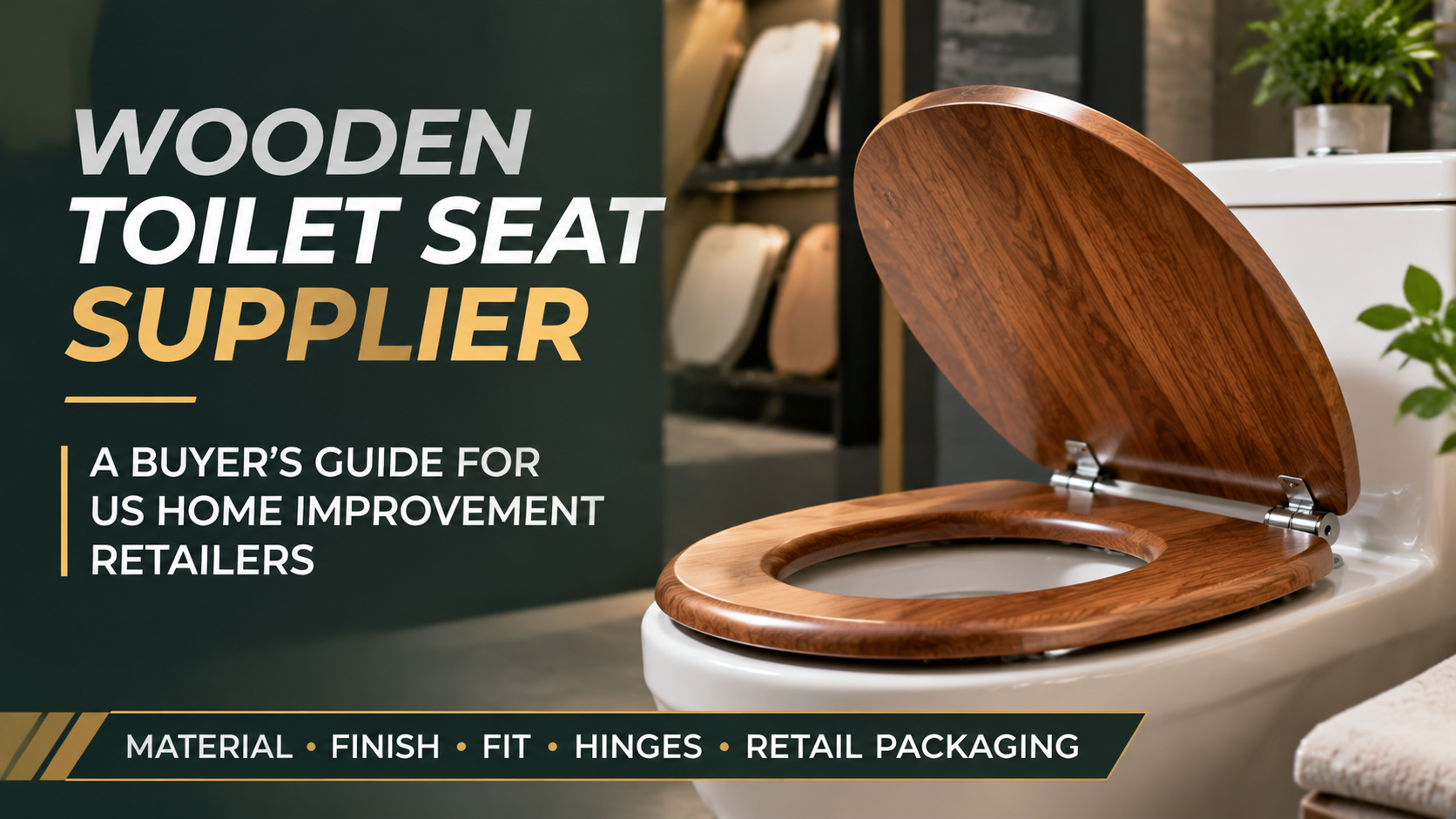
Wooden Toilet Seat Supplier for US Home Improvement Retailers
Wooden toilet seats can give a bathroom range a warmer appearance and a more substantial feel than many entry-level plastic options.
For US home improvement retailers, a successful wooden toilet seat program depends on more than selecting a color or a wood-effect pattern. Buyers need to control the product material, finish, hinge system, ceramic fit, retail packaging, instructions and repeat-order specification.
A supplier should be able to support the full retail process, from product selection and sample approval to carton labeling and replenishment.
This guide explains how home improvement retailers can evaluate a wooden toilet seat supplier for a private-label or wholesale program.
Define the Retail Assortment Role
Start by deciding what role the wooden toilet seat will play in the category.
Possible positions include:
Entry-level wood-effect replacement seat
Mid-range painted wood seat
Decorative bathroom collection
Premium molded wood product
Seasonal or color-led retail range
E-commerce add-on SKU
Store-brand private-label program
The intended price point influences the material, coating, hinge type, package design and retail presentation.
A basic replacement seat may use standard hardware and simple packaging. A premium retail range may require soft close, quick release, coordinated hinge finishes and stronger carton presentation.
Clarify What “Wooden Toilet Seat” Means
Retail buyers should not use “wooden” as the only material description.
The supplier should confirm the exact product construction, such as:
Molded wood
MDF-based seat
Solid wood design where available
Printed wood-effect surface
Painted wood finish
Decorative coated board
For the proposed product, ask about:
Board type
Product thickness
Product weight
Surface coating system
Edge sealing
Underside finish
Moisture-protection process
Gloss or matte level
Available colors or decorative options
The product-data sheet should describe the approved material and finish clearly enough for future purchasing teams to identify the same configuration.
Choose a Product Shape That Fits the Target Market
The supplier should offer shapes suited to the retailer’s target ceramic range.
Common options include:
Round
Elongated
D-shape
Custom or ceramic-specific profiles
Before sample approval, provide:
Target bowl dimensions
Mounting-hole spacing
Mounting-hole diameter
Bowl photographs
Rear ceramic platform details
Technical drawing where available
Physical fixture or representative ceramic sample where possible
The sample should be installed and checked for alignment, buffer contact, fixing access and stability.
A product should not enter a retail range based only on a catalogue image or approximate dimensions.
Select Hinge and Fixing Options for Retail Use
The hinge and fixing kit affect installation experience, customer satisfaction and return rates.
Confirm:
| Feature | Buyer decision |
|---|---|
| Closing function | Standard close or soft close |
| Quick release | Required or not required |
| Hinge material | Metal, plastic or approved alternative |
| Hinge finish | Chrome, white, black, brushed or other finish |
| Fixing method | Top-fix or bottom-fix |
| Fixing-kit contents | Bolts, nuts, washers, plugs and tools if included |
| Adjustment range | Suitability for target toilets |
| Buffers | Number, material and placement |
| Spare parts | Availability of replacement hardware |
For a retail replacement seat, installation should be understandable for a typical customer.
The instruction sheet should match the actual fixing kit in the box.
Approve the Finish on a Full Product Sample
A wood toilet seat may have a painted surface, wood effect, printed pattern or natural-look finish.
Approve the complete physical product, including the seat ring, lid, edges, underside and visible hinge components.
Check:
Color consistency
Print or grain alignment
Surface smoothness
Coating coverage
Edge finish
Gloss level
Surface marks or defects
Hinge-cover appearance
Buffer color
Overall retail presentation
For custom colors or decorative patterns, record the approved sample and artwork version before bulk production.
Digital imagery should support the discussion, but it should not replace a physical sample approval.
Design Retail Packaging for the Sales Channel
Packaging needs to sell the product and protect it.
For a home improvement retail program, consider:
Retail box design
Product photography or illustrations
Key feature claims approved by the buyer
Product shape and compatibility guidance
Material description
Installation instructions
Hardware-bag presentation
Barcode location
Country-of-origin marking
Carton quantity
Maximum carton weight
Outer-carton shipping marks
Pallet requirements
For e-commerce distribution, assess whether the retail package needs additional protection for parcel delivery.
A heavy molded wood seat may require stronger internal support than a lightweight PP product.
Provide Clear Compatibility and Installation Information
Incorrect fitting is a common reason for customer dissatisfaction.
The retail package or instruction sheet should clearly explain:
Product shape
Key dimensions
Mounting-hole adjustment range
Top-fix or bottom-fix requirement
Included hardware
Installation steps
Cleaning guidance
Quick release instructions, if applicable
Soft-close handling guidance, if applicable
Avoid broad compatibility claims unless the product has been assessed against the intended range of toilet bowls.
Agree on Quality Controls Before Bulk Production
The retailer and supplier should agree on the product controls that matter.
Typical checks include:
Product dimensions
Material confirmation
Coating and finish quality
Color or decorative pattern
Hinge alignment
Soft-close performance where applicable
Quick release performance where applicable
Fixing-kit completeness
Buffer placement
Product stability after installation
Packaging condition
Barcode readability
Carton markings
The supplier should request approval before changing the board material, coating, hinge, fixing kit, buffer or packaging component.
Compare Suppliers Beyond Unit Price
A supplier comparison should include more than a single unit price.
| Evaluation area | What to compare |
|---|---|
| Product construction | Board type, finish and overall product weight |
| Ceramic fit | Adjustment range and sample-installation result |
| Hinge system | Function, appearance and component identity |
| Packaging | Retail readiness, protection and carton data |
| MOQ | Product, color, artwork and packaging requirements |
| Sample process | Cost, timing and approval method |
| Documentation | Product data, material information and project support |
| Quality control | Inspection points and change-control process |
| Lead time | Basis from approval to shipment |
| Repeat orders | Ability to preserve the approved configuration |
The lowest headline price may not offer the best result if the supplier cannot maintain hinge, finish or packaging consistency.
Plan Replenishment and Product Changes
Retail programs depend on reliable repeat orders.
Keep a controlled record of:
Buyer SKU
Factory model
Product material
Color and finish reference
Hinge code
Fixing-kit code
Buffer configuration
Approved physical sample
Retail artwork version
Barcode version
Carton specification
Inspection record
Batch information
Approved changes
A new purchase order should refer to these details rather than only the product name.
How BOFAN Supports Wooden Toilet Seat Retail Programs
BOFAN supports wooden and molded wood toilet seat programs for home improvement retailers, distributors and private-label buyers.
Support may include product-model review, ceramic-fit discussion, material and finish selection, soft-close and quick-release options, retail-packaging coordination, sample preparation and repeat-order change management.
CTA: Request a Wooden Toilet Seat Retail Review
Planning a wooden toilet seat retail program? Send BOFAN your target shape, ceramic information, material preference, hinge requirements, expected quantity, packaging needs and destination. Our team can help identify an appropriate model and approval process.
FAQ
What types of wooden toilet seats are available for retail programs?
Options may include molded wood, MDF-based, painted, coated and decorative wood-effect toilet seats, depending on the supplier’s product range.
Are wooden toilet seats suitable for home improvement retailers?
They can be suitable when the product fit, surface finish, hinge system, packaging and installation instructions are properly controlled.
Can wooden toilet seats use soft-close hinges?
Suitable models can be configured with soft-close hinges. The exact hinge and fixing system should be confirmed during sample approval.
What should retailers check before approving a wooden toilet seat?
Check ceramic fit, material construction, finish, hinge function, fixing kit, buffers, installation instructions, packaging and barcode placement.
How can retailers control repeat wooden toilet seat orders?
Keep a controlled specification with the factory model, approved sample, material, finish, hinge and fixing codes, packaging artwork and inspection records.
Table of Contents
- Wooden Toilet Seat Supplier for US Home Improvement Retailers
- Define the Retail Assortment Role
- Clarify What “Wooden Toilet Seat” Means
- Choose a Product Shape That Fits the Target Market
- Select Hinge and Fixing Options for Retail Use
- Approve the Finish on a Full Product Sample
- Design Retail Packaging for the Sales Channel
- Provide Clear Compatibility and Installation Information
- Agree on Quality Controls Before Bulk Production
- Compare Suppliers Beyond Unit Price
- Plan Replenishment and Product Changes
- How BOFAN Supports Wooden Toilet Seat Retail Programs
-
FAQ
- What types of wooden toilet seats are available for retail programs?
- Are wooden toilet seats suitable for home improvement retailers?
- Can wooden toilet seats use soft-close hinges?
- What should retailers check before approving a wooden toilet seat?
- How can retailers control repeat wooden toilet seat orders?