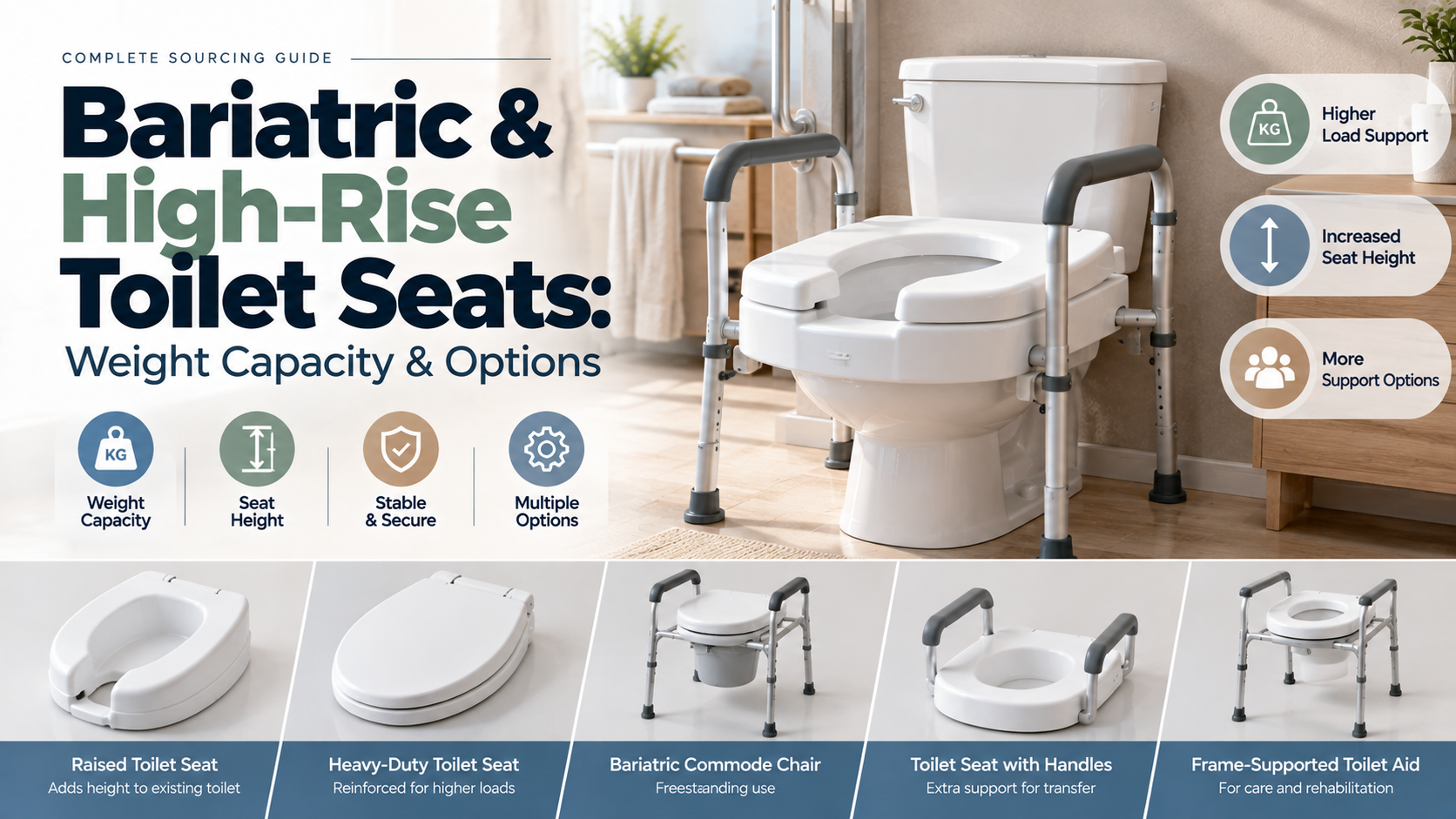
Bariatric & High-Rise Toilet Seats: Weight Capacity & Options
A bariatric or high-rise toilet seat should never be selected by appearance alone.
For care homes, rehabilitation programs, medical distributors and accessibility-product buyers, the seat height, load requirement, locking method, handle arrangement and compatibility with the toilet bowl all affect whether a product is appropriate for its intended use.
This guide explains how buyers can evaluate bariatric and high-rise toilet seat options before selecting a product or requesting a quotation.
What Is a Bariatric Toilet Seat?
A bariatric toilet seat is generally designed for users who require higher load support than a standard residential toilet seat. Depending on the product category, it may be:
A reinforced replacement toilet seat
A raised toilet-seat attachment
A freestanding commode-style seat
A frame-supported toilet aid with handles
A specialist care or rehabilitation product
These categories are not interchangeable.
A reinforced standard toilet seat may be suitable for a toilet-bowl installation, while a raised toilet aid may sit on, lock to or surround an existing toilet. Buyers should confirm the intended use before comparing load claims.
What Is a High-Rise Toilet Seat?
A high-rise toilet seat increases the seated height above the ceramic bowl. It can help users who find it difficult to lower themselves onto, or rise from, a standard-height toilet.
Common height options include:
| Raised height | Typical application |
|---|---|
| 2 inches / 50 mm | Mild height increase |
| 4 inches / 100 mm | Common mobility-support option |
| 6 inches / 150 mm | Higher-assistance requirement |
| Adjustable or frame-supported | Care, rehabilitation or specialist use |
Height should be selected according to user needs, transfer method, toilet configuration and care guidance. A higher seat is not automatically safer for every user.
Weight Capacity: What Buyers Must Check
A stated load capacity is important, but the number alone is not enough.
Ask the supplier:
What is the stated maximum user weight?
How was the product evaluated?
Does the rating apply to a static load, normal use or a specific test method?
Is the load carried by the toilet bowl, the fixing system or a separate support frame?
Does the capacity apply to the complete assembled product?
Are handles included in the stated rating?
Is the product intended for home, care or clinical use?
What documentation is available for the exact model?
Do not compare a standard toilet-seat load figure with a bariatric support product’s rating as if they describe the same test condition.
Standard Toilet Seats vs Bariatric Support Products
| Product type | Main purpose | Buyer consideration |
|---|---|---|
| Standard toilet seat | Everyday residential use | Shape, material, hinge and ceramic fit |
| Heavy-duty toilet seat | More robust standard installation | Hinge, fixing system, bowl compatibility and specified load requirement |
| Raised toilet seat attachment | Increases seating height | Locking system, height, bowl fit and cleaning access |
| Bariatric raised seat | Higher-support accessibility use | Rated capacity, safety instructions and intended use |
| Frame-supported toilet aid | Additional support beyond the bowl | Footprint, handles, stability and care environment |
A project specification should identify the product category first, then define its safety, dimensional and operational requirements.
Materials and Construction
Bariatric and high-rise products may use several material systems.
| Material or component | Typical role |
|---|---|
| Reinforced plastic | Lightweight molded seat or riser body |
| Steel frame | Structural support for selected care products |
| Aluminum frame | Lightweight support structure in some mobility aids |
| Stainless steel hardware | Moisture-resistant fixing or hinge components |
| Rubber feet or pads | Grip and stability for freestanding support products |
| Locking brackets | Secure a raised attachment to the toilet bowl |
Buyers should not assume that a thick-looking plastic product has a higher usable capacity. The shape, ribs, fasteners, contact points and installation method all matter.
With Handles or Without Handles?
Handles may assist with balance and transfer, but they change the product’s size, storage requirements and user experience.
A high-rise toilet seat with handles may be appropriate where users require additional support. However, buyers should confirm:
Handle width and clearance
Handle height
Whether handles are fixed or removable
Whether the product fits the bathroom layout
Whether the user can transfer safely
Whether the handles are included in the relevant load guidance
Cleaning and maintenance requirements
For institutional procurement, intended user needs should be assessed by the appropriate care or clinical professional.
Fixing and Compatibility
A raised or bariatric toilet-seat product must match the toilet and installation environment.
Check:
Round, elongated or proprietary bowl shape
Bowl length and width
Rear ceramic contour
Rim thickness
Mounting-hole arrangement where applicable
Seat locking method
Clearance to the wall, cistern and grab bars
Whether the product can be cleaned without removal
Whether it interferes with a bidet attachment or other bathroom accessory
An installed sample is the most reliable way to confirm fit.
Procurement Checklist for Care and Accessibility Buyers
Before purchasing in bulk, record:
Product category and intended use
Required seat height
Required user-weight range
Product dimensions
Toilet-bowl compatibility
Material and construction
Locking or fixing method
Handle requirement
Cleaning process
Instruction and warning-label requirements
Required product documentation
Packaging and storage requirements
Sample-installation approval
Spare-part or replacement policy
Avoid These Common Mistakes
Selecting only by the highest advertised weight figure
Treating a raised toilet aid as a standard replacement seat
Ignoring bowl shape and rim dimensions
Ordering before checking installation clearance
Assuming handles suit every user or bathroom
Not confirming the exact test basis behind a capacity claim
Using a standard soft-close toilet seat where a specialist care product is required
Failing to provide correct instructions and product-use guidance
How BOFAN Supports Heavy-Duty Toilet Seat Discussions
BOFAN supports standard and heavy-duty toilet-seat discussions for bathroom brands, distributors, hospitality and project buyers. Product suitability depends on the selected ceramic, hinge, fixing method, intended environment and specification.
Specialist bariatric, rehabilitation or medical-use requirements should be confirmed separately for the exact product and intended use.
CTA: Request a Heavy-Duty Toilet Seat Review
Looking for a toilet seat with a specific material, hinge, fixing method or project requirement? Send BOFAN your ceramic information, product target, quantity and destination. Our team can help assess an appropriate standard or heavy-duty toilet-seat configuration.
FAQ
What is the difference between a bariatric toilet seat and a heavy-duty toilet seat?
A bariatric product is generally intended for higher-support care or accessibility use. A heavy-duty toilet seat may refer to a reinforced standard toilet-seat configuration. Their intended use and test basis may differ.
How high should a raised toilet seat be?
Common heights are 2, 4 and 6 inches, but the correct height depends on the user, toilet, transfer needs and professional care guidance.
Can a raised toilet seat fit every toilet?
No. Bowl shape, dimensions, rim contour and locking method must be checked before purchase.
Does a heavier toilet seat always have a higher weight capacity?
No. Capacity depends on the complete construction, support points, fixing method and intended use—not only product weight.
Can BOFAN supply a bariatric medical toilet seat?
BOFAN can discuss standard and heavy-duty toilet-seat requirements. Any medical, rehabilitation or bariatric-use suitability must be confirmed separately for the exact product and program.
Table of Contents
- Bariatric & High-Rise Toilet Seats: Weight Capacity & Options
- What Is a Bariatric Toilet Seat?
- What Is a High-Rise Toilet Seat?
- Weight Capacity: What Buyers Must Check
- Standard Toilet Seats vs Bariatric Support Products
- Materials and Construction
- With Handles or Without Handles?
- Fixing and Compatibility
- Procurement Checklist for Care and Accessibility Buyers
- Avoid These Common Mistakes
- How BOFAN Supports Heavy-Duty Toilet Seat Discussions
- FAQ