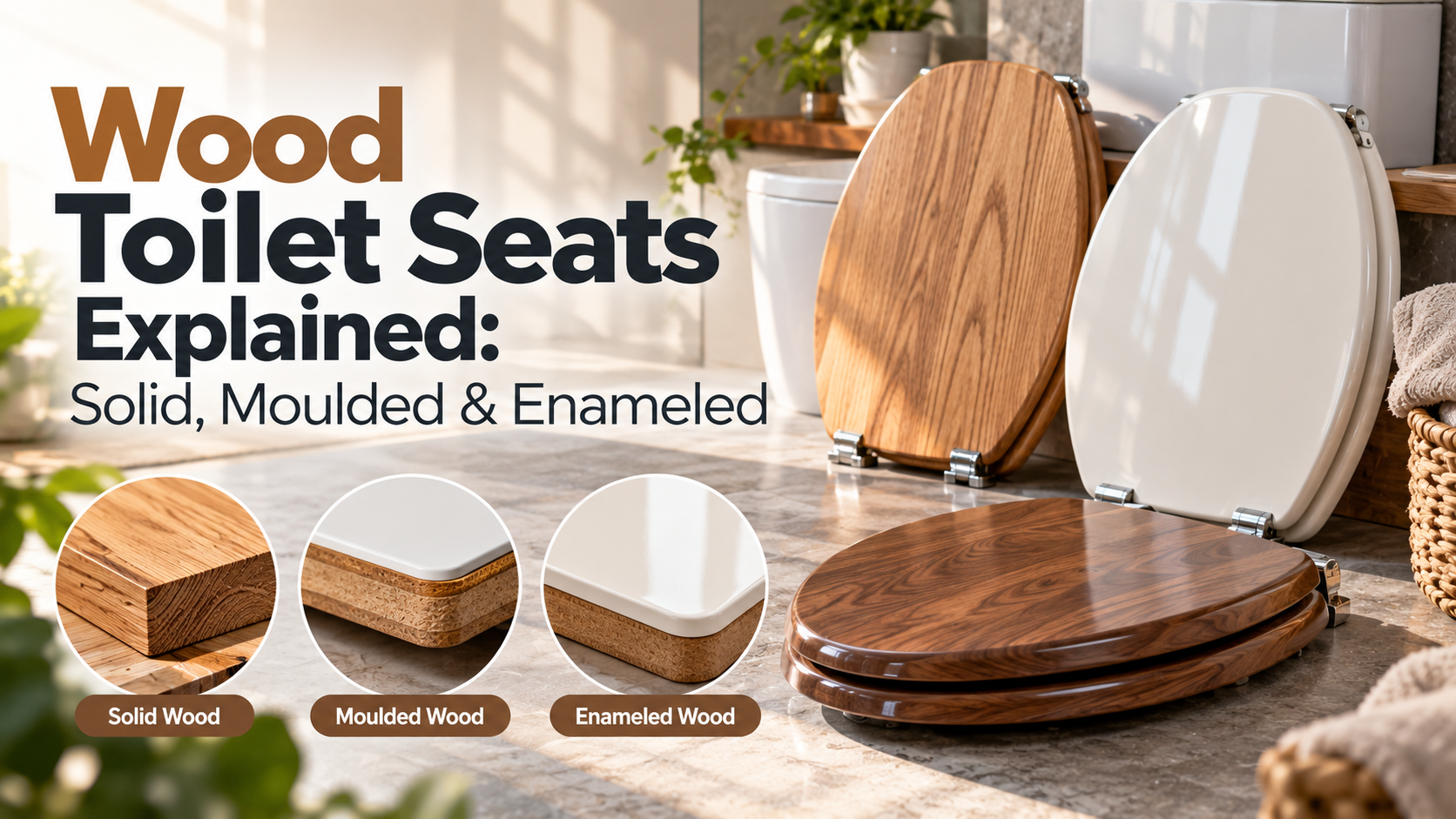
Wood Toilet Seats Explained: Solid, Moulded & Enameled
A wood toilet seat can give a bathroom range a warmer, more decorative appearance than a standard plastic model. But “wood toilet seat” is not one single construction.
For importers, distributors, DIY retailers and private-label bathroom brands, it is important to understand whether a product uses solid wood, moulded wood or an enameled wood construction. The substrate, coating, hinge system and packaging all influence product appearance, durability, cost and repeat-order control.
This guide explains the main wood toilet seat types and the questions buyers should ask before approving a sourcing program.
What Is a Wood Toilet Seat?
A wood toilet seat is a toilet seat and lid made from a wood-based substrate rather than PP plastic or UF duroplast.
The term may describe several different constructions:
Solid wood
Moulded or pressed wood
MDF-based wood seat
Enameled wood seat
Printed, veneered or decorative wood-effect seat
These products may look similar in a catalogue, but they can perform differently in humid bathroom conditions. Buyers should therefore request the exact substrate, finish process and approved sample rather than approving a product only by photo.
Solid Wood Toilet Seats
A solid wood toilet seat is made from natural timber components shaped and assembled into the seat and lid.
Solid wood can offer a distinctive grain pattern and a more natural appearance. It can be suitable for decorative bathroom collections, boutique hospitality projects and traditional-style retail ranges.
However, natural wood requires careful material selection and surface protection. Wood is affected by moisture, temperature changes and repeated cleaning exposure. The quality of the coating and edge sealing is therefore essential.
Buyers should confirm:
Timber species or wood type
Moisture-control process before production
Surface coating system
Edge and underside sealing
Appearance variation that is acceptable between units
Hinge fixing method
Cleaning-product limitations
Packaging protection against scratches and impact
Natural grain variation can be a feature of solid wood, but it should be managed with an approved visual standard for retail programs.
Moulded Wood Toilet Seats
Moulded wood toilet seats are generally produced from processed wood fibres or wood-based material that is pressed into shape.
This construction can support a more consistent profile than a multi-piece solid wood seat. It is widely used when buyers want a substantial decorative seat with a painted, printed or wood-effect finish.
A moulded wood toilet seat may be supplied in many shapes and finishes, including:
Round shapes
Elongated shapes
D-shape profiles
Glossy painted finishes
Matte painted finishes
Printed patterns
Wood-effect decoration
Private-label colour programs
The buyer should not assume that every moulded wood product has the same density, coating quality or moisture performance. Confirm the exact construction and sample route for the selected model.
What Is an Enameled Wood Toilet Seat?
An enameled wood toilet seat uses a wood-based substrate with a finished coating designed to create a smooth, decorative surface.
The word “enameled” is often used commercially to describe a painted or coated appearance. It should not be treated as a complete technical specification by itself.
For sourcing purposes, buyers should clarify:
| Approval item | What to confirm |
|---|---|
| Substrate | Solid wood, moulded wood, MDF or another wood-based construction |
| Surface finish | Gloss, matte, satin, printed or decorative finish |
| Coating system | Number of coating stages and edge coverage |
| Colour standard | Approved physical sample, paint reference or artwork |
| Visible areas | Seat top, lid top, edges, underside and hinge area |
| Cleaning expectation | Products and cleaning methods the finish should withstand |
| Quality standard | Surface defects, colour variation and scratch acceptance criteria |
An enameled finish can make a wood toilet seat suitable for many retail concepts, but its durability depends on the complete product system—not only the finish name.
Solid Wood vs Moulded Wood vs Enameled Wood
| Feature | Solid wood | Moulded wood | Enameled wood |
|---|---|---|---|
| Core construction | Natural timber components | Pressed or moulded wood-based substrate | Wood-based substrate with painted or coated finish |
| Appearance | Natural grain and variation | Consistent shaped profile | Smooth decorative or coloured appearance |
| Product positioning | Traditional, decorative or premium collections | Retail and decorative bathroom programs | Private-label and coordinated bathroom ranges |
| Surface control | Depends on timber and coating | Depends on substrate and coating | Depends strongly on coating quality and approval standard |
| Colour consistency | Natural variation expected | More controllable | Usually more controllable when approved by physical sample |
| Key sourcing concern | Moisture protection and grain variation | Density, finish and edge sealing | Coating performance, colour and scratch resistance |
A buyer should select the construction based on the target retail price, aesthetic direction, expected use and customer-care requirements.
Moisture, Coating and Durability
Bathroom humidity is one of the main considerations for wood toilet seats.
No wood-based product should be assumed to be maintenance-free. Water left on the surface, standing moisture around hinges or aggressive cleaning chemicals can affect the finish over time.
A sourcing specification should address:
Surface smoothness and coating uniformity
Coverage around edges and hinge areas
Resistance to normal bathroom cleaning
Finish adhesion
Scratch and impact expectations
Lid and seat alignment
Buffer contact points
Packaging protection during transport
Instructions for installation and cleaning
The right approach is to agree practical performance expectations for the selected product, then review them on a production-representative sample.
Wood Toilet Seats vs Plastic Toilet Seats
Wood and plastic toilet seats serve different product positions.
PP plastic toilet seats are often chosen for lightweight, cost-sensitive and high-volume programs. UF duroplast seats are commonly selected where buyers want a harder, ceramic-like appearance. Wood toilet seats are often selected for decorative value, warmer visual styling or a more substantial retail presentation.
| Buyer priority | Typical material direction |
|---|---|
| Entry-level, lightweight program | PP plastic |
| Hard surface and clean modern appearance | UF duroplast |
| Decorative, painted or printed retail range | Moulded or enameled wood |
| Natural-material appearance | Solid wood |
| Traditional bathroom collection | Solid wood or decorative moulded wood |
Material selection should consider the complete range strategy, not only the unit price.
Hinges and Fixings Matter
A wood toilet seat requires an appropriate hinge and fixing configuration.
Because wood-based products can be heavier than standard PP seats, buyers should confirm:
Hinge type and material
Soft-close or standard-close function
Top-fix or bottom-fix installation
Fixing-kit code
Adjustment range
Seat stability after installation
Buffer configuration
Whether replacement hinges or fixing kits are needed
The approved product specification should identify the exact hinge and fixing-kit configuration. A general description such as “metal hinge” is not enough for repeat-order control.
Wood Toilet Seats for Hospitality and Project Supply
For hotel, apartment and project programs, appearance is important, but repeatability is equally important.
Buyers should consider:
Expected cleaning frequency
Moisture exposure
Replacement-seat availability
Hinge and fixing-kit continuity
Surface repair or replacement policy
Carton protection for project delivery
Batch traceability
Approved colour and finish reference
A decorative wood toilet seat may suit a premium room concept, but it should be selected with the actual maintenance environment in mind.
Care Instructions Should Be Part of the Program
Clear care instructions can help reduce preventable surface complaints.
Typical guidance may include:
Wipe away standing water promptly.
Use a soft cloth and mild cleaner.
Avoid abrasive pads and aggressive chemicals.
Do not use strong bleach or solvent-based products unless the approved product instructions allow them.
Check hinge tightness as part of normal maintenance.
Keep the product dry during storage before installation.
The final instruction sheet should match the approved material and finish.
Wood Toilet Seat Sourcing Checklist
Before placing an order, confirm:
Exact seat shape and ceramic compatibility
Wood construction type
Surface finish and colour reference
Hinge and fixing-kit codes
Soft-close and quick-release requirements
Buffer layout
Sample approval process
Packaging format
Carton quantity and protection method
Care instructions
Inspection points
Change-control requirements for material, coating or hardware
How BOFAN Supports Wood Toilet Seat Programs
BOFAN supports decorative toilet seat programs across MDF and wooden product ranges, including painted, printed and wood-effect options.
For qualified projects, the team can help review product shape, hinge configuration, finish direction, packaging requirements, samples and repeat-order controls.
Final material construction, finish performance, MOQ and production timing should be confirmed for the selected model and program.
CTA: Request a Wood Toilet Seat Sample Review
Planning a wood toilet seat range? Send BOFAN your target shape, finish reference, hinge requirement, expected quantity, packaging format and destination. We can help identify a suitable sample and sourcing path.
FAQ
Are all wood toilet seats made from solid wood?
No. Wood toilet seats may use solid wood, moulded wood, MDF-based construction or a coated wood-based substrate. Buyers should confirm the exact construction.
What is an enameled wood toilet seat?
It is generally a wood-based toilet seat with a painted or coated surface finish. The substrate and coating process should be specified before approval.
Are wood toilet seats suitable for bathrooms?
They can be suitable when the selected product has an appropriate finish, care instruction and intended-use specification. Buyers should not assume every wood seat has the same moisture performance.
Are wood toilet seats heavier than plastic toilet seats?
Many wood-based seats are heavier than standard PP plastic seats. Hinge, fixing and packaging requirements should therefore be reviewed as part of the product specification.
What should be approved before bulk production?
Approve the construction, finish, colour, hinge, fixing kit, sample, packaging, instructions and inspection requirements for the exact SKU.
Table of Contents
- Wood Toilet Seats Explained: Solid, Moulded & Enameled
- What Is a Wood Toilet Seat?
- Solid Wood Toilet Seats
- Moulded Wood Toilet Seats
- What Is an Enameled Wood Toilet Seat?
- Solid Wood vs Moulded Wood vs Enameled Wood
- Moisture, Coating and Durability
- Wood Toilet Seats vs Plastic Toilet Seats
- Hinges and Fixings Matter
- Wood Toilet Seats for Hospitality and Project Supply
- Care Instructions Should Be Part of the Program
- Wood Toilet Seat Sourcing Checklist
- How BOFAN Supports Wood Toilet Seat Programs
- FAQ