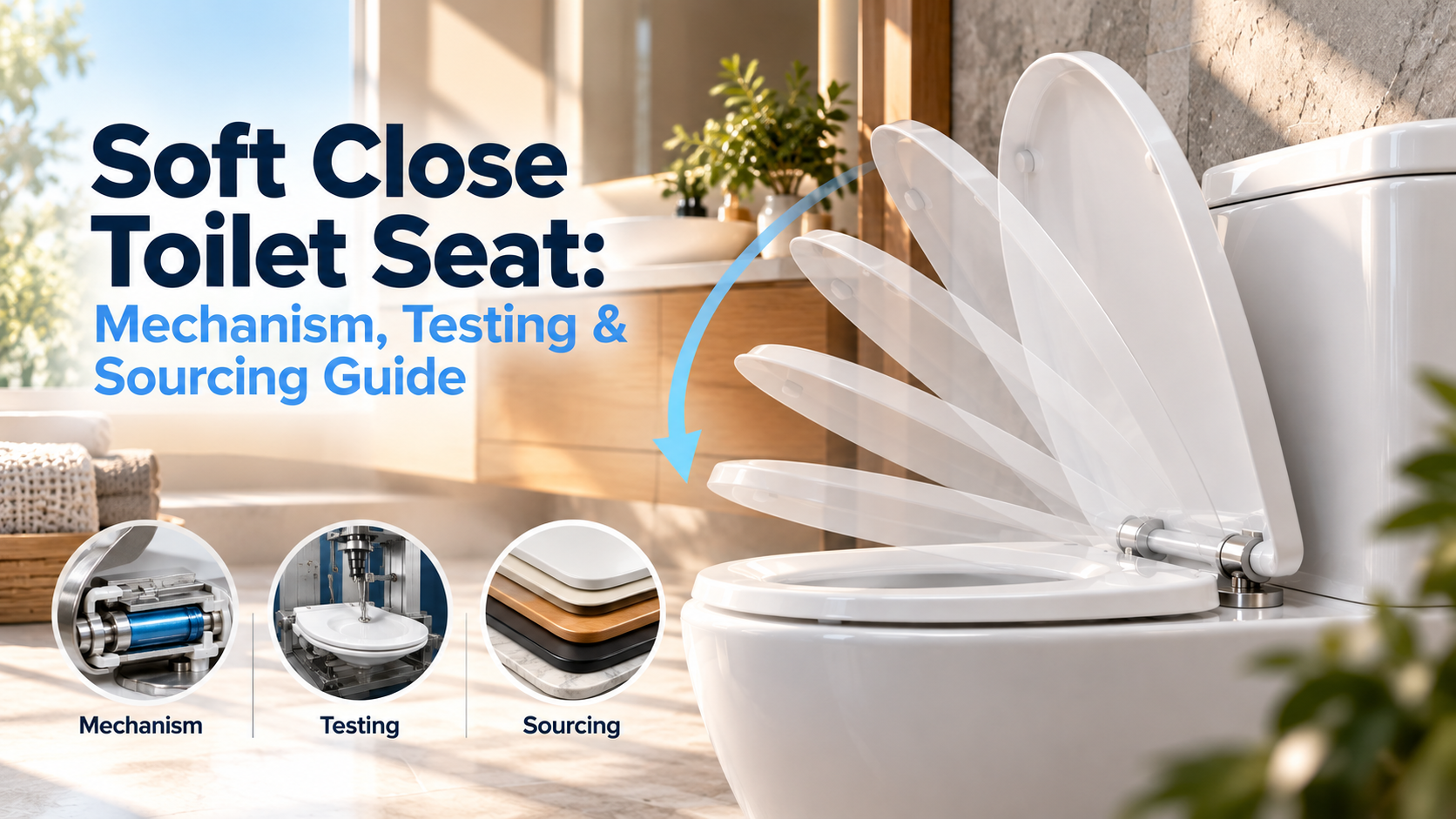
Soft Close vs Slow Close vs Quiet Close: Toilet Seat Terminology Explained
“Soft close,” “slow close” and “quiet close” are widely used terms in the toilet seat market. They are often used to describe the same customer benefit: a lid or seat ring that lowers gradually instead of falling quickly.
For OEM buyers, distributors and private-label retailers, however, the wording alone is not enough. A product can be described as soft close while using a different hinge, damper, closing speed or component arrangement from another supplier’s soft-close model.
The key is to define the actual product function, not simply the marketing term.
Are Soft Close, Slow Close and Quiet Close the Same?
In most retail and wholesale contexts, these three terms refer to a controlled-closing toilet seat.
| Term | Common meaning | What buyers should confirm |
|---|---|---|
| Soft close | A damped hinge lowers the seat or lid gradually | Which parts close slowly and which hinge is used |
| Slow close | Another common description for controlled closing | Closing action, speed and sample performance |
| Quiet close | A consumer-facing term focused on reduced noise | Whether the product has a true damper-based closing system |
The terms are not always technical standards. Different manufacturers may use them differently. For that reason, a purchase order should describe the required function in clear operational language.
For example:
“Seat ring and lid to use the approved dual soft-close hinge configuration. Both parts must close smoothly from normal opening position and reach final closure without dropping.”
That statement is more useful than writing only “quiet-close toilet seat.”
How a Soft-Close Toilet Seat Works
A soft-close toilet seat normally uses damped hinges. The damper controls the speed of the seat ring, lid or both as they move downward.
The complete system may include:
Seat ring
Lid
Hinge body
Rotary damper or integrated damper
Hinge pins or shafts
Fixing kit
Buffers
Ceramic mounting position
The performance of the feature depends on the complete configuration. A hinge that performs well on a lightweight PP seat may not behave the same way on a heavier UF or moulded-wood product.
Lid-Only, Seat-Only or Dual Soft Close
A buyer should state exactly which parts are required to close slowly.
| Configuration | What it means | Typical buyer consideration |
|---|---|---|
| Lid-only soft close | The lid lowers gradually; the seat ring may close normally | Entry-level feature upgrade |
| Seat-only soft close | The seat ring lowers gradually; the lid may close normally | Less common configuration |
| Dual soft close | Both lid and seat ring close gradually | Common premium retail and private-label option |
The approved sample should show the specified function. Do not assume that a supplier’s “soft-close toilet seat” automatically means both parts have slow-close action.
Why Hinge Selection Matters
The hinge is not just a decorative part. It affects closing behaviour, stability, installation and repeat-order consistency.
Before approval, confirm:
Hinge material
Hinge finish
Damper type or hinge code
Lid-only or dual soft-close function
Hinge adjustment range
Top-fix or bottom-fix installation
Fixing-kit code
Quick-release compatibility
Buffer layout
Spare-parts availability
For a private-label program, record the exact hinge and fixing-kit code in the controlled product specification. A generic description such as “metal soft-close hinge” leaves too much room for variation.
Soft Close Is Not the Same as Quick Release
Soft close and quick release are separate features.
Soft close controls how the seat or lid lowers.
Quick release allows the seat and lid to be removed more easily for cleaning.
A toilet seat can have:
Soft close only
Quick release only
Both soft close and quick release
Neither feature
When both functions are required, buyers should test the complete system. The seat must release and reattach correctly, remain aligned, and still perform as approved when installed.
How to Specify a Soft-Close Toilet Seat in an RFQ
A clear RFQ should include more than the phrase “soft close.”
Use the following checklist:
Product shape: round, elongated, D-shape or custom profile
Material: PP, UF, MDF, moulded wood or another approved material
Seat and lid configuration
Lid-only or dual soft-close requirement
Hinge type and finish
Fixing system: top-fix or bottom-fix
Mounting-hole adjustment range
Quick-release requirement
Buffer configuration
Ceramic reference or bowl dimensions
Target closing behaviour
Required test method, if applicable
Packaging requirements
Approved sample and change-control process
This gives suppliers a consistent basis for quotation and sample preparation.
How to Evaluate a Soft-Close Sample
The first sample should be reviewed as a complete installed product.
Check:
Seat ring and lid align correctly
The seat closes smoothly from normal open positions
The lid does not drop suddenly at the end of travel
The required parts have slow-close action
The hinge remains stable after repeated operation
Buffers contact the ceramic correctly
The fixing kit is complete and suitable for the intended bowl
Quick-release components lock securely, if included
The product remains stable after installation
Packaging protects the hinge and lid surface
A photograph or short video can support communication, but it should not replace an approved physical sample for a bulk order.
Define Test Expectations Before Production
“Durable soft close” is not an inspection standard.
If a buyer requires a cycle test, closing-speed review, static-load check or installation-stability test, the method should be agreed before production. The supplier can then confirm sample quantity, cost, timing and feasibility.
The order specification should identify:
Test method
Sample condition
Number of cycles or repetitions, if applicable
Acceptance criteria
Inspection stage
Required records
Approval contact
This reduces disputes caused by vague quality language.
Common Soft-Close Sourcing Mistakes
Avoid these common issues:
Using “soft close” without defining the required function
Not confirming whether the lid, seat ring or both close slowly
Approving a hinge without recording its code
Testing the seat without installing it on ceramic
Ignoring buffer contact and fixing stability
Changing the damper or hinge after sample approval
Assuming the same hinge works for every material and seat shape
Ordering packaging before the final hinge arrangement is approved
Reordering based only on a product photo or old purchase-order description
A soft-close product should be controlled as a complete product system.
How BOFAN Supports Soft-Close Toilet Seat Programs
BOFAN supports soft-close toilet seat programs across PP, UF, MDF and wooden product ranges.
For qualified OEM, wholesale and private-label projects, the team can help review:
Product shape and ceramic compatibility
Lid-only or dual soft-close function
Hinge and fixing-kit configuration
Quick-release options
Sample preparation
Packaging requirements
Production inspection points
Repeat-order component control
Final product performance, test requirements, MOQ and lead time should be confirmed for the exact model and destination market.
CTA: Request a Soft-Close Toilet Seat Sample
Planning a soft-close toilet seat program? Send BOFAN your target shape, material, ceramic information, hinge requirement, quantity, packaging format and destination. We can help identify a suitable model for sample review.
FAQ
Is soft close the same as slow close?
In most toilet seat markets, the terms are used to describe a controlled, gradual closing function. Buyers should still confirm the actual hinge configuration and required performance.
What is a quiet-close toilet seat?
Quiet close is generally a consumer-facing term for a toilet seat that closes with less impact and noise, usually through a damped hinge system.
Does every soft-close toilet seat have a slow-close lid and seat ring?
No. Some models have lid-only soft close, while others have dual soft close. The required configuration should be written into the specification.
Can a quick-release toilet seat also have soft close?
Yes. Many product platforms combine quick-release and soft-close functions, but the complete installed sample should be approved before bulk production.
What should buyers record for repeat orders?
Keep the approved sample, factory model, buyer SKU, material, hinge and fixing-kit codes, packaging version, test record and any approved component changes.
Table of Contents
- Soft Close vs Slow Close vs Quiet Close: Toilet Seat Terminology Explained
- Are Soft Close, Slow Close and Quiet Close the Same?
- How a Soft-Close Toilet Seat Works
- Lid-Only, Seat-Only or Dual Soft Close
- Why Hinge Selection Matters
- Soft Close Is Not the Same as Quick Release
- How to Specify a Soft-Close Toilet Seat in an RFQ
- How to Evaluate a Soft-Close Sample
- Define Test Expectations Before Production
- Common Soft-Close Sourcing Mistakes
- How BOFAN Supports Soft-Close Toilet Seat Programs
- FAQ