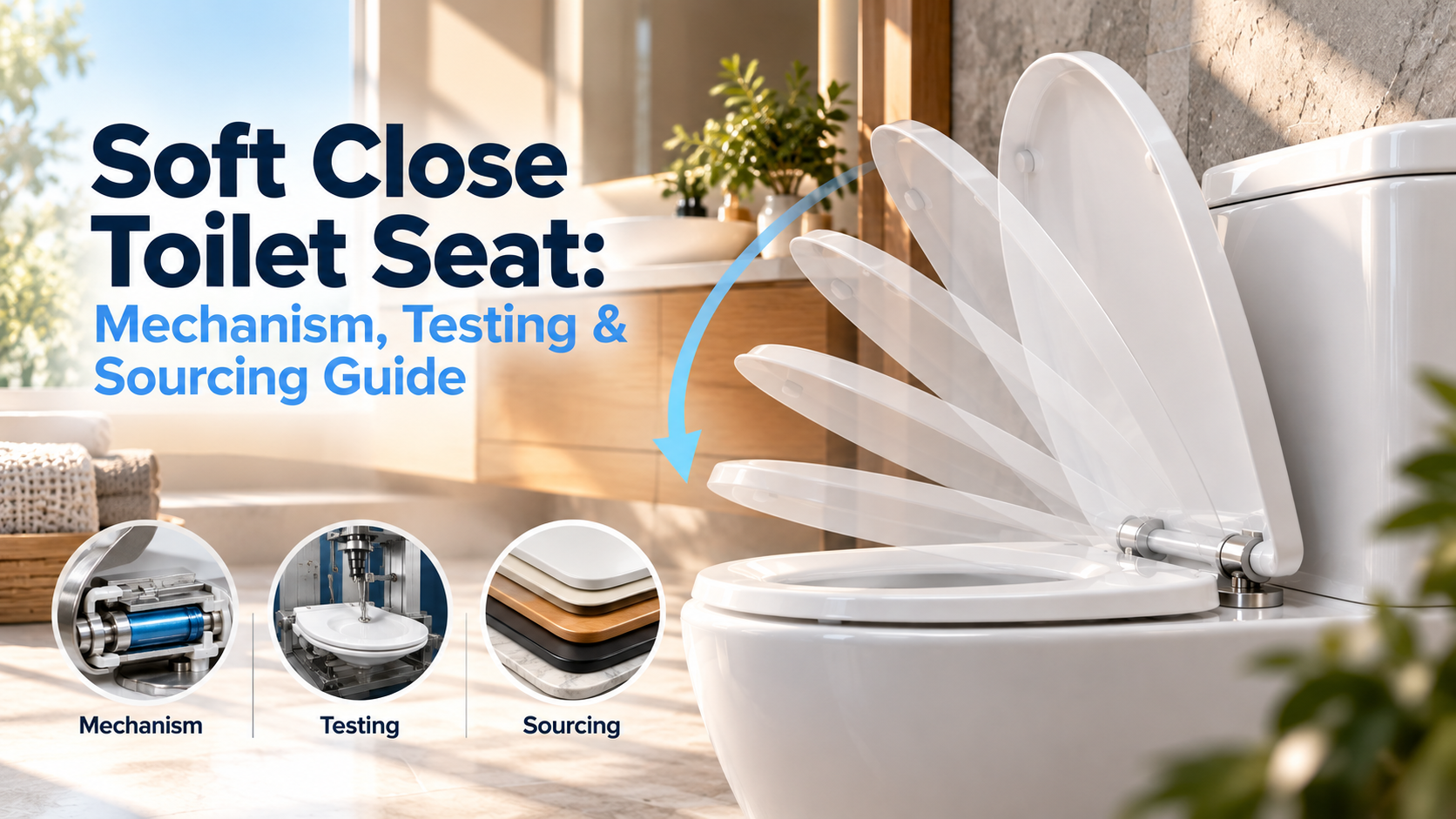
Soft Close Toilet Seat: Mechanism, Testing & Sourcing Guide
A soft close toilet seat is easy to demonstrate but much harder to source correctly.
During a first sample review, almost every soft-close seat may appear to work well. The real purchasing question is whether the selected hinge will keep closing smoothly after repeated use, remain stable on the toilet bowl, match the approved seat material and be supplied consistently in future orders.
For importers, distributors and private-label bathroom brands, “soft close” should never be the entire specification. The buyer needs to define the exact hinge configuration, closing behavior, durability expectation, fixing method and quality-control process before placing a bulk order.
This guide explains how the mechanism works and what to check when sourcing a soft close toilet seat program.
What Is a Soft Close Toilet Seat?
A soft close toilet seat uses a damping mechanism in the hinge system to slow the movement of the seat, lid or both before they reach the toilet bowl.
Depending on the design, soft-close function may apply to:
The lid only
The seat ring only
Both the lid and seat ring
A removable quick-release seat
A standard fixed-hinge seat
A top-fix or bottom-fix installation system
The buyer should state this clearly in the product specification. “Soft close toilet seat” can mean different product configurations, and a quotation should identify exactly what is included.
How a Soft-Close Hinge Works
Most soft-close toilet seats use a controlled damping system inside or connected to the hinge assembly.
When the user lowers the seat or lid, the hinge resists rapid movement and guides it toward the final closed position. The purpose is to reduce slamming, improve the user experience and protect the ceramic and seat surface from repeated impact.
A soft-close system typically includes:
| Component | Function |
|---|---|
| Hinge body | Connects the toilet seat and lid to the fixing system |
| Damper | Controls the speed of movement |
| Shaft or rotating element | Transfers movement through the hinge |
| Spring or return mechanism | Supports hinge movement, depending on design |
| Hinge cover | Provides a finished appearance and may protect the mechanism |
| Fixing kit | Secures the seat to the ceramic |
| Buffers | Reduce contact impact between the seat and toilet bowl |
The exact construction varies by supplier. A buyer should request the hinge code and fixing-kit code rather than approving a generic “metal soft-close hinge.”
Soft Close, Slow Close and Quiet Close: Are They Different?
In most commercial product discussions, these terms describe the same customer benefit: controlled closing without a sudden slam.
Common search and sales terms include:
Soft close toilet seat
Soft closing toilet seat
Slow close toilet seat
Quiet close toilet seat
No-slam toilet seat
Whisper close toilet seat
Silent close toilet seat
The wording may differ by brand or sales channel, but buyers should not assume that the internal hinge performance is the same.
Instead, confirm:
Which part has the damping function
The expected closing motion
Whether the seat and lid close at a similar speed
Whether the hinge should close from a raised position without assistance
The cycle-life expectation
The approved hinge and damper configuration
The Difference Between a Real Damper and a Weak Closing System
A soft-close function should be evaluated by product behavior, not only by its product description.
A properly specified system should normally show:
Smooth, controlled movement
No sudden drop near the end of closing
No loud impact against the ceramic
Stable left and right hinge movement
Similar behavior from both sides of the seat
Consistent closing after repeated operation
No excessive side-to-side movement after installation
A weak or poorly matched system may show:
A fast drop during the final section of travel
One side closing faster than the other
Jerking or sticking movement
A lid that closes smoothly but a seat ring that does not
Hinge noise during movement
Loss of damping after repeated cycles
Seat loosening caused by an unsuitable fixing kit
The hinge system, seat weight, lid weight, material, geometry and fixing method all influence final performance.
Why Seat Material Affects Soft-Close Performance
The same hinge cannot always deliver the same result across different toilet seat materials.
| Material | Typical product characteristic | Soft-close sourcing consideration |
|---|---|---|
| PP | Lightweight and cost-efficient | Damper must be matched to a lighter moving mass |
| UF / Duroplast | Harder surface and more substantial feel | Hinge needs suitable control for the product weight |
| MDF / molded wood | Heavier and often decorative | Hinge and fixing stability become more critical |
| Decorative or printed seat | Custom appearance requirements | Sample approval should include the full finished surface and hinge covers |
A damper selected for a light PP seat may not perform correctly on a heavier molded-wood lid. Conversely, a hinge designed for a heavy seat may feel slow or inconsistent on a lightweight product.
The factory should confirm that the selected hinge was developed or approved for the exact seat-and-lid configuration.
What B2B Buyers Should Specify Before Quotation
Before requesting a price, include the following information:
Product shape: round, elongated, D-shape or custom fit
Toilet bowl dimensions and mounting-hole range
Seat material and lid material
Product weight, where available
Soft-close scope: lid, seat or both
Quick-release requirement
Hinge material and visible finish
Top-fix or bottom-fix installation
Required fixing kit
Color of hinge covers and buffers
Expected sales channel
Packaging requirement
Expected order quantity
Required sample and test process
Required documentation or inspection controls
This prevents suppliers from quoting visually similar products with a lower-level hinge, different damper, basic fixing kit or unsuitable packaging.
Soft-Close Cycle Testing: What Should Be Checked?
A cycle test is designed to evaluate repeated opening and closing of the product under an agreed method.
The exact test setup should be agreed for the project. A buyer should not rely only on a generic claim such as “50,000 cycles” without understanding what was tested.
Confirm:
Which product model was tested
Which material was tested
Whether the seat, lid or both were included
The selected hinge and damper code
The fixing-kit configuration
Test method and operating sequence
Number of cycles
Acceptance criteria
Date and source of the report
Whether the evidence applies to the current production arrangement
For many private-label programs, BOFAN discusses soft-close durability targets in the range of 30,000 to 50,000 cycles depending on the selected product and project requirement. Final testing requirements should always be confirmed for the exact model, hinge and customer program.
Common Soft-Close Failure Modes
Understanding failure patterns helps buyers set better inspection points.
Damping becomes weak
The seat or lid begins to close faster than the approved sample.
Possible causes:
Damper wear
Unsuitable damper for product weight
Unapproved hinge-component change
Manufacturing variation
Incorrect assembly
One side closes differently
The left and right sides do not move at the same speed.
Possible causes:
Different damper performance
Hinge misalignment
Uneven seat or lid weight distribution
Incorrect assembly of paired hinge components
Seat loosens after installation
The soft-close mechanism may still work, but the seat moves on the ceramic.
Possible causes:
Fixing kit does not match the bowl
Insufficient tightening or adjustment range
Incorrect top-fix or bottom-fix selection
Hinge and fixing system not approved together
Hinge cover becomes loose or discolored
The function may remain acceptable, but the product loses retail appearance.
Possible causes:
Weak cover retention
Poor material match
Surface-finishing issue
Incompatible cleaning chemicals
The lid does not close fully
The lid stops before reaching the intended closed position.
Possible causes:
Damper resistance is too high
Hinge geometry is incorrect
Seat or lid weight differs from the approved configuration
Buffer position affects the final movement
Five Checks During Sample Approval
The sample should be reviewed as an installed product, not only as loose components on a table.
Install it on the intended ceramic.
Check mounting-hole range, rear clearance, buffer contact and overall alignment.Operate the lid and seat repeatedly.
Review closing speed, final closure, left-right consistency and noise.Confirm the exact components.
Record hinge code, damper code where applicable, fixing-kit code, buffer configuration and hinge-cover finish.Check stability after installation.
Confirm whether the seat shifts, rocks or loosens during normal use.Review the complete sellable unit.
Check instructions, hardware bag, labels, packaging and barcode placement where relevant.
The approved production sample should be identified and retained as a golden sample for bulk-production comparison.
What to Check During Factory Evaluation
When evaluating a soft close toilet seat supplier, ask practical questions about process control.
| Evaluation point | What the buyer should ask |
|---|---|
| Hinge sourcing | Is the hinge produced in-house or purchased from an approved supplier? |
| Component identity | How are hinge, damper and fixing-kit codes controlled? |
| Incoming inspection | How are purchased components checked before assembly? |
| Assembly | How is left-right hinge pairing controlled? |
| Functional testing | What percentage of products receive soft-close checks? |
| Installation review | Is stability checked on a representative fixture? |
| Change control | Does the buyer approve changes to the hinge, damper or fixing kit? |
| Traceability | Can the production batch be identified if a problem occurs? |
| Spare parts | Are replacement hinges and fixing kits available for repeat orders? |
A reliable supplier should be able to explain the process clearly. The answer does not need to be complex, but it should show control of the actual components used in the product.
Packaging Matters for Soft-Close Products
Soft-close hinges can be damaged during transport if the seat, lid or hardware moves inside the carton.
The packaging specification should address:
Protection around the hinge area
Separation of seat and lid surfaces where required
Hardware-bag location
Buffer protection
Carton strength
Maximum carton weight
Product orientation
Individual box versus bulk pack
Barcode and SKU identification
Outer-carton shipping marks
For e-commerce and retail programs, the buyer should review the packed sample, not only the product sample.
How to Control Repeat Soft-Close Orders
A repeat order should reference a controlled product record containing:
Buyer SKU
Factory model
Seat and lid material
Color and finish
Hinge code
Damper configuration
Fixing-kit code
Buffer type and position
Product dimensions
Packaging artwork version
Barcode version
Approved sample reference
Inspection requirements
Approved change history
Do not rely on a previous purchase order description such as “white elongated soft-close toilet seat.” That description does not control the components that determine product function.
How BOFAN Supports Soft-Close Toilet Seat Programs
BOFAN supports soft-close toilet seat programs across PP, UF and molded-wood product ranges. Depending on the selected project, support may include ceramic-fit discussion, hinge and fixing selection, quick-release options, sample preparation, packaging coordination, production inspection discussion and repeat-order change control.
For BOFAN programs, static-load checks, soft-close cycle testing and installed-product stability can be discussed according to the selected model and buyer requirement. Final test method, acceptance criteria and report applicability should always be confirmed for the exact product configuration.
CTA: Request a Soft-Close Product Review
Planning a soft-close toilet seat range? Send BOFAN your preferred shape, ceramic information, material, hinge function, fixing method, expected quantity and packaging requirement. Our team can help prepare a suitable sample and sourcing path.
FAQ
Does soft close mean both the seat and lid close slowly?
Not always. Some products have soft-close function on the lid only, while others control both the lid and seat ring. Confirm the exact configuration before ordering.
How many cycles should a soft-close toilet seat last?
The required cycle target depends on the product position, hinge system and customer requirement. The test method, model, hinge configuration and acceptance criteria should be agreed before production.
Why does a soft-close toilet seat stop working?
Common causes include damper wear, an unsuitable hinge for the seat weight, component variation, installation problems or unapproved changes to the hinge system.
Can soft-close toilet seats use quick-release hinges?
Yes. A soft-close seat can also use a quick-release function, but both functions should be tested and approved together on the selected product.
What should buyers approve before bulk production?
Approve the seat shape, material, hinge and fixing-kit codes, soft-close function, installed sample, packaging, labels, inspection requirements and change-control process.
Table of Contents
- Soft Close Toilet Seat: Mechanism, Testing & Sourcing Guide
- What Is a Soft Close Toilet Seat?
- How a Soft-Close Hinge Works
- Soft Close, Slow Close and Quiet Close: Are They Different?
- The Difference Between a Real Damper and a Weak Closing System
- Why Seat Material Affects Soft-Close Performance
- What B2B Buyers Should Specify Before Quotation
- Soft-Close Cycle Testing: What Should Be Checked?
- Common Soft-Close Failure Modes
- Five Checks During Sample Approval
- What to Check During Factory Evaluation
- Packaging Matters for Soft-Close Products
- How to Control Repeat Soft-Close Orders
- How BOFAN Supports Soft-Close Toilet Seat Programs
- FAQ