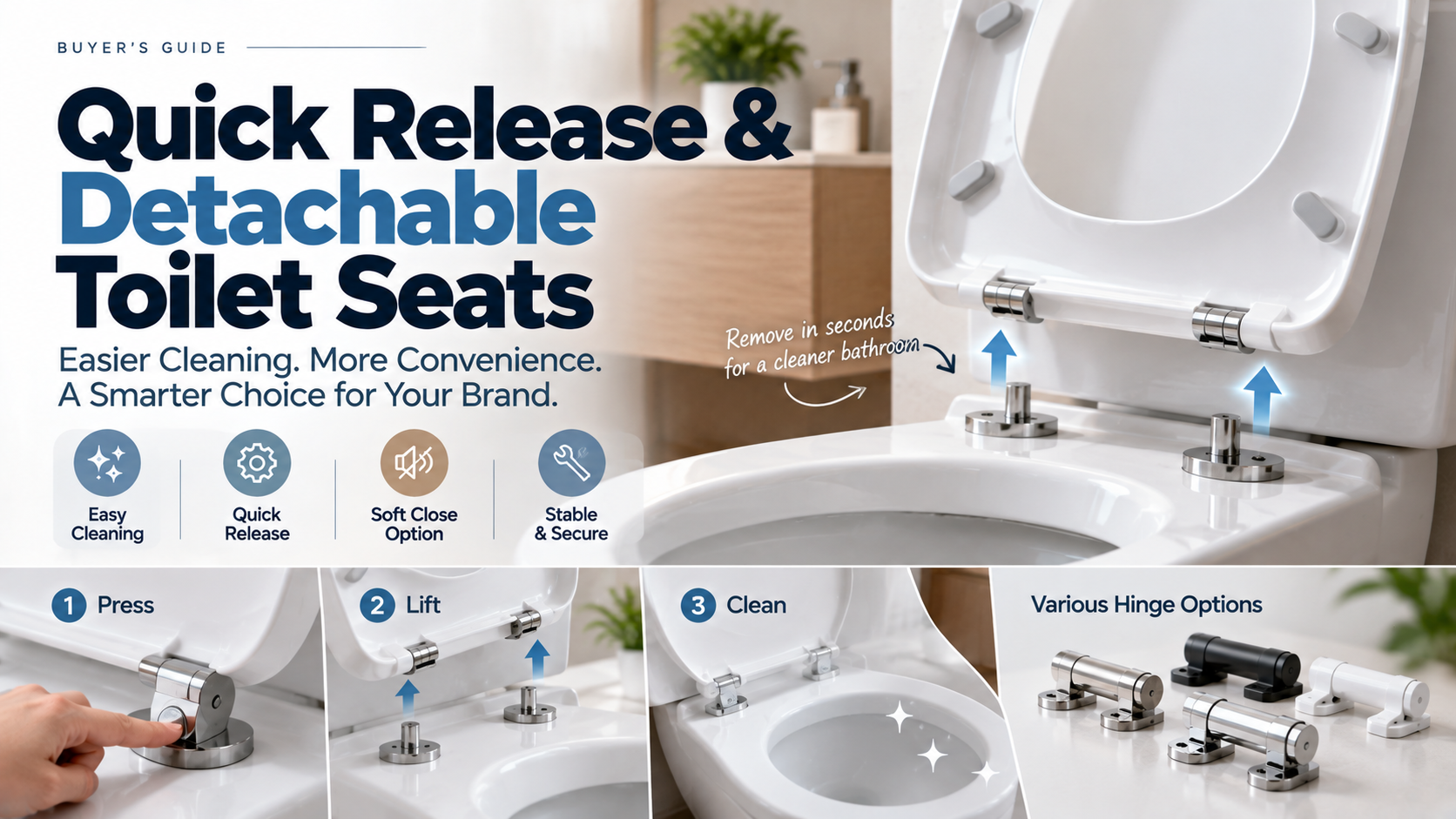
Quick Release & Detachable Toilet Seats: Buyer’s Guide
A quick-release toilet seat allows the seat and lid to be removed from the hinge area without taking out the complete fixing kit.
For end users, this can make cleaning around the rear ceramic area easier. For importers, distributors and private-label brands, it adds another mechanical function that must be clearly specified, sampled and controlled during repeat orders.
A quick-release seat may look similar to a standard soft-close seat, but its hinge structure, locking mechanism and user instructions are different. Buyers should approve the complete installed product rather than only the seat body.
What Is a Quick-Release Toilet Seat?
A quick-release toilet seat uses a hinge mechanism that allows the seat and lid assembly to detach from the fixing posts or base with a button, lever or lift-and-release action.
Depending on the hinge design, the user may:
Press one or two release buttons
Lift the seat vertically from the hinge posts
Pull a release tab
Rotate or unlock a small hinge mechanism
The seat should lock securely again after it is reinstalled.
Quick Release vs Standard Toilet Seat
| Feature | Standard toilet seat | Quick-release toilet seat |
|---|---|---|
| Seat removal | Usually requires tools | Usually removable without tools |
| Cleaning access | Hinge area can be harder to reach | Easier access around rear ceramic |
| Hinge system | Basic hinge and fixing kit | Hinge, locking mechanism and fixing kit |
| Product cost | Often lower | May include additional component cost |
| User instructions | Standard installation instructions | Installation plus removal/reinstallation instructions |
| Spare-parts planning | Hinge and fixings | Hinge, locking part, damper and fixing kit |
A quick-release product can also include soft-close. The two functions are separate: soft close controls closing motion, while quick release enables removal.
Why Buyers Choose Quick Release
Quick-release toilet seats are often selected for:
Retail and e-commerce products that emphasize easy cleaning
Hotel and hospitality bathroom programs
Apartment and property-management projects
Bathroom brands with premium or convenience-focused collections
Private-label products with differentiated features
Consumer replacement-seat ranges
The feature is most valuable when the release action is intuitive, reliable and suitable for the expected cleaning routine.
Types of Quick-Release Mechanisms
| Release type | How it works | Buyer checks |
|---|---|---|
| Push-button release | Buttons unlock the seat from hinge posts | Button feel, locking security and durability |
| Lift-off release | Seat is lifted from the hinge base | Alignment and accidental-release risk |
| Lever release | Lever or tab activates the release | Accessibility and visual integration |
| Concealed release | Mechanism is hidden under hinge covers | Cleaning access and clear instructions |
| One-button system | One action releases both sides | Symmetry and reinstallation ease |
| Two-button system | Separate left and right release points | User operation and lock confirmation |
The release design should match the product’s market position and expected user experience.
What to Check During Sample Approval
A quick-release function should be tested on the intended toilet bowl.
Check:
The seat aligns correctly with the ceramic.
The seat locks securely after reinstallation.
The release button or lever works smoothly.
The seat does not detach during normal use.
The hinge posts remain stable after repeated removal.
Soft-close motion remains consistent, where included.
The fixing kit stays tight after installation.
Bumpers contact the ceramic correctly.
Cleaning access improves in practice.
The installation sheet clearly explains release and reinstallation.
A factory photo of the mechanism is not enough for approval.
Quick Release, Soft Close and Hinge Selection
Many private-label programs combine quick release with soft close. In this configuration, the hinge system must support:
Seat and lid weight
Closing speed
Complete final closure
Left-right damper consistency
Repeated removal and reattachment
Secure locking after cleaning
The intended top-fix or bottom-fix method
The RFQ should identify whether soft close is required for the lid, seat ring or both.
Top-Fix vs Bottom-Fix With Quick Release
Quick-release hinges can be paired with either top-fix or bottom-fix installation.
| Installation method | Suitable situation | Buyer verification |
|---|---|---|
| Top-fix | Toilet bowl has no underside access | Hole diameter, expansion plug and tightening method |
| Bottom-fix | Underside mounting access is available | Bolt length, nut type and clearance below the bowl |
The quick-release function does not remove the need to verify ceramic compatibility and installation access.
Common Quick-Release Problems
Common complaints usually come from an incomplete product specification:
Seat does not lock after reinstallation
Release buttons stick or feel uneven
Hinge posts become loose
Seat becomes misaligned after removal
Soft-close motion changes after repeated cleaning
Instructions do not explain correct reinstallation
A replacement hinge does not match the original model
These issues can be reduced by recording the exact hinge and fixing-kit codes, approving an installed sample and controlling component changes.
What to Include in a Quick-Release RFQ
Include:
Product shape and dimensions
Intended ceramic model or drawing
Material and finish
Quick-release mechanism type
Hinge code
Soft-close requirement
Top-fix or bottom-fix method
Fixing-kit code
Hinge-cover finish
Bumper configuration
Required sample process
Spare-part requirement
Packaging and instruction-sheet requirement
Approved golden-sample reference
How BOFAN Supports Quick-Release Toilet Seat Programs
BOFAN supports selected quick-release toilet-seat programs across PP, UF and molded-wood product ranges. Depending on the model, buyers can discuss soft-close function, hinge options, fixing systems, private-label packaging and sample approval.
Final product compatibility should be confirmed on the intended ceramic and with the approved hardware configuration.
CTA: Request a Quick-Release Toilet Seat Review
Planning a detachable toilet-seat program? Send BOFAN your product shape, ceramic details, required material, hinge function, quantity and packaging requirement. Our team can help identify a suitable quick-release configuration.
FAQ
Is a quick-release toilet seat the same as a soft-close toilet seat?
No. Quick release allows the seat to be removed for cleaning. Soft close controls how the seat and lid lower. A product can include both functions.
Can a quick-release toilet seat become loose?
It can if the hinge, fixing kit or locking mechanism is not correctly installed or matched to the product. The installed sample should be checked for stability.
Are quick-release toilet seats easy to reinstall?
A well-designed system should lock back into place clearly and securely. The user should follow the supplied instructions.
Can quick-release hinges be used on every toilet bowl?
No. Bowl shape, mounting-hole position, installation access and rear ceramic geometry must be checked.
What spare parts should buyers keep?
Depending on the model, buyers may keep replacement hinges, dampers, fixing kits, hinge covers and related locking components.
Table of Contents
- Quick Release & Detachable Toilet Seats: Buyer’s Guide
- What Is a Quick-Release Toilet Seat?
- Quick Release vs Standard Toilet Seat
- Why Buyers Choose Quick Release
- Types of Quick-Release Mechanisms
- What to Check During Sample Approval
- Quick Release, Soft Close and Hinge Selection
- Top-Fix vs Bottom-Fix With Quick Release
- Common Quick-Release Problems
- What to Include in a Quick-Release RFQ
- How BOFAN Supports Quick-Release Toilet Seat Programs
- FAQ