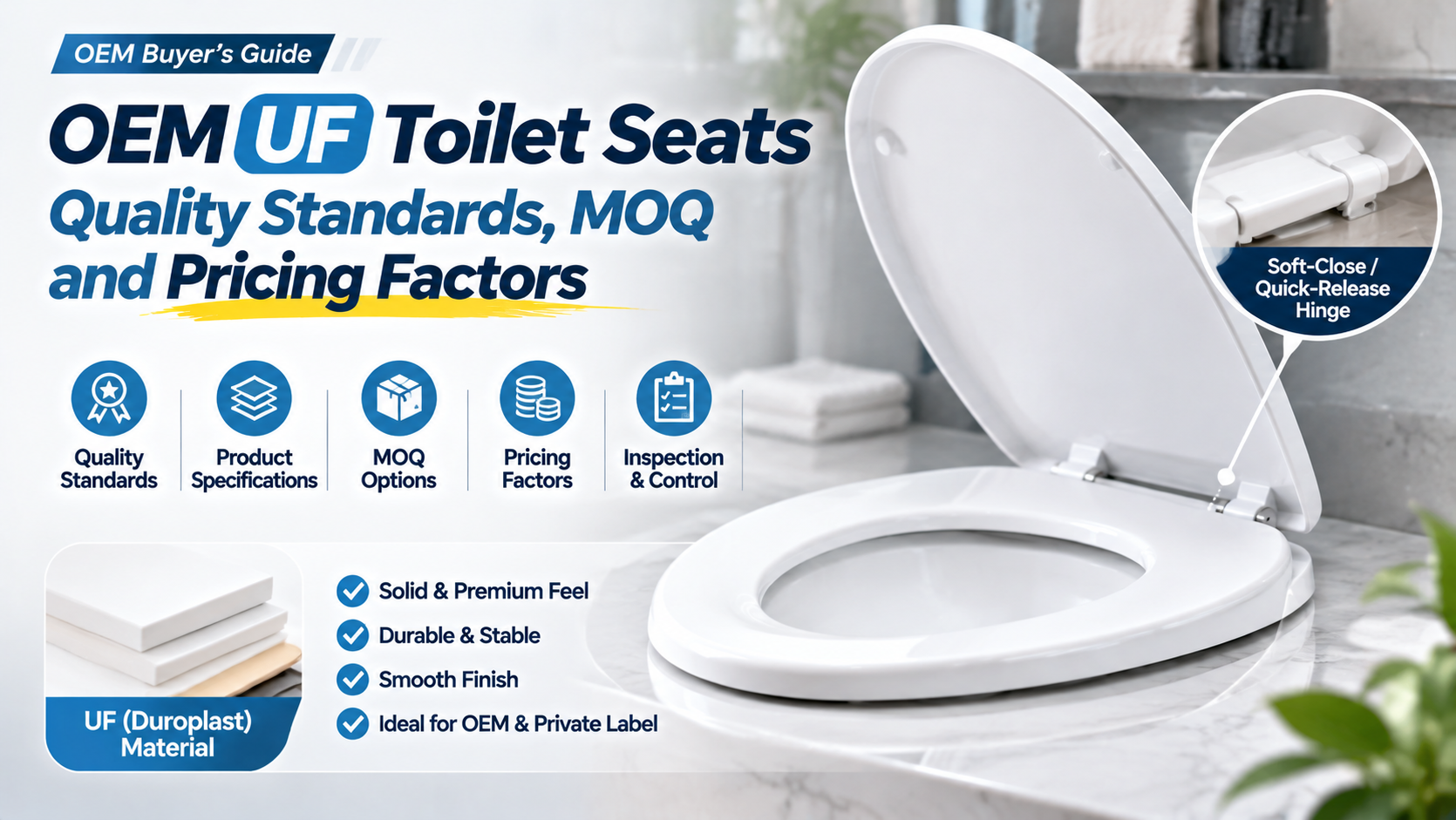
OEM UF Toilet Seats: Quality Standards, MOQ and Pricing Factors
UF toilet seats, often described in the market as duroplast seats, are commonly selected for mid-range and premium bathroom programs because of their solid feel, refined finish and durable appearance.
For an OEM buyer, however, “UF toilet seat” is only the starting point. The final result depends on the selected shape, resin formulation, molding quality, hinge system, fixing kit, finish standard, packaging and inspection controls.
This guide explains the main quality, MOQ and pricing factors that US buyers should review before launching an OEM UF toilet seat project.
What Should Be Defined in an OEM UF Toilet Seat?
A clear specification should identify the complete product configuration.
Include:
Product shape: round, elongated, D-shape or custom ceramic fit
Seat and lid dimensions
Material requirement
Product weight where relevant
Surface finish
Color reference
Hinge type and finish
Soft-close requirement
Quick-release requirement
Fixing-kit code
Top-fix or bottom-fix installation
Buffer configuration
Retail packaging
Barcode and label requirements
Inspection standard
This prevents a supplier from quoting a visually similar seat with different hinges, finishing details or packaging protection.
Review Surface Quality and Appearance
UF toilet seats are often chosen because buyers want a clean, substantial and premium-looking product. The surface standard should therefore be defined before sample approval.
Review:
Surface smoothness
Gloss level
Color consistency
Molded details
Edge finish
Hinge-area appearance
Visible marks or imperfections
Lid and seat alignment
Consistency between seat ring and lid
Print or decoration quality, where applicable
Use a physical approved sample as the primary visual reference. Product photographs can support communication but should not become the only acceptance standard.
Choose the Correct Hinge System
The hinge affects both the product appearance and the user experience.
Confirm:
| Hinge item | Buyer decision |
|---|---|
| Closing function | Standard-close or soft-close |
| Release function | Fixed or quick-release |
| Hinge finish | Chrome, white, black or another approved finish |
| Hinge material | Confirm exact component construction |
| Fixing method | Top-fix or bottom-fix |
| Adjustment range | Compatibility with the ceramic mounting holes |
| Hinge code | Controlled factory reference for repeat orders |
| Spare parts | Replacement hinge and fixing-kit availability |
A premium-looking UF seat can still fail a customer expectation if the hinge or fixing kit is not stable after installation.
Confirm Ceramic Fit Before Bulk Production
A UF seat must be checked on the intended toilet bowl.
Provide:
Bowl drawing or measurements
Mounting-hole spacing
Rear platform details
Bowl length and width
Installation access
Photos from top and side views
Physical ceramic sample where possible
During sample review, check seat alignment, lid clearance, buffer contact, opening position and movement after installation.
Understand MOQ Variables
MOQ is rarely based only on the number of seats.
It may depend on:
Selected product model
Product color
Surface finish
Hinge type
Fixing-kit configuration
Printed decoration
Retail packaging
Carton artwork
Required test or sample process
A buyer should ask for MOQ by component category rather than assuming one quantity applies to the entire project.
For example, an existing white UF model in standard packaging may have a different MOQ from the same model with a custom black hinge cover, private-label carton and printed artwork.
Main OEM UF Toilet Seat Pricing Factors
The price of a UF toilet seat can change based on product design and commercial requirements.
| Pricing factor | Why it changes cost |
|---|---|
| Product shape | Different molds, material use and production complexity |
| Product weight | More material can increase unit cost |
| Surface finish | Gloss, matte, print or decorative treatment affects processing |
| Hinge system | Soft-close and quick-release hinges add component cost |
| Fixing kit | Top-fix, bottom-fix and specialty hardware differ in cost |
| Color | Standard colors and custom colors may have different MOQ or setup needs |
| Packaging | Retail boxes, inserts, instructions and labels add cost |
| Order quantity | Larger production runs can improve material and packing efficiency |
| Testing | Project-specific tests may add cost and lead time |
| Shipping configuration | Carton size, weight and container loading affect landed cost |
Ask suppliers to explain what is included in the quoted unit price: seat, lid, hinges, fixing kit, buffers, instructions and packaging should all be clearly listed.
Use Samples to Control Quality Expectations
The sample approval should cover the full sellable product.
Check:
Surface finish
Color
Shape and dimensions
Product weight
Hinge appearance
Soft-close movement
Quick-release operation
Fixing-kit completeness
Installed stability
Buffer contact
Retail carton
Barcode and labels
Instruction sheet
The approved sample should be identified and retained as a reference for production and final inspection.
Set Inspection Controls Before Production
A buyer should agree inspection points with the supplier before bulk production starts.
Typical controls include:
Material confirmation
Dimensions
Shape and alignment
Surface finish
Color consistency
Hinge code
Fixing-kit code
Soft-close operation
Quick-release operation
Packaging completeness
Barcode accuracy
Outer-carton marks
Batch traceability where agreed
If the supplier proposes a change to a hinge, fixing kit, color formulation, material or packaging component, the buyer should review and approve it before implementation.
How BOFAN Supports OEM UF Toilet Seat Programs
BOFAN supports OEM and private-label UF toilet seat programs for distributors, bathroom brands and retail buyers. Support may include existing-model selection, ceramic compatibility review, hinge and fixing options, soft-close functions, sample preparation, private-label packaging and production specification control.
CTA: Request an OEM UF Toilet Seat Quotation
Send BOFAN your toilet shape, material target, hinge requirement, finish reference, packaging format, estimated quantity and destination for a UF toilet seat quotation review.
FAQ
What is a UF toilet seat?
UF refers to a duroplast-style toilet seat material commonly used for solid-feeling bathroom seat products. The exact material construction and product specification should be confirmed with the supplier.
Are UF toilet seats suitable for private-label retail programs?
Yes. UF seats can be supplied with controlled product specifications, branded packaging, instructions, barcodes and approved hinge configurations.
What affects the MOQ for OEM UF toilet seats?
MOQ can depend on the product model, color, hinge, fixing kit, decoration, packaging and order quantity.
Why does a UF toilet seat need a physical sample approval?
A physical sample allows the buyer to assess surface finish, color, ceramic fit, hinge appearance, installation stability and packaging before bulk production.
What should be included in an OEM UF toilet seat quotation?
The quotation should identify the product model, material, hinge and fixing kit, MOQ, unit price basis, packaging, carton data, sample process, lead time and available quality documentation.
Table of Contents
- OEM UF Toilet Seats: Quality Standards, MOQ and Pricing Factors
- What Should Be Defined in an OEM UF Toilet Seat?
- Review Surface Quality and Appearance
- Choose the Correct Hinge System
- Confirm Ceramic Fit Before Bulk Production
- Understand MOQ Variables
- Main OEM UF Toilet Seat Pricing Factors
- Use Samples to Control Quality Expectations
- Set Inspection Controls Before Production
- How BOFAN Supports OEM UF Toilet Seat Programs
- FAQ