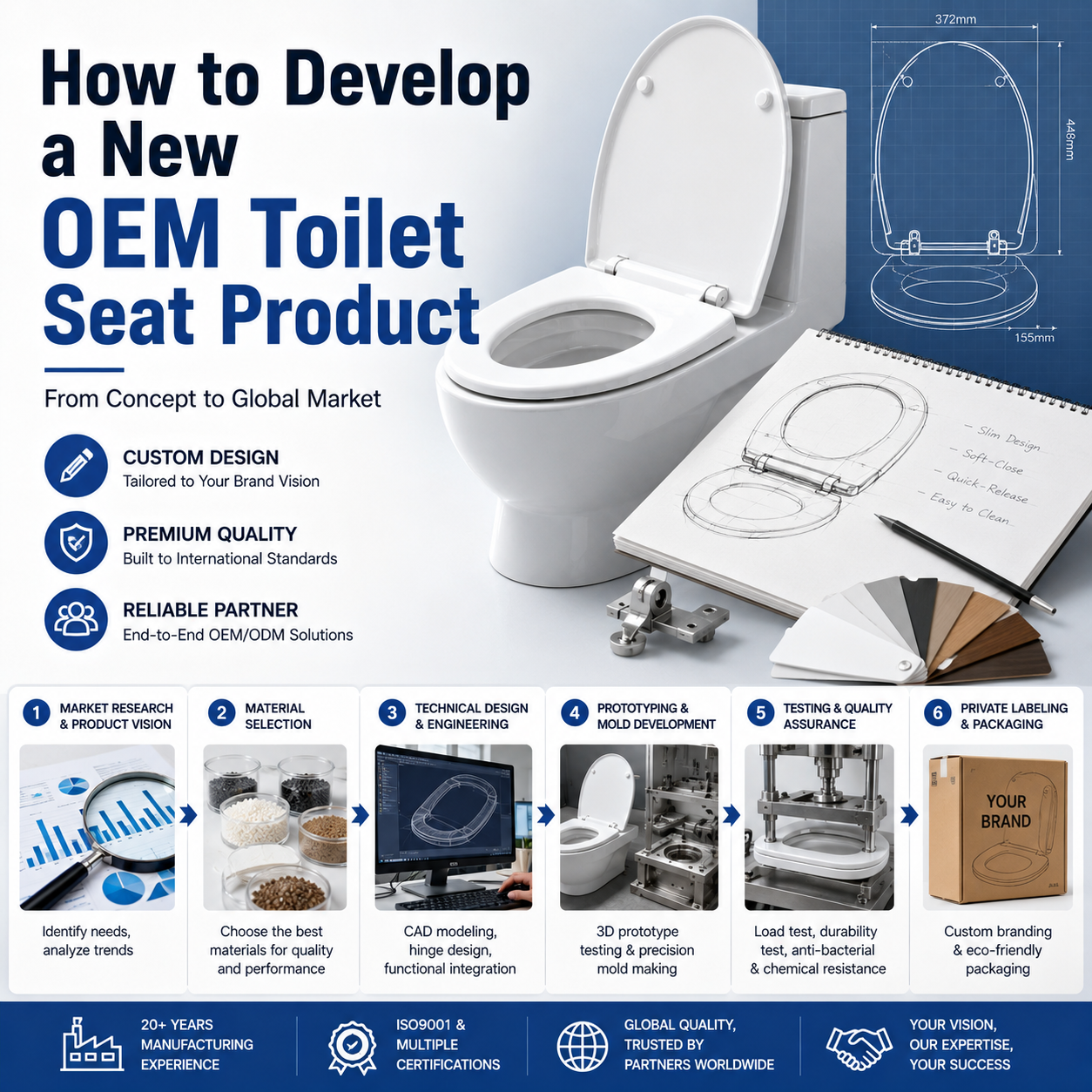
In the competitive world of bathroom fixtures, standing out requires more than just functionality; it requires innovation, customization, and a deep understanding of manufacturing excellence. For brands, wholesalers, and real estate developers, learning how to develop an OEM toilet seat product is the gateway to creating a unique brand identity and capturing specific market segments.
At Bofan, with decades of experience in the industry, we have refined the process of bringing a concept from a mere sketch to a global retail shelf. This guide explores the essential steps involved in developing a high-quality OEM toilet seat, ensuring your product meets international standards and consumer expectations.
Phase 1: Market Research and Defining Your Product Vision
Before a single mold is cast, you must understand the "why" behind your product. The bathroom industry is shifting toward specific niches—sustainability, luxury aesthetics, and aging-in-place ergonomics.
Identifying Target Demographics
Are you targeting the high-end European market that demands scratch-resistant Urea-Formaldehyde (UF) seats? Or is your focus on the cost-effective, high-volume North American rental market where Polypropylene (PP) is king? Defining your demographic dictates your material, price point, and design language.
Analyzing Market Trends
Current trends show a massive surge in:
- Eco-friendly Materials: Bamboo and recycled wood fibers are in high demand.
- Slim Designs: Minimalist, ultra-thin seats that complement modern "D-shaped" or square toilets.
- Hygiene Innovation: Anti-bacterial surfaces and easy-to-clean quick-release mechanisms.
By defining these parameters early, you streamline the entire develop oem toilet seat product workflow.
Phase 2: Material Selection—The Foundation of Quality
Material is the most critical decision in the OEM process. It affects the product's lifespan, feel, and perceived value.
Urea-Formaldehyde (UF): The Premium Choice
UF is a thermoset plastic known for its ceramic-like feel. It is scratch-resistant, non-flammable, and does not yellow over time. For brands looking to position themselves in the premium segment, UF is the non-negotiable standard.
Polypropylene (PP): Durability and Flexibility
PP is a thermoplastic that is virtually unbreakable. It is lighter than UF and highly resistant to chemical cleaners. This makes it ideal for public facilities or budget-friendly household lines.
Molded Wood & MDF: Traditional Comfort
These materials offer a warm touch and a classic weight. They are popular in traditional markets but require high-quality coatings to ensure moisture resistance—an area where Bofan excels through advanced paint-coating technologies.
Phase 3: Technical Design and Engineering
Once the material is chosen, the engineering team takes over to ensure the seat is not only beautiful but also functional.
Creating CAD Drawings and 3D Models
The journey to develop an OEM toilet seat product involves precise CAD (Computer-Aided Design) drafting. Every curve must be calculated to ensure a "universal fit" or a "perfect fit" for specific toilet bowls. We look at bolt-hole distances, seat width, and the angle of the lid.
Soft-Close and Quick-Release Integration
Modern consumers expect a silent bathroom experience. Engineering the hydraulic dampers for a soft-close hinge is a science in itself. Similarly, "One-Button" or "Two-Button" quick-release hinges are essential for hygiene-conscious users who want to remove the seat for deep cleaning.
Phase 4: Prototyping and Mold Development
Transitioning from digital to physical is where the magic happens.
From 3D Print to Physical Sample
We use high-precision 3D printing to create a "fit-and-feel" prototype. This allows the client to see the product in three dimensions and test it on actual toilet bowls before committing to expensive steel molds.
Precision Tooling for Mass Production
If the prototype is approved, we move to mold creation. A high-quality steel mold for a UF seat can take 35 to 45 days to manufacture. Precision is key; even a 0.1mm deviation can lead to "seat wiggle" or hinge misalignment.
Phase 5: Rigorous Testing and Quality Assurance (QA)
A successful OEM product must be built to last. At Bofan, we subject every new design to a battery of tests that exceed industry standards like DIN 19516 or NF.
Static and Dynamic Load Testing
Can the seat withstand a 150kg to 250kg load without cracking? We use hydraulic presses to simulate extreme weight to ensure structural integrity.
Life Cycle Durability
Our automated testing rigs open and close the seat 30,000 to 50,000 times. If the soft-close mechanism fails or the hinges loosen, the design goes back to the drawing board.
Anti-Bacterial and Chemical Resistance
We test the surfaces against common household cleaners and bacteria (like E. coli and Staphylococcus). A high-quality OEM seat must remain hygienic after years of use.
Phase 6: Private Labeling and Custom Packaging
The final step in the develop oem toilet seat product journey is branding.
Branding Your Product
We offer laser engraving, silk-screen printing, and custom-branded hinges. This ensures that every time a user lifts the lid, they see your logo, reinforcing brand loyalty.
Eco-friendly Packaging
In today’s market, the box is as important as the product. We provide FSC-certified cardboard options and plastic-free internal packaging to align with global sustainability goals.
Partnering with Bofan: Your Ideal OEM Manufacturer
Developing a new product is a complex journey, but you don’t have to walk it alone. Bofan specializes in end-to-end ODM and OEM services.
Why choose us?
- Technical Expertise: Our engineers have over 20 years of experience in mold design.
- Material Diversity: We are one of the few factories globally capable of high-volume production in UF, PP, Resin, and Wood.
- Quality Certification: We hold ISO9001, BSCI, and multiple product-specific certifications.
Conclusion
To develop an OEM toilet seat product that succeeds in today’s market, you need a blend of market insight, engineering precision, and a reliable manufacturing partner. By following these phases—from research and material selection to rigorous testing—you can launch a product that not only fits the toilet bowl but also fits your brand’s vision for excellence.
Ready to start your next project? Contact Bofan today to turn your vision into a reality.