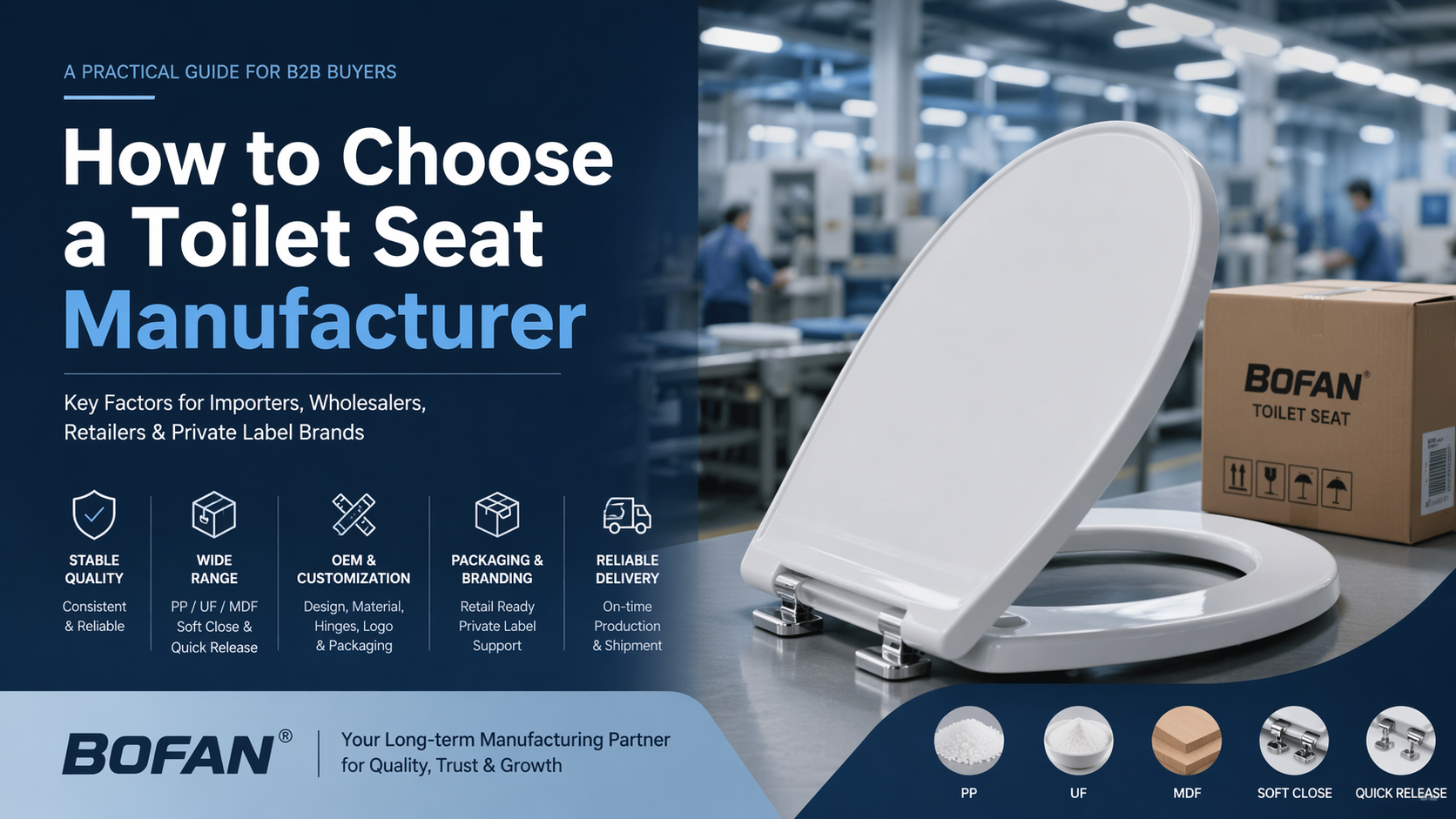
How to Choose a Toilet Seat Manufacturer
Choosing the right toilet seat manufacturer is an important decision for importers, wholesalers, retailers, e-commerce sellers, and private label brands.
A good manufacturer affects much more than product price. It also affects product quality, packaging execution, delivery reliability, repeat-order consistency, and long-term business stability. For many buyers, the manufacturer is not just a supplier. It is a long-term production partner.
As a professional toilet seat manufacturer, BOFAN works with buyers on standard supply, OEM projects, private label cooperation, and bulk production for different markets. That makes manufacturer selection especially important, because the wrong factory can create delays, quality problems, packaging mistakes, and unnecessary sourcing risk.
This guide explains how to choose a toilet seat manufacturer and what buyers should evaluate before starting cooperation.
Why Choosing the Right Toilet Seat Manufacturer Matters
A toilet seat manufacturer has a direct effect on product consistency, customer satisfaction, and repeat-order performance.
If the manufacturer cannot maintain stable quality, the buyer may face complaints, returns, and damaged customer trust. If the lead time is unstable, the buyer may lose sales opportunities or face inventory pressure. If packaging execution is weak, the final product may not meet retail or e-commerce requirements.
This is why manufacturer selection matters so much. A strong factory is not only producing products. It is helping the buyer build a stable and repeatable business model.
For long-term sourcing, the best manufacturer is usually the one that can combine stable production, practical support, and clear communication over time.
What Does a Toilet Seat Manufacturer Usually Provide?
A toilet seat manufacturer usually does more than basic product assembly.
Depending on the factory, the manufacturer may provide:
- standard toilet seat products
- bulk production support
- OEM development
- ODM options
- private label packaging
- sample development
- export packing
- shipment coordination
For buyers, this means the manufacturer is often involved in more than the product itself. It may also support packaging, branding, product adjustment, and long-term reorder management.
At BOFAN, manufacturing support can include standard bulk supply, product development discussion, packaging coordination, and repeat-order production for different customer types.
What Buyers Usually Look for in a Toilet Seat Manufacturer
When buyers evaluate a toilet seat manufacturer, they usually focus on several key points.
Stable Product Quality
Sample quality is important, but bulk consistency matters more.
A strong manufacturer should be able to keep the same structure, finish, hinge performance, and packaging quality across different production batches. Buyers do not only need one good order. They need a factory that can repeat the same standard over time.
Broad Product Range
A factory with a broader product range is often more useful for long-term cooperation. Buyers may want to source:
- PP toilet seats
- UF toilet seats
- MDF toilet seats
- soft close toilet seats
- quick release toilet seats
A manufacturer that can support multiple materials and product levels gives the buyer more flexibility.
OEM and Customization Ability
Many buyers need more than ready-made stock products. They may want support in:
- material selection
- hinge options
- shape and size
- color and finish
- logo application
- packaging design
Customization ability is especially important for OEM and branded projects.
Packaging and Branding Support
A toilet seat manufacturer should also be able to support retail box packaging, outer cartons, barcodes, manuals, and private label presentation.
This is very important for retailers, e-commerce sellers, and private label brands. A good product with weak packaging execution still creates problems in the market.
Reliable Lead Time
Lead time is one of the most practical factors in manufacturer selection.
A factory that cannot deliver on time creates planning problems for the buyer. This affects inventory, promotions, launches, and repeat-order scheduling.
Clear Communication
Good sourcing depends on clear communication.
Inquiry handling, sample discussion, artwork confirmation, packaging coordination, and shipment planning all need to be managed clearly. Weak communication often leads to avoidable mistakes.
Export Experience
For overseas buyers, export experience is also very important. A factory should understand export packing, shipping marks, carton standards, and international order coordination.
Buyers often prefer manufacturers like BOFAN that can combine manufacturing, packaging support, and export coordination in one workflow.
How to Evaluate a Toilet Seat Manufacturer Before Cooperation
Before starting cooperation, buyers should evaluate the manufacturer in a practical way.
Review Product Samples Carefully
Samples help the buyer check real product quality.
A good sample review should include:
- fit and dimensions
- structure and stability
- hinge feel
- finish quality
- packaging presentation
Sample approval is often the best first test of factory capability.
Check Manufacturing Capability
The buyer should confirm whether the manufacturer can handle the required order volume, product type, and production schedule.
A factory may have good samples, but still not be suitable for larger or repeated orders if capacity is weak.
Check Product Categories
It is useful to know whether the factory can support only one product type or a broader range. A manufacturer that can produce PP, UF, MDF, soft close, and quick release products is often more useful for growing buyers.
Ask About OEM and Private Label Experience
A buyer planning an OEM or branded project should confirm whether the factory has real experience in similar work. This includes product development, packaging execution, and long-term coordination.
Check Packaging Execution Ability
The manufacturer should be able to turn packaging artwork into real production-ready output correctly. Retail boxes, labels, cartons, barcodes, and manuals all matter in commercial supply.
Evaluate Production and Delivery Stability
The buyer should also review whether the factory has dependable lead times, repeat-order management, and shipment coordination ability.
Which Product Capabilities Matter Most in a Toilet Seat Manufacturer?
Different buyers need different product capabilities, but several are especially important.
PP Toilet Seat Manufacturing
PP toilet seats are often used in standard, cost-effective, and practical product lines. A strong manufacturer should be able to support stable PP production for wholesale and retail demand.
UF Toilet Seat Manufacturing
UF toilet seats are often chosen for products that need a cleaner and more premium appearance. A capable factory should be able to keep surface consistency and structure quality stable.
MDF Toilet Seat Manufacturing
MDF toilet seats are more suitable for decorative and design-led product lines. A manufacturer with MDF capability should be able to handle finish appearance and structure reliability carefully.
Soft Close Toilet Seat Capability
Soft close toilet seats are now one of the most important upgraded product categories. The hinge system is critical here, so the manufacturer should have stable soft close performance and long-term consistency.
Quick Release Toilet Seat Capability
Quick release toilet seats are useful for convenience-focused and easier-cleaning product lines. This function can be important for retail, hospitality, and branded collections.
At BOFAN, product capability can cover multiple materials and functions based on buyer requirements and target market needs.
Why Price Alone Is Not Enough
Many buyers begin by comparing prices, but price alone is not enough to choose a manufacturer.
A cheaper factory may create higher costs later through inconsistent quality, delayed delivery, packaging mistakes, or customer complaints. In many cases, poor sourcing decisions become more expensive after the order arrives than they looked during quotation.
This is especially true for repeat business. If a factory cannot keep stable quality over time, the buyer may face returns, lost trust, and wasted time in future orders.
That is why long-term sourcing should focus on total business risk, not only on unit price.
How Different Buyers Choose a Toilet Seat Manufacturer
Different buyers usually have different priorities when choosing a manufacturer.
For Wholesalers and Importers
Wholesalers and importers usually focus on stable supply, broad product range, consistent quality, and delivery reliability.
For Retailers and E-Commerce Brands
Retailers and e-commerce sellers usually care more about packaging, product positioning, visual presentation, and differentiation.
For OEM and Private Label Buyers
OEM and private label buyers often focus on customization, packaging control, branding execution, and repeat-order consistency.
For Project and Contractor Buyers
Project buyers usually focus on fit, durability, installation practicality, and delivery coordination.
A strong manufacturer should be able to understand which sourcing logic matters most for each buyer type.
What Should Buyers Confirm Before Placing an Order?
Before placing an order, buyers should confirm the main product and order details clearly.
Material and Product Positioning
The buyer should decide whether the product is better suited for PP, UF, MDF, or another material. This should match the target customer and market level.
Shape and Fit Standard
Shape, size, and hole spacing must be confirmed early. This is critical for correct product fit and customer satisfaction.
Hinge Function
The buyer should define whether the order needs standard hinges, soft close function, or quick release function.
Packaging and Branding Details
Logo files, retail box layout, barcode position, manual content, and carton marks should all be checked before production begins.
MOQ, Sample Time, Lead Time, and QC Standard
These are some of the most important control points in sourcing. Many manufacturing problems start because these points are not confirmed clearly enough at the beginning.
How a Typical Toilet Seat Manufacturing Project Works
A typical manufacturing project usually follows a clear process.
First, the buyer sends the inquiry.
Second, the manufacturer confirms product options and project requirements.
Third, quotation and sample arrangement are prepared.
Fourth, the buyer reviews and approves the sample.
Fifth, packaging details are confirmed if needed.
Sixth, the order moves into bulk production.
Seventh, the finished goods are inspected, packed, and shipped.
Finally, repeat-order support continues if the cooperation develops well.
A strong manufacturer should be able to manage this process clearly and efficiently.
What Makes a Good Long-Term Toilet Seat Manufacturer
A good long-term manufacturer is not only a factory with equipment. It is a production partner that supports business growth over time.
That usually means:
- stable product quality
- realistic communication
- packaging accuracy
- dependable lead times
- repeat-order consistency
- support across different product lines
As a professional toilet seat manufacturer, BOFAN focuses on helping buyers develop reliable toilet seat solutions through stable production, practical communication, and long-term cooperation support.
Conclusion
Choosing a toilet seat manufacturer is about much more than comparing prices.
Buyers should evaluate product quality, customization ability, packaging support, communication, and delivery reliability before making a decision. The right manufacturer helps the buyer build a more stable, scalable, and competitive toilet seat business.
For importers, wholesalers, retailers, OEM buyers, and private label brands, working with a factory like BOFAN can make sourcing more efficient because product manufacturing, packaging execution, and repeat-order support can be managed in a more consistent way.
Table of Contents
- How to Choose a Toilet Seat Manufacturer
- Why Choosing the Right Toilet Seat Manufacturer Matters
- What Does a Toilet Seat Manufacturer Usually Provide?
- What Buyers Usually Look for in a Toilet Seat Manufacturer
- How to Evaluate a Toilet Seat Manufacturer Before Cooperation
- Which Product Capabilities Matter Most in a Toilet Seat Manufacturer?
- Why Price Alone Is Not Enough
- How Different Buyers Choose a Toilet Seat Manufacturer
- What Should Buyers Confirm Before Placing an Order?
- How a Typical Toilet Seat Manufacturing Project Works
- What Makes a Good Long-Term Toilet Seat Manufacturer
- Conclusion