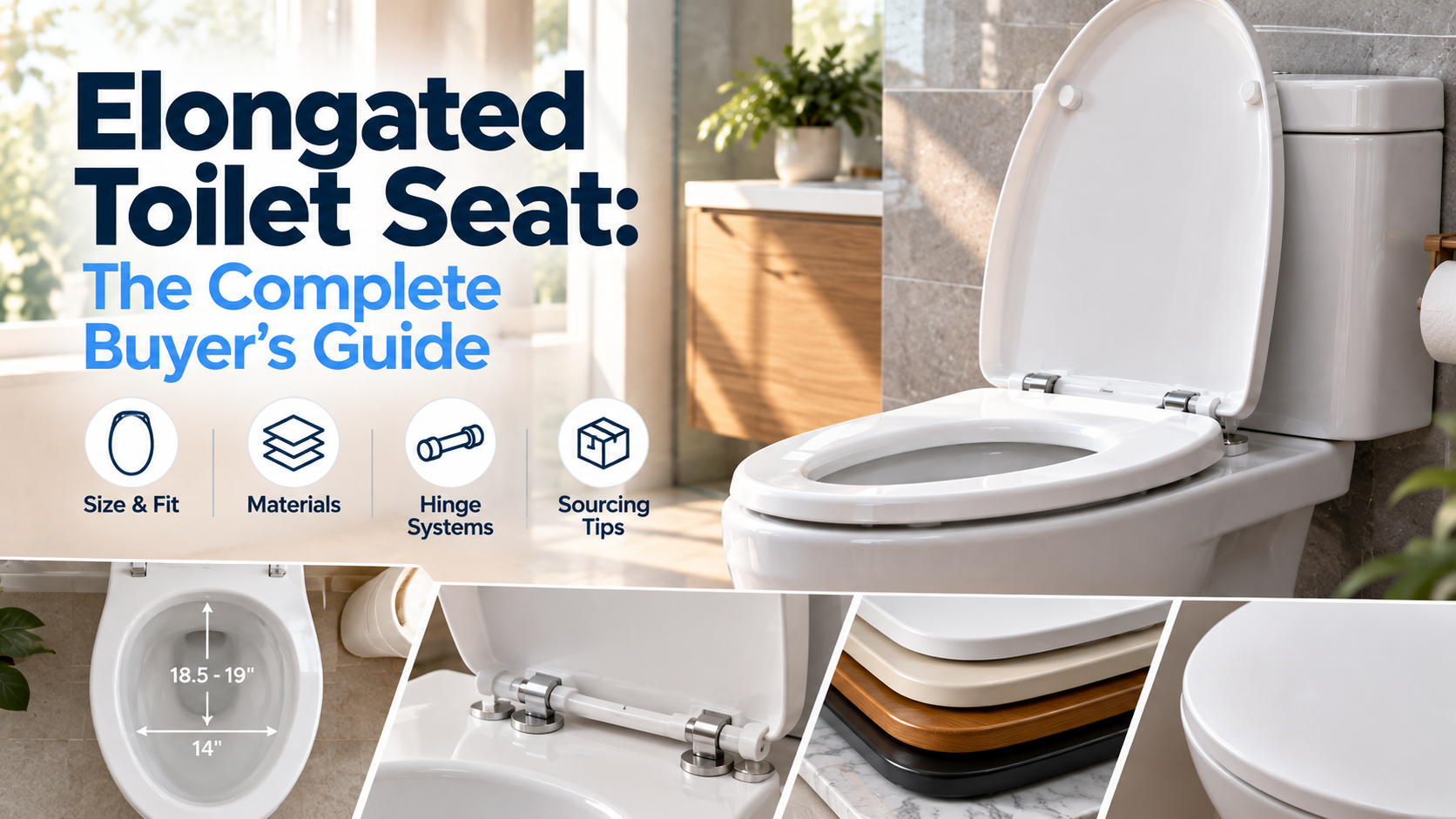
Elongated Toilet Seat: The Complete Buyer’s Guide
An elongated toilet seat is one of the most common toilet seat formats in the North American market. It is also one of the easiest products to specify incorrectly.
A buyer may describe a seat as “elongated,” but that alone does not confirm that it will fit the intended toilet bowl. Bowl length, rear ceramic shape, mounting-hole position, hinge adjustment range, seat material and fixing system all affect the installed result.
For distributors, private-label brands, e-commerce sellers and bathroom-project buyers, the correct approach is to define the complete product rather than source a visually similar seat.
This guide explains how elongated toilet seats differ from round seats, how to measure fit, which materials and hinge systems to consider, and what should be confirmed before a bulk order.
What Is an Elongated Toilet Seat?
An elongated toilet seat is designed for an oval-shaped toilet bowl that extends farther toward the front than a standard round bowl.
In the US market, an elongated bowl is often around 18.5 to 19 inches from the center of the mounting holes to the front edge. A round bowl is commonly closer to 16.5 to 17 inches. These are useful reference points, not universal standards.
A correct elongated toilet seat should align with:
The bowl’s front profile
The bowl length and width
The rear ceramic platform
The mounting-hole spacing
The available hinge adjustment range
The fixing access from above or below
The buffer-contact positions on the ceramic
A seat that is too short can leave the front of the bowl exposed. A seat that is too long may overhang the ceramic or create poor buffer contact.
Elongated vs Round Toilet Seats
| Feature | Elongated toilet seat | Round toilet seat |
|---|---|---|
| Typical bowl profile | Oval and extended front | More circular front profile |
| Typical US bowl length | Often about 18.5–19 inches | Often about 16.5–17 inches |
| Common applications | Newer residential bathrooms, upgrades and many commercial projects | Compact bathrooms and older toilet configurations |
| Product-selection risk | Poor front alignment or rear clearance | Incorrect length or limited mounting adjustment |
| Buyer requirement | Confirm bowl geometry and hinge range | Confirm bowl geometry and hinge range |
Do not choose a seat only by the word “elongated” in a supplier catalogue. Measure the actual bowl or obtain the ceramic drawing.
How to Measure for an Elongated Toilet Seat
For a replacement or OEM project, take the following measurements before requesting a quotation.
1. Measure Bowl Length
Measure from the center point between the mounting holes to the front edge of the ceramic bowl.
This is the most important measurement for distinguishing an elongated bowl from a round bowl.
2. Measure Bowl Width
Measure the widest point of the bowl from side to side. The seat should provide suitable coverage without excessive overhang.
3. Measure Mounting-Hole Spacing
Measure the center-to-center distance between the two fixing holes. Also record the hole diameter.
Different fixing kits can allow different adjustment ranges. The supplier should confirm whether the proposed system covers your measurement.
4. Review the Rear Ceramic Platform
The rear section of the toilet bowl can affect hinge placement and lid clearance.
Check:
Shape of the rear ceramic surface
Distance from mounting holes to the tank or wall
Available space for hinge covers
Access to the underside of the fixing holes
Whether top-fix installation is required
5. Check Buffer Contact
The seat buffers should contact stable areas of the ceramic bowl. Poor buffer contact can create rocking, movement or an uneven appearance after installation.
Information to Send the Supplier
A complete fit brief should include:
Bowl length
Bowl width
Mounting-hole spacing
Mounting-hole diameter
Rear platform photos
Top-view and side-view photos
Access information for top-fix or bottom-fix installation
Ceramic drawing, if available
Physical toilet sample for major projects, where practical
A product photo without measurements is useful for discussion but not enough for final fit approval.
Elongated Toilet Seat Materials Compared
The material should match the target price point, sales channel and expected customer experience.
| Material | Key characteristics | Typical applications |
|---|---|---|
| PP | Lightweight, practical and cost-efficient | Value retail, high-volume wholesale and e-commerce |
| UF / Duroplast | Hard, dense surface with a premium feel | Mid-range retail, bathroom collections and distributors |
| Molded wood | Substantial feel with decorative options | Traditional ranges, hospitality and design-led retail |
| MDF | Can support printed or decorative programs | Selected retail and private-label collections |
PP Elongated Toilet Seats
PP is widely used for practical replacement seats. It suits programs where competitive cost, lightweight shipping and straightforward maintenance are important.
Buyers should still confirm the seat thickness, buffer layout, hinge type and fixing-kit stability. A low-cost PP seat can perform poorly if the hinge and fixing system are not matched to the bowl.
UF / Duroplast Elongated Toilet Seats
UF, also called Duroplast, usually provides a denser and more premium surface feel than PP. It is often selected for bathroom brands and mid-range retail programs.
For UF products, check the exact hinge configuration, surface finish, color consistency and whether the selected fixing system can keep the heavier seat stable after installation.
Molded-Wood Elongated Toilet Seats
Molded-wood seats are often selected for traditional styling, decorative finishes and a more substantial product feel.
The hinge and fixing system matter especially for wood-based products because the seat and lid may be heavier than a basic PP configuration. Packaging should also protect corners, hinges and painted or printed surfaces.
Soft-Close, Standard-Close and Quick-Release Options
An elongated toilet seat can use several functional configurations.
| Function | What it does | What buyers should confirm |
|---|---|---|
| Standard-close | Closes without damping | Hinge strength and basic stability |
| Soft-close | Controls closing movement | Lid only, seat only or both; hinge and damper code |
| Quick-release | Allows removal for cleaning | Locking security, release method and reinsertion fit |
| Soft-close + quick-release | Combines both functions | Test both functions together on the approved product |
For a soft-close elongated toilet seat, record the exact hinge and fixing-kit configuration. Avoid approving a product described only as “metal soft-close hinge.”
Buyers can also review BOFAN’s soft-close toilet seat options when comparing functional configurations.
Top-Fix vs Bottom-Fix Installation
The installation method must match the toilet bowl.
Bottom-Fix
Bottom-fix hardware is tightened from underneath the ceramic bowl. It is common where underside access is available.
Top-Fix
Top-fix hardware is installed from above. It can be useful where the underside of the ceramic is inaccessible, such as with certain concealed or fully skirted toilet designs.
Before quotation, confirm:
Whether underside access is available
The mounting-hole diameter
The fixing-kit adjustment range
Required hinge position
Whether the fixing kit includes all required hardware
Whether the installed seat remains stable after tightening
What Makes an Elongated Seat Stable?
Seat stability depends on the complete installed system, not only the hinge.
Key factors include:
Correct bowl compatibility
Hinge location
Fixing-kit quality
Adjustment range
Seat and lid weight
Buffer position
Ceramic surface shape
Installation torque and method
The factory should test the selected product on the intended ceramic or a representative fixture before bulk approval. For important OEM programs, the approved installed sample should become part of the controlled product record.
Elongated Soft-Close Toilet Seats for Retail and E-Commerce
For retail and e-commerce programs, fit information and packaging are as important as the product itself.
The packaging should clearly state:
Elongated shape compatibility
Required bowl measurements
Installation method
Included fixing hardware
Soft-close or quick-release functions
Care instructions
Product material
Barcode and country-of-origin marking
Warning information where applicable
An elongated seat that fits correctly but is described poorly can still create returns, customer complaints and unnecessary support costs.
OEM and Wholesale Options
For an OEM or private-label elongated toilet seat program, buyers may be able to customize:
Material selection
Product shape or ceramic fit
Soft-close or standard-close function
Quick-release function
Hinge material and finish
Top-fix or bottom-fix hardware
Color and surface finish
Printed or decorative artwork
Buffer configuration
Private-label packaging
Instructions, barcodes and carton marks
The available options depend on the selected model, order quantity and production route.
What to Approve Before Bulk Production
Before releasing an elongated toilet seat order, confirm:
Product shape and dimensions
Ceramic fit and mounting-hole range
Seat and lid material
Hinge and fixing-kit codes
Soft-close and quick-release function, if included
Color, surface finish and visible components
Buffer position and stability after installation
Packaging, instructions and barcode placement
Approved production sample
Inspection requirements and change-control process
This approval process protects repeat orders and reduces the risk of receiving a product that looks similar but uses unapproved components.
How BOFAN Supports Elongated Toilet Seat Programs
BOFAN supports elongated toilet seat programs across PP, UF and molded-wood products for importers, distributors, retailers and bathroom brands.
For qualified projects, the team can review ceramic information, material choice, hinge and fixing requirements, soft-close options, packaging needs and sample plans before quotation.
Final compatibility, MOQ, testing, lead time and documentation requirements should always be confirmed for the selected product and destination.
CTA: Request an Elongated Toilet Seat Review
Planning an elongated toilet seat range? Send BOFAN your toilet-bowl drawing or measurements, preferred material, hinge requirements, expected quantity, packaging format and destination. Our team can help identify a suitable model and sample path.
FAQ
What is the standard size of an elongated toilet seat?
Many elongated toilet bowls are around 18.5 to 19 inches from the mounting-hole center to the front edge, but dimensions vary. Always measure the actual toilet bowl.
Can an elongated toilet seat fit a round toilet?
Usually not correctly. An elongated seat may overhang a round bowl and create poor alignment or buffer contact.
What is the best material for an elongated toilet seat?
PP is often suitable for high-volume and value-focused programs. UF and molded wood can provide a more premium appearance. The best choice depends on target price, channel and customer expectation.
Can an elongated toilet seat have soft-close hinges?
Yes. Soft-close function can apply to the lid, the seat ring or both. Confirm the exact hinge configuration before ordering.
How do I know whether I need top-fix hardware?
Top-fix hardware is often used when the underside of the toilet bowl is inaccessible. Confirm the ceramic design, mounting-hole size and supplier’s approved fixing system.
Table of Contents
- Elongated Toilet Seat: The Complete Buyer’s Guide
- What Is an Elongated Toilet Seat?
- Elongated vs Round Toilet Seats
- How to Measure for an Elongated Toilet Seat
- Information to Send the Supplier
- Elongated Toilet Seat Materials Compared
- Soft-Close, Standard-Close and Quick-Release Options
- Top-Fix vs Bottom-Fix Installation
- What Makes an Elongated Seat Stable?
- Elongated Soft-Close Toilet Seats for Retail and E-Commerce
- OEM and Wholesale Options
- What to Approve Before Bulk Production
- How BOFAN Supports Elongated Toilet Seat Programs
- FAQ